
This is a real-world rehashing of the theoretical blog post https://schneide.blog/2024/12/30/surviving-the-big-one-in-it-part-i/ about surviving a critical security flaw.
Last week was filled with several critical security vulnerabilities that affected both us and our IT infrastructure and the project deployments of our customers. What made it tricky was that we had to analyze, decide and act fast for each vulnerability while triaging the different vulnerabilities against each other the moment a new flaw was published. So it was a multi-dimensional task: Find the highest-risk vulnerability, mitigate the highest-risk projects and products and continue with the second-highest risk vulnerability, its highest-risk projects and so forth.
Let’s have a look at the vulnerabilities that kept us busy:
- java4shell (CVE-2026-114938): Remote Code Execution flaw in Java. Affects recent versions running on recent CPUs only.
- ruby2shell (CVE-2026-132825): Remote Code Execution flaw in Ruby. Affects virtually every Ruby version on any hardware.
- nginx2root (CVE-2026-123007): Remote Code Execution flaw in nginx. Affects every nginx installation except with specific configuration settings.
- php (CVE-2026-129289 and others): Remote Code Execution flaws in PHP. Affects installations with different configuration settings.
- wordpress (CVE-2026-119977): Remote Code Execution flaw in wordpress core. Affects all wordpress installations.
The last two vulnerabilities only affected our infrastructure, because we don’t develop in PHP or deploy wordpress instances, but the first three were relevant for services we use ourself (like ruby2shell and gitlab) and our customers.
Own oxygen mask first
One core principle of disaster mitigation is to prioritize self-preservation over assistance to others. By securing your own life support first, you ensure that you can stabilize yourself enough to be a reliable source of help.
Applied to our situation, we would be of no long-term use if we patched our customer’s deployments but got compromised on our own servers. The dreaded malware would just make one more stop on our infrastructure before spilling over to our customers. So we assessed our risk and our affected infrastructure at the beginning of each triage run.
Once again, the PHP and wordpress vulnerabilities had a different flavor than the rest. Our homepage ran on a self-hosted wordpress instance and used PHP underneath, but other than that, we don’t employ the technology. And the homepage server is isolated from the rest of our servers. So both flaws meant work, but without the risk of overwhelming scaling factors.
In fact, we already had prepared a static site generator version of the homepage that was free from PHP and wordpress. Our plan was to switch at the end of the year, but we accelerated the process and put it live last week. We didn’t patch wordpress, we removed it from the equation.
Triage in an active situation
Bringing the relevant information for the other three vulnerabilities together in one place, deciding the risk for each affected instance and planning remedies was a crucial task in the beginning of each situation. Our “mission whiteboard” was a wiki page with a large table that listed all potentially affected projects and documented our current discovery progress and state of knowledge.
This table is both the central place to reflect our mission state and to journal our decisions, actions and inactions. We explicitely documented if we found a project to be unaffected and that we cease mitigation work on it. The goal is to be able to give account of all mitigations we made or didn’t make. It is always easy to remember the actions you took, but a lot harder to explain why you didn’t take certain actions. We documented it the moment we made the decision against the action.
If we decided to take action, we put it on the todo list of our operators and began working on this list as soon as the high risk targets were examined. The actions ranged from contacting the customer to inform them and discuss sensible measures over creating and deploying patches to shutting down systems in order to patch them in a controlled setting later. At this point, the mission ran smooth and coordinated.
Software guys forget about hardware
One point that stood out in our post-mortem was that the java4shell vulnerability relied on certain CPU types (or hardware instruction sets) to be relevant. We hadn’t current information about our customers’ hardware, so we treated all instances as affected. In retrospect, we could have saved half of our effort because we would have ruled out an instance as “not vulnerable” due to the hardware aspect. In our experience, it’s unusual that a software vulnerability is so dependent on hardware, so our process didn’t prepare for that aspect, but we think about improvements to be more informed next time.
Closing thoughts
As busy as those days were, they didn’t lean into chaotic. Our incident management process guided us through the crisis, even as the crisis became a multi-event thing. But three things stand out:
- The amount of concurrent incidents we as humans can handle is clearly limited. Double the amount of vulnerabilities that happen at virtually the same time again and we can’t keep up with it anymore. And that might happen, as this curve suggests:
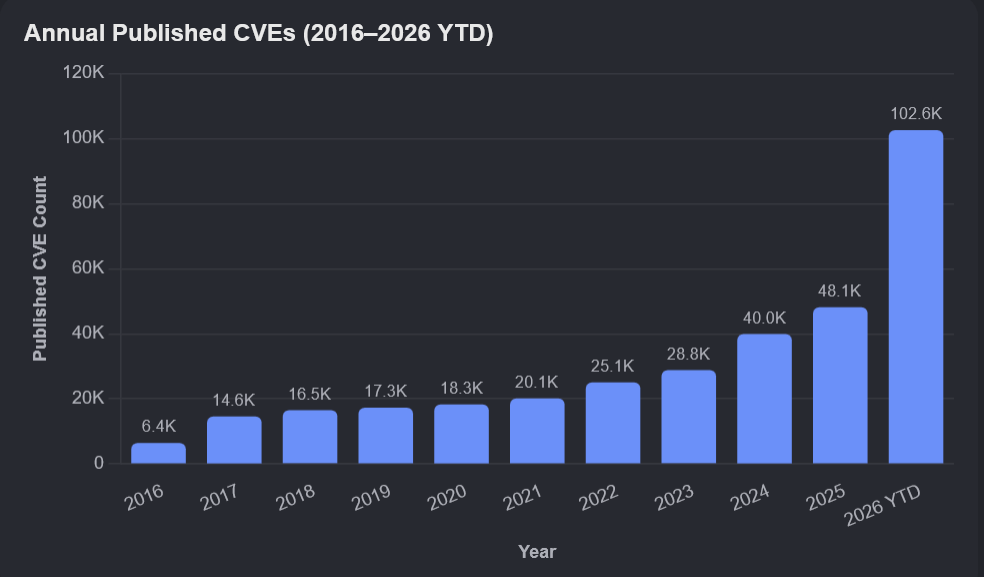
These numbers are frightening enough, but you can see from the “year-to-date (YTD)” marking that the last bar is actually still rising.
- The timing of such incident is crucial. If this situation had unfolded over a weekend instead of the middle of the week, we wouldn’t have had the manpower and seamless customer communications that were essential in dealing with it. I sincerely hope that we put a moratorium on the weekends in regard of IT security problems. Let’s not have that stress 24/7 for the next years, please.
- This is probably the result of current AI finding low-hanging fruits on the IT security vulnerability tree during peacetime. I can’t fathom the situation if an opposing force uses tomorrow’s AI in a coordinated attack to exploit the higher regions of that metaphorical tree.

