
This week, a very fortunate event will take at our company: We all come together to have a summer party in person. This will be the first time in nearly 3 and a half years that we all spend time in the same room. It will be the conclusion of a decision that I call the “biggest one” that I had to come to. This is the very shortened story of that decision.
The end of an era
Our company was founded and set up as a place for direct interaction and short communication distances. We favored office workplaces and open space room plans and often visited customers at their location.
In March 2020, this setup appeared to be the exact opposite of what is advised. I remember the week from the 9th to the 13th March, when every day and every hour, things got worse and more restricted due to the Sars-Cov2 pandemic. On Friday, the 13th of March 2020, I was in a phone call with an employee that lasted 30 minutes. When we began to speak, one federal state had closed the schools. When we stopped, every school was closed in the whole country.
During the weekend, I tried to approach the situation with plans and lists. A list of endangered projects, a list of endangered customers, a list of endangered employees, a list of critical tasks, a plan to stay ahead of circumstances. I came up with a scheme to assess the risk and derive actions, but spent the whole sunday to talk with my employees just to gather some of the information necessary to base any decision on more than fear and hope. I am very grateful that my employees all picked up the phone and went through my questions with me. It helped me to realize that no matter how fitting the lists, how clever the plan, I won’t be able to process the information with the required speed.
Some employees offered to go on holiday to take moving parts out of the equation, but it was still overwhelming. If you know the feeling in a roller coaster when a certain “feel-good” speed limit is exceeded and real fear takes hold of your heart and head, you can imagine how these days felt for me.
The beginning of a different era
And then, on Monday morning, I knew exactly what to do. The situation necessitates that we change everything at the company at once. We need to go “virtual”, to retreat into home offices that didn’t exist yet.
Monday, 16th of March was the last day that several people were in our office simultaneously for a long time.
Everything the company was used to do didn’t work anymore. We had to buy new hardware, new furniture, new chairs and everything else that was needed in the home offices. We had to examine every business process and partition it into “on site” and “remote” work steps. We had to introduce new means of communication in the company and with our customers. We had to continue with our project work while transforming everything in our professional and our private lifes. We had to keep up our spirits while experiencing isolation and uncertainty.
And just like that, we replaced the “pre-covid” company with the “during-covid” company. Nobody could say that it would work. Nobody knew how long it would be required to work. Nobody could anticipate how much it would cost us.
The decision
The only thing I was certain of was that if we need to change, we would do it wholeheartedly. I was sure that even if the pandemic suddenly disappears, I don’t want to look back at that time and think of it as a makeshift solution.
My decision was to embrace the uncertainty and let go of any remnant of a masterplan that I might have left. I “jumped into the fog”.
For me, it felt as if I placed a wager on the existence of the whole company: “I bet we can do what we did for twenty years, but totally different and in a time of crisis. And we can start right now and keep going for an indeterminate period of time”.
The outcome
Since then, a long time has passed. The fog has cleared and we have survived. And not only that. The “gamble” has paid off:
We resumed our project work within two days and steadily improved our situation day by day and week by week. Our revenue went up, our productivity went up, our profits went up. New customers called us, new projects were started. Today, we are in a much better place than before.
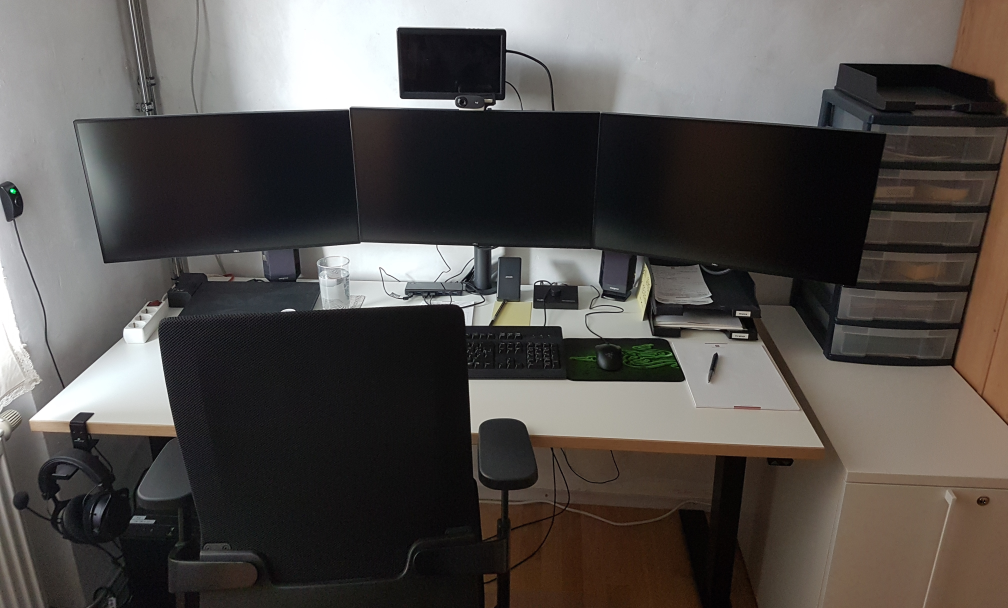
But that’s not all: We have established new means of collaboration and communication, regardless of workplace. Every employee has a full-fledged home office with as many monitors as are physically possible, fitting furniture, a good webcam, good audio equipment, a powerful notebook or desktop computer and all the accessories that make the difference between “a workplace” and “my own workplace”. So we are fully equipped for any future isolation event that hopefully never comes.
Making the decision, trusting my employees and providing them with the equipment to master the challenge yielded the best outcome I could have hoped for. The whole experience humbled me: I lost any control over the situation early on and it didn’t really matter. What mattered was to keep innovating, investing and improving. And that is a group effort, not the vision of a single mind.
The future
So, here we are, at the natural end of the story. If this was a movie, the credits would begin to roll when we raise our glasses to celebrate our success. To me, it seems that lots of companies operate like this. “The temporarily embarrassing loss of control of upper management is past, now return to the office and commence the old rituals. And don’t forget to bring in that notebook that we borrowed you for your kitchen table home office.”
I’ve seen the potential of this transformation way too clearly to go back. There is nothing gained by reverting to the old ways. We will continue as a “hybrid” company with an attractive office and equally attractive home offices. We will continue to find ways to collaborate with each other and our customers that we didn’t think of before. We will continue to spend time, effort and money to improve our work reality. It might cost 15k euros to equip one workplace in the office and 15k euros more to do it again at home, but that money is the best investment I can think of. The return on investment is amazing.
I witnessed it firsthand.
 Schneide Blog