
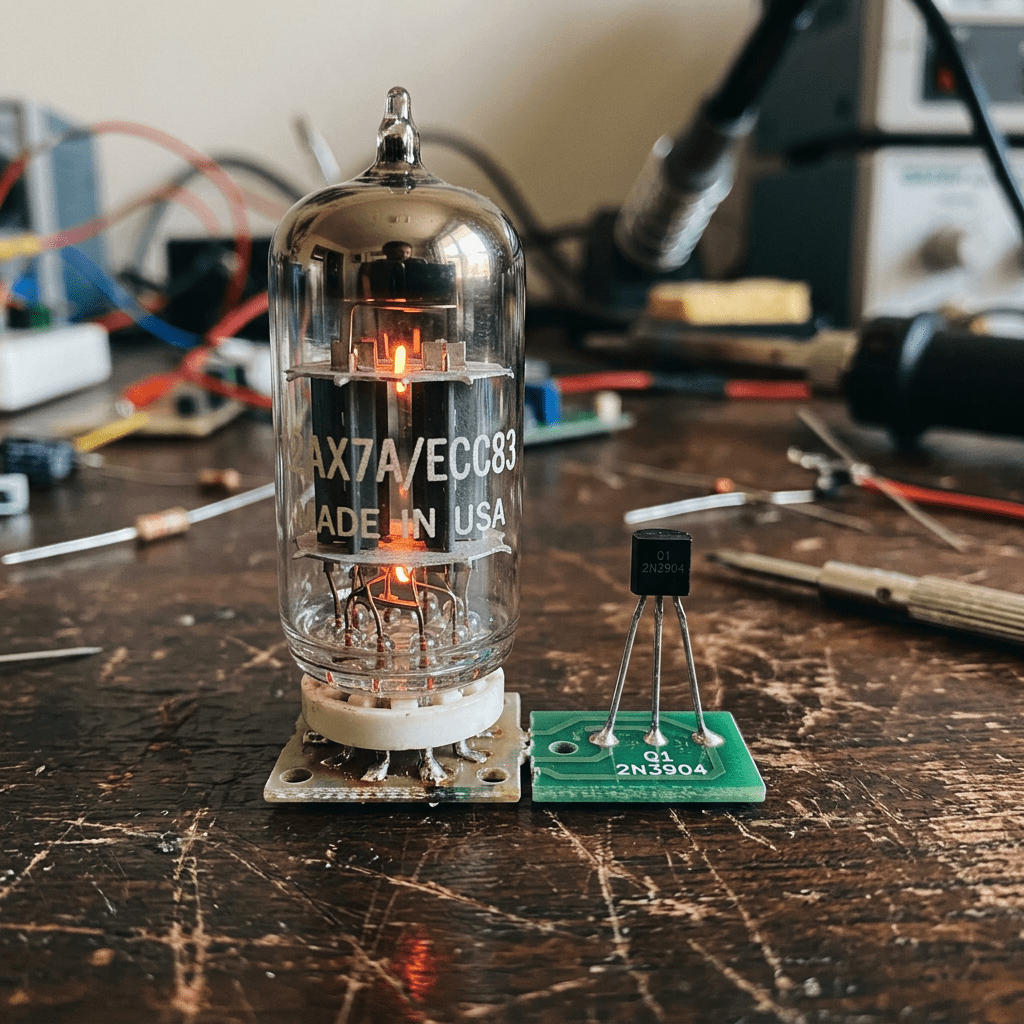
This is the first part of the series “Impressions of Our Current AI Usage”, as outlined by the introduction article.
In the early days of computing, the mechanism that actually works on the data often was an analog technical device that had a certain kind of fuzzyness to it. Think about paper tape with punched holes as longterm storage: If the paper feeder was not aligned with the distance between the holes, there might be spurious variations in the code. Or, a real possibility from my own childhood: You could store digital data on music tape, an inherently analog storage medium. If the loading process succeeded relied on a mixture of patience, delicate handling, room temperature and luck. Most computing devices had specific analog/digital conversion gateways for the periphery, for the display (a very mechanical cathode ray monitor) and even for their own calculation units. The foundation we built our digital world on was influenced by sunshine, moisture, electrical isolation and lots of other factors that could influence the results. I remember a story about the early mainframe computers where a specific bug only appeared if somebody stepped on the physical floor tile where the cables ran beneath. The pressure change altered the physical properties of the cables which resulted in transmission errors.
Over the years, the physical aspects of computing slowly went away or at least faded into the background. We no longer joked about “cosmic ray errors” because the computing substrate was reliable enough to produce the same result regardless of environmental influences. The world got repeatable and therefore, predictable. We got comfortable with machines that were dumb, but reliable. If they had learnt a functionality, they could repeat it virtually forever, without the slightest variation. We had the precision of a nanosecond clockwork and the determinism of a written story that plays out the same every time it is read.
In the early 1990s, there was the first attempt to soften this black-or-white logic fabric up again. The term “fuzzy logic” was all the hype for a few years. Products like cameras, coffee machines, toasters and even water boilers were marketed as “enhanced by fuzzy logic”. How exactly the coffee got better by miniscule variations in the production process was up to your imagination. The core belief of fuzzy logic was that if we express a formula or algorithm by categorized terms instead of numbers, we could bridge the gap between “gut feeling” and digital mathematics.
In my opinion, the same thing happens again with artificial intelligence as the fuzzy component. I doubt that it disappears as thoroughly as fuzzy logic vanished, but the core belief seems to be the same. If you describe a problem in layman’s terms to an “inference”, it finds a solution that appears to be acceptable. If you describe the same problem again tomorrow, the solution might vary in detail or even in grand concept. What works today might not work anymore tomorrow or work even better. The quality of results rely on “the environment” again, not only on the input. The operating units of computing cease to be deterministic again. Computing gets fuzzy once again.
There are some immediate problems that I see with this approach:
- Every quality promise comes with severe limitations: The machine will work as expected today, but it is unclear if that extends very far into the future. The current results vary a bit, but might vary tremendously going forward. If the inference unit isn’t included into the product, it might not work anymore soon. Or it works noticeably different from now.
- The machine might change its personality on a whim. This is a problem already with encompassing updates every now and then. My smartphone itself stays the same, but the graphical presentation, usage paths and functionality changes over the course of months, if not weeks. In a world where we are used that a stone acts like a stone, a kitchen timer stays a kitchen timer and a text editor doesn’t turn into an e-mail client, we begin to lose that certainty. Our digital assistants begin to have “phases” with decreased alignment to our use cases. Or, expressed as a positive, we can hope that our digital assistants get to know us better and tune themselves in to us.
- We enter a world with limited transferability. One benefit of strict specifications is interchangeability. If you change one capacitor in music electronics, the sound changes (or so they claim). If you change one transistor in a digital circuit, the result stays exactly the same, because the change doesn’t cause enough variance to toggle from “black” to “white”. If the building blocks if your system are less specified digital entities like inference providers, you can’t exchange one against another without possibly altering the system’s behaviour in a noticeable way. This makes the reproducability of an equal system with slightly different components more of an adventure. You just don’t know beforehands that it will work.
There are probably more problems and maybe a lot more advantages to this approach than I can fit into one blog post. My main point is that we layered a strict, digital computing substrate on a messy, analog electronics layer and now put another layer of blurry looseness on top of it. Building future systems on this level might feel like engineering the analog systems of the past. I find it interesting (and ironic) that we try this approach right the moment when the last analog technology heroes step back and take their expertise with them.

