Your Placeholder Data Still Conveys Meaning – Part I

There is a long-standing tradition to fill unknown text fields with placeholder data. In graphic design, these texts are called “dummy text”. In the german language, the word is “Blindtext”, which translates directly as “blind text”. The word means that while some text is there, the meaning of it can’t be seen.

A popular dummy text is the latin sounding “Lorem ipsum dolor sit amet”, which isn’t actually valid latin. It has no meaning other than being text and taking up space.

While developing software user interfaces, we often deal with smaller input areas like textfields (instead of text areas that could hold a sizeable portion of “lorem ipsum”) or combo boxes. If we don’t know the actual content yet, we tend to fill it with placeholder data that tries to reflect the software’s domain. And by doing that, we can make many mistakes that seem small because they can easily be fixed – just change the text – but might have negative effects that can just as easily be avoided. But you need to be aware of the subtle messages your placeholders send to the reader.

In this series, we will look at a specific domain example: digital invoices. The mistakes and solutions aren’t bound to any domain, though. And we will look at user interfaces and the corresponding source code, because you can fool yourself or your fellow developers with placeholder data just as easily as your customer.

We start with a relatively simple mistake: Letting your placeholder data appear to be real.

The digital (or electronic) invoice is a long-running effort to reduce actual paper document usage in the economy. With the introduction of the european norm EN 16931, there is a chance of a unified digital format used in one major economic region. Several national interpretations of the norm exist, but the essential parts are identical. You can view invoices following the format with a specialized viewer application like the Quba viewer. One section of the data is the information about the invoice originator, or the “seller” in domain terms:

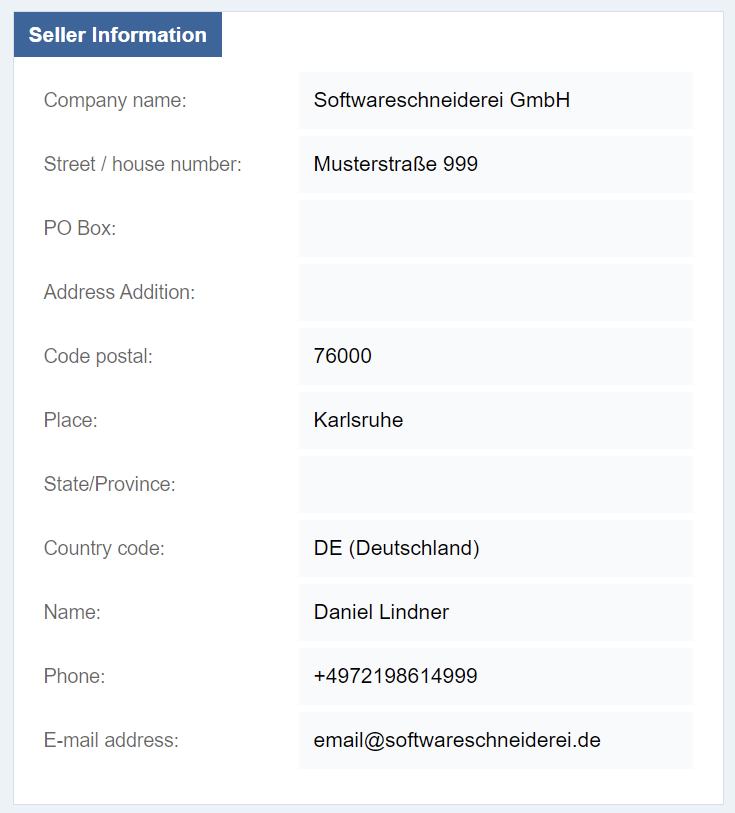
You can see the defined fields of the norm (I omitted a few for simplicity – a mistake we will discuss later in detail) and a seemingly correct set of values. It appears to be the address of my company, the Softwareschneiderei GmbH.

If you take a quick look at the imprint of our home page, you can already spot some differences. The street is obviously wrong and the postal code is a near miss. But other data is seemingly correct: The company name is real, the country code is valid and my name has no spelling error.

And then, there are those placeholder texts that appear to be correct, but really aren’t. I don’t encourage you to dial the phone number, because it is a real number. But it won’t connect to a phone, because it is routed to our fax machine (we don’t actually have a “machine” for that, it’s a piece of software that will act like a fax). Even more tricky is the e-mail address. It could very well be routed, but actually isn’t.

Both placeholder texts serve the purpose of “showing it like it might be”, but appear to be so real and finalized that they lose the “placeholder” characteristics. If you show the seller data to me, I will immediately spot the wrong street and probably the wrong postal code, but accept the phone number as “real”. But is isn’t real, it is just very similar to the real one.

How can you avoid placeholders that look too real?

One possibility is to fake the data completely until given the real values:

These texts have the same “look and feel” and the same lengths as the near-miss entries, but are readily recognizable as made-up values.

There is only one problem: If you mix real and made-up values, you present your readers a guessing game for each entry: real or placeholder? If it is no big deal to change the placeholders later on, resist the urge to be “as real as possible”. You can change things like the company name from “Softwareschneiderei GmbH” to “Your Company Name Here Inc.” or something similar and it won’t befuddle anybody because the other texts are placeholders, too. You convey the information that this section is still “under construction”. There is no “80% done” for these things. The section is fully real or not. Introducing situations like “the company name and the place are already real, but the street, postal code and anything else isn’t” doesn’t clear anything and only makes things more complicated.

But I want to give you another possibility to make the placeholders look less real:

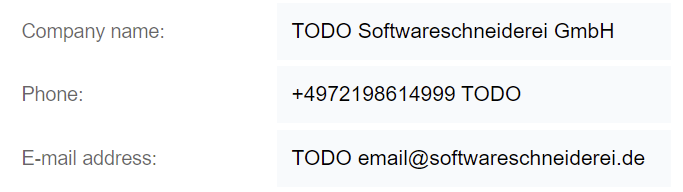
Add a prefix or suffix that communicates that the entry is in a state of flux:

That way, you can communicate that you know, guess or propose a value for the field, but it still needs approval from the customer. Another benefit is that you can search for “TODO” and list all the decisions that are pending.

If, for some reason, it is not possible to include the prefix or suffix with a separator, try to include it as visible (and searchable) as possible:

This are the two ways I make my placeholder text convey the information that they are, indeed, just placeholders and not the real thing yet.

Maybe there are other possibilities that you know of? Describe them in a comment below!

In the first part of this series, we looked at two mistakes:

  1. Your placeholders look too real
  2. You mix real data with placeholders

And we discussed three solutions:

  1. Make your placeholders unmistakably fake
  2. Give your placeholders a “TODO” prefix or suffix
  3. Demote your real data to placeholders as long as there is still an open question

In the next part of this series, we will look at the code side of the problem and discover that we can make our lives easier there as well.

Highlight Your Assumptions With a Test

There are many good reasons to write unit tests for your code. Most of them are abstract enough that it might be hard to see the connection to your current work:

  • Increase the test coverage
  • Find bugs
  • Guide future changes
  • Explain the code
  • etc.

I’m not saying that these goals aren’t worth it. But they can feel remote and not imperative enough. If your test coverage is high enough for the (mostly arbitrary) threshold, can’t we let the tests slip a bit this time? If I don’t know about future changes, how can I write guidelining tests for them? Better wait until I actually know what I need to know.

Just like that, the tests don’t get written or not written in time. Writing them after the fact feels cumbersome and yields subpar tests.

Finding motivation by stating your motivation

One thing I do to improve my testing habit is to state my motivation why I’m writing the test in the first place. It seemed to boil down to two main motivations:

  • #Requirement: The test ensures that an explicit goal is reached, like a business rule that is spelled out in the requirement text. If my customer wants the value added tax of a price to be 19 % for baby food and 7 % for animal food, that’s a direct requirement that I can write unit tests for.
  • #Bugfix: The test ensures the perpetual absence of a bug that was found in production (or in development and would be devastating in production). These tests are “tests that should have been there sooner”. But at least, they are there now and protect you from making the same mistake twice.

A code example for a #Requirement test looks like this:

/**
 * #Requirement: https://ticket.system/TICKET-132
 */
@Test
void reduced_VAT_for_animal_food() {
    var actual = VAT.addTo(
        new NetPrice(10.00),
        TaxCategory.animalFood
    );
    assertEquals(
        new GrossPrice(10.70),
        actual
    );
}

If you want an example for a #Bugfix test, it might look like this:

/**
 * #Bugfix: https://ticket.system/TICKET-218
 */
@Test
void no_exception_for_zero_price() {
    try {
        var actual = VAT.addTo(
            NetPrice.zero,
            TaxCategory.general
        );
        assertEquals(
            GrossPrice.zero,
            actual
        );
    } catch (ArithmeticException e) {
        fail(
            "You messed up the tax calculation for zero prices (again).",
            e
        );
    }
}

In my mind, these motivations correlate with the second rule of the “ATRIP rules for good unit tests” from the book “Pragmatic Unit Testing” (first edition), which is named “Thorough”. It can be summarized like this:

  • all mission critical functionality needs to be tested
  • for every occuring bug, there needs to be an additional test that ensures that the bug cannot happen again

The first bullet point leads to #Requirement-tests, the second one to #Bugfix-tests.

An overshadowed motivation

But recently, we discovered a third motivation that can easily be overshadowed by #Requirement:

  • #Assumption: The test ensures a fact that is not stated explicitly by the requirement. The code author used domain knowledge and common sense to infer the most probable behaviour of the functionality, but it is a guess to fill a gap in the requirement text.

This is not directly related to the ATRIP rules. Maybe, if one needs to fit it into the ruleset, it might be part of the fifth rule: “Professional”. The rule states that test code should be crafted with care and tidyness, that it is relevant even if it doesn’t get shipped to the customer. But this correlation is my personal opinion and I don’t want my interpretation to stop you from finding your own justification why testing assumptions is worth it.

How is an assumption different from a requirement? The requirement is written down somewhere else, too and not just in the code. The assumption is necessary for the code to run and exhibit the requirements, but it’s only in the code. In the mind of the developer, the assumption is a logical extrapolation from the given requirements. “It can’t be anything else!” is a typical thought about it. But it is only “written down” in the mind of the developer, nowhere else.

And this is a perfect motivation for a targeted unit test that “states the obvious”. If you tag it with #Assumption, it makes it clear for the next developer that the actual content of the corresponding coded fact is more likely to change than other facts, because it wasn’t required directly.

So if you come across an unit test that looks like this:

/**
 * #Assumption: https://ticket.system/TICKET-132
 */
@Test
void normal_VAT_for_clothing() {
    var actual = VAT.addTo(
        new NetPrice(10.00),
        TaxCategory.clothing
    );
    assertEquals(
        new GrossPrice(11.90),
        actual
    );
}

you know that the original author made an educated guess about the expected functionality, but wasn’t explicitly told and is not totally sure about it.

This is a nice way to make it clear that some of your code is not as rigid or expected as other code that was directly required by a ticket. And by writing an unit test for it, you also make sure that if anybody changes that assumed fact, they know what they are doing and are not just guessing, too.

Your null parameter is hostile

I hope we all agree that emitting null values is a hostile move. If you are not convinced, please ask the inventor of the null pointer, Sir Tony Hoare. Or just listen to him giving you an elaborate answer to your question:

https://www.infoq.com/presentations/Null-References-The-Billion-Dollar-Mistake-Tony-Hoare/

So, every time you pass a null value across your code’s boundary, you essentially outsource a problem to somebody else. And even worse, you multiply the problem, because every client of yours needs to deal with it.

But what about the entries to your functionality? The parameters of your methods? If somebody passes null into your code, it’s clearly their fault, right?

Let’s look at an example of pdfbox, a java library that deals with the PDF file format. If you want to merge two or more PDF documents together, you might write code like this:

File left = new File("C:/temp/document1.pdf");
File right = new File("C:/temp/document2.pdf");

PDFMergerUtility merger = new PDFMergerUtility();
merger.setDestinationFileName("C:/temp/combined.pdf");

merger.addSource(left);
merger.addSource(right);

merger.mergeDocuments(null);

If you copy this code verbatim, please be aware that proper exception and resource handling is missing here. But that’s not the point of this blog entry. Instead, I want you to look at the last line, especially the parameter. It is a null pointer and it was my decision to pass it here. Or was it really?

If you look at the Javadoc of the method, you’ll notice that it expects a StreamCacheCreateFunction type, or “a function to create an instance of a stream cache”. If you don’t want to be specific, they tell you that “in case of null unrestricted main memory is used”.

Well, in our example code above, we don’t have the necessity to be specific about a stream cache. We could implement our own UnrestrictedMainMemoryStreamCacheCreator, but it would just add cognitive load on the next reader and don’t provide any benefit. So, we decide to use the convenience value of null and don’t overthink the situation.

But that’s the same as emitting null from your code over a boundary, just in the other direction. We use null as a way to communicate a standard behaviour here. And that’s deeply flawed, because null is not standard and it is not convenient.

Offering an interface that encourages clients to use null for convience or abbreviation purposes should be considered just as hostile as returning null in case of errors or “non-results”.

How could this situation be defused by the API author? Two simple solutions come to mind:

  1. There could be a parameter-less method that internally delegates to the parameterized one, using the convenient null value. This way, my client code stays clear from null values and states its intent without magic numbers, whereas the implementation is free to work with null internally. Working with null is not that big of a problem, as long as it doesn’t pass a boundary. The internal workings of a code entity is of nobody’s concern as long as it isn’t visible from the outside.
  2. Or we could define the parameter as optional. I mean in the sense of Optional<StreamCacheCreateFunction>. It replaces null with Optional.empty(), which is still a bit weird (why would I pass an empty box to a code entity?), but communicates the situation better than before.

Of course, the library could also offer a variety of useful standard implementations for that interface, but that would essentially be the same solution as the self-written implementation, minus the coding effort.

In summary, every occurrence of a null pointer should be treated as toxic. If you handle toxic material inside your code entity without spilling it, that’s on you. If somebody spills toxic material as a result of a method call, that’s an hostile act.

But inviting your clients to use toxic material for convenience should be considered as an hostile attitude, too. It normalizes harmful behaviour and leads to a careless usage of the most dangerous pointer value in existence.

Revisiting the bus factor concept

The concept of a “bus factor” is both grim and very useful to manage project risks. It originates from the area of project management and is sometimes called a “truck number” or (to give it a more positive spin) the “lottery factor”.

It tries to pinpoint the number of people in a project that can drop out suddenly and unplanned without the project success being jeopardized. The “bus” or “truck” is conceptually used as the tool to enforce the drop out. The big lottery win might produce the same outcome, but with less implacability.

The sole number of a bus factor is often helpful to make lurking project risks visible. Especially a bus factor of 1, the most nerve-wrecking number, should be avoided. It means that the project success is directly coupled to the health (or gambling luck) of one specific person.

But even a higher bus factor, lets say 3, is no complete relief. What if those three people hop into the same car to meet the customer in a project meeting and have an accident? The only way to mitigate those “cluster risks” is to plan separate routes and means of travel. Most people would regard those measures as “overly paranoid” and it robs the three people from communicating directly before and after the meeting.

You can explore the individual project risk with more sophisticated tools than just a number. Setting up and filling out a RACI matrix (or one of its many variants) is a good way to make things visible.

But in this blog post, I want to highlight another detail of the bus factor that I learned the hard way: The “bus factor risk” of different people can vary a lot. The “bus factor risk” is the individual probability that the bus factor occurs.

Let’s have an example with the lottery: Your project has two key players that keep the project afloat. One of them never fills out a lottery ticket, the other plays regularly. Their “lottery factor risk percentage” is not equal. Given the low probability to win the lottery, the percentage doesn’t change much, but it changes.

Now imagine one person that often pursues high risk spare time activities. I don’t want to single out one specific activity, but think about free-climbing maybe. The other person stays mostly at home and cooks delicious meals without using sharp knives or hot water. Ok, this comparison sounds a bit contrived, but you get the message:

Two projects with a bus factor of 2 each can vary a lot in the actual risk percentage, because all 4 people have their individual drop out percentage.

It doesn’t have to be spare time activities, by the way. Every person has an individual health risk that can only be improved to a certain degree. Every person simply has “luck” or “misfortune” and can’t do anything about it.

My message is simply that the bus factor number 2 might not be “half the risk” than 1. Or even that two bus factor numbers with the same value denote equal risk.

I don’t think that it is useful to try to quantify the individual “bus factor risk”of a person. Way too many factors come into play and most of them should not be the employer’s concern (like a medical history or spare time activities). What might be useful is to be aware that equal numbers don’t equate equal actual risk.

How to improve this() by using super()

I have a particular programming style regarding constructors in Java that often sparks curiosity and discussion. In this blog post, I want to note my part in these discussions down.

Let’s start with the simplest example possible: A class without anything. Let’s call it a thing:

public class Thing {
}

There is not much you can do with this Thing. You can instantiate it and then call methods that are present for every Object in Java:

Thing mine = new Thing();
System.out.println(
    mine.hashCode()
);

This code tells us at least two things about the Thing class that aren’t immediately apparent:

  • It inherits methods from the Object class; therefore, it extends Object.
  • It has a constructor without any parameters, the “default constructor”.

If we were forced to write those two things in code, our class would look like this:

public class Thing extends Object {
    
    public Thing() {
        super();
    }
}

That’s a lot of noise for essentially no signal/information. But I adopted one rule from it:

Rule 1: Every production class has at least one constructor explicitly written in code.

For me, this is the textual anchor to navigate my code. Because it is the only constructor (so far), every instantiation of the class needs to call it. If I use “Callers” in my IDE on it, I see all clients that use the class by name.

Every IDE has a workaround to see the callers of the constructor(s) without pointing at some piece of code. If you are familiar with such a feature, you might use it in favor of writing explicit constructors. But every IDE works out of the box with the explicit constructor, and that’s what I chose.

There are some exceptions to Rule 1:

  • Test classes aren’t instantiated directly, so they don’t benefit from a constructor. See also https://schneide.blog/2024/09/30/every-unit-test-is-a-stage-play-part-iii/ for a reasoning why my test classes don’t have explicit constructors.
  • Record classes are syntactic sugar that don’t benefit from an explicit constructor that replaces the generated one. In fact, record classes use much of their appeal once you write constructors for them.
  • Anonymous inner types are oftentimes used in one place exclusively. If I need to see all their clients by using the IDE, my code is in a very problematic state, and an explicit constructor won’t help.

One thing that Rule 1 doesn’t cover is the first line of each constructor:

Rule 2: The first line of each constructor contains either a super() or a this() call.

The no-parameters call to the constructor of the superclass is done regardless of my code, but I prefer to see it in code. This is a visual cue to check Rule 3 without much effort:

Rule 3: Each class has only one constructor calling super().

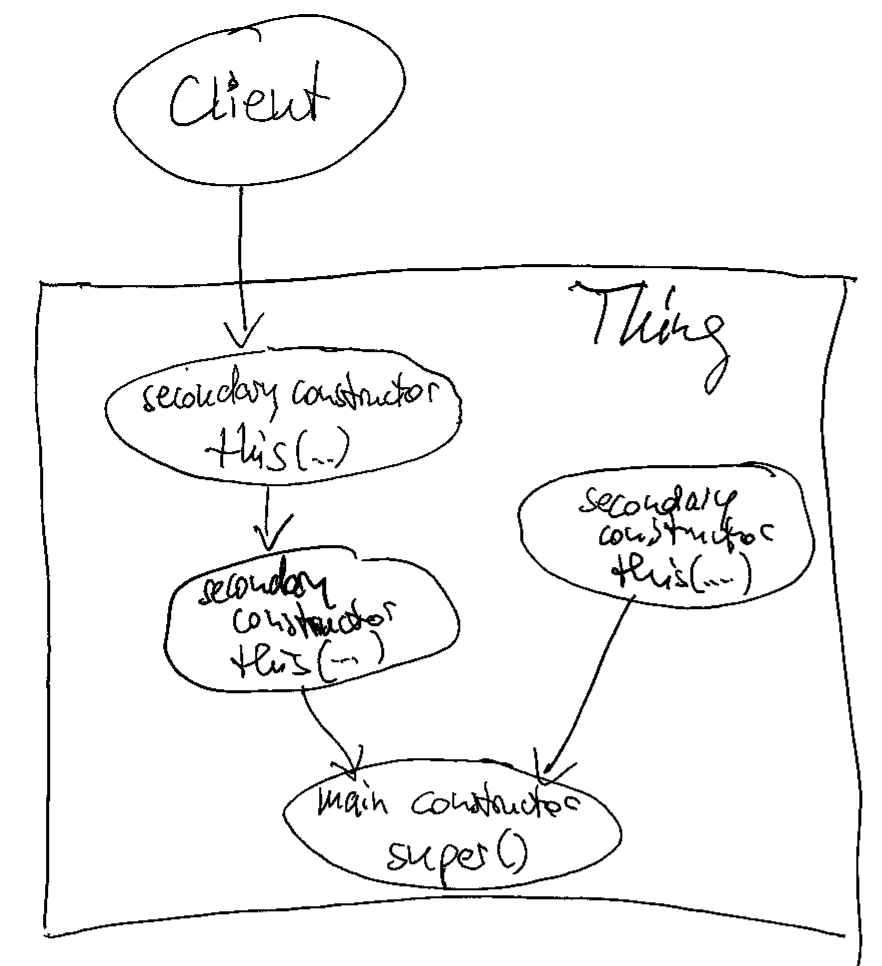
If you incorporate Rule 3 into your code, the instantiation process of your objects gets much cleaner and free from duplication. It means that if you only exhibit one constructor, it calls super() – with or without parameters. If you provide more than one constructor, they form a hierarchy: One constructor is the “main” or “core” constructor. It is the one that calls super(). All the other constructors are “secondary” or “intermediate” constructors. They use this() to call the main constructor or another secondary constructor that is an intermediate step towards the main constructor.

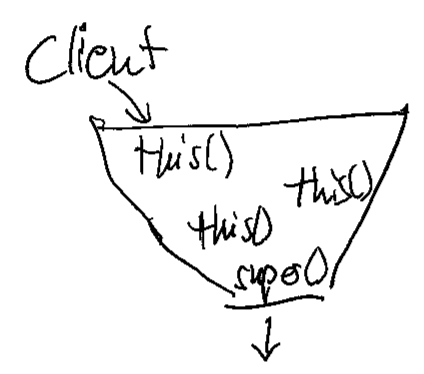
If you visualize this construct, it forms a funnel that directs all constructor calls into the main constructor. By listing its callers, you can see all clients of your class, even those that use secondary constructors. As soon as you have two super() calls in your class, you have two separate ways to construct objects from it. I came to find this possibility way more harmful than useful. There are usually better ways to solve the client’s problem with object instantiation than to introduce a major source of current or future duplication (and the divergent change code smell). If you are interested in some of them, leave a comment, and I will write a blog entry explaining some of them.

Back to the funnel:

if you don’t see the funnel yet, let me abstract the situation a bit more:

This is how it looks in source code:

public class Thing {
    
    private final String name;
    
    public Thing(int serialNumber) {
        this(
            "S/N " + serialNumber
        );
    }
    
    public Thing(String name) {
        super();
        this.name = name;
    }
}

I find this structure very helpful to navigate complex object construction code. But I also have a heuristic that the number of secondary constructors (by visually counting the this() calls) is proportional to the amount of head scratching and resistance to change that the class will induce.

As always, there are exceptions to the rule:

  • Some classes are just “more specific names” for the same concept. Custom exception types come to mind (see the code example below). It is ok to have several super() calls in these classes, as long as they are clearly free from additional complexity.
  • Enum types cannot have the super() call in the main constructor. I don’t write a comment as a placeholder; I trust that enum types are low-complexity classes with only a few private constructors and no shenanigans.

This is an example of a multi-super-call class:

public class BadRequest extends IOException {

    public BadRequest(String message, Throwable cause) {
        super(message, cause);
    }

    public BadRequest(String message) {
        super(message);
    }
}

It clearly does nothing more than represent a more specific IOException. There won’t be many reasons to change or even just look at this code.

I might implement a variation to my Rule 2 in the future, starting with Java 22: https://openjdk.org/jeps/447. I’m looking forward to incorporating the new possibilities into my habits!

As you’ve seen, my constructor code style tries to facilitate two things:

  • Navigation in the project code, with anchor points for IDE functionality.
  • Orientation in the class code with a standard structure for easier mental mapping.

It introduces boilerplate or cruft code, but only a low amount at specific places. This is the trade-off I’m willing to make.

What are your ideas about this? Leave us a comment!

Java enum inheritance preferences are weird

Java enums were weird from their introduction in Java 5 in the year 2004. They are implemented by forcing the compiler to generate several methods based on the declaration of fields/constants in the enum class. For example, the static Enum::valueOf(String) method is only present after compilation.

But with the introduction of default methods in Java 8 (published 2014), things got a little bit weirder if you combine interfaces, default methods and enums.

Let’s look at an example:

public interface Person {

  String name();
}

Nothing exciting to see here, just a Person type that can be asked about its name. Let’s add a default implementation that makes clearly no sense at all:

public interface Person {

  default String name() {
    return UUID.randomUUID().toString();
  }
}

If you implement this interface in a class and don’t overwrite the name() method, you are the weird one:

public class ExternalEmployee implements Person {

  public ExternalEmployee() {
    super();
  }
}

We can make your weirdness visible by creating an ExternalEmployee and calling its name() method:

public class Main {

  public static void main(String[] args) {
    ExternalEmployee external = new ExternalEmployee();
    System.out.println(external.name());
  }
}

This main method prints the “name” of your external employee on the console:

1460edf7-04c7-4f59-84dc-7f9b29371419

Are you sure that you hired a human and not some robot?

But what if we are a small startup company with just a few regular employees that can be expressed by a java enum?

public enum Staff implements Person {

  michael,
  bob,
  chris,
  ;
}

You can probably predict what this little main method prints on the console:

public class Main {

  public static void main(String[] args) {
    System.out.println(
      Staff.michael.name()
    );		
  }
}

But, to our surprise, the name() method got overwritten, without us doing or declaring to do so:

michael

We ended up with the “default” generated name() method from the Java enum type. In this case, the code generated by the compiler takes precedence over the default implementation in the interface, which isn’t what we would expect at first glance.

To our grief, we can’t change this behaviour back to a state that we want by overwriting the name() method once more in our Staff class (maybe we want our employees to be named by long numbers!), because the generated name() method is declared final. From the source code of the enum class:

/**
 * @return the name of this enum constant
 */
public final String name() {
  return name;
}

The only way out of this situation is to avoid the names of methods that are generated in an enum type. For the more obscure ordinal(), this might be feasible, but name() is prone for name conflicts (heh!).

While I can change my example to getName() or something, other situations are more delicate, like this Kotlin issue documents: https://youtrack.jetbrains.com/issue/KT-14115/Enum-cant-implement-an-interface-with-method-name

And I’m really a fan of Java’s enum functionality, it has the power to be really useful in a lot of circumstances. But with great weirdness comes great confusion sometimes.

No more Schneide Dev Brunches

In the year 2004, we had an idea: What if we met on Sunday for a late breakfast or early lunch (hence the word “brunch”) and talked about software, software development and IT in general while we ate?

The “brunch” theme pinpointed the time: 11 o’clock. The presence of food implied the presence of a dining table, something we found in our company kitchen (and later directly besides it). This defined the place: The kitchen of the Softwareschneiderei became the location to meet, eat and talk every other month, six times a year.

The brunches had no real structure or guest list, we showed up and were open to contributions, ideas and nearly everything that happened, as long as it fitted the shared interest of the participants.

For 20 years, we continued this series of events. It was great fun, real inspiration and always a source for thoughts and new ideas. Because it was designed as a meeting in presence, we had some challenges over the years:

First, the list of regular guests grew until the demand for some kind of transcript of meetings that were missed added the habit of “recap blog entries”. You can still find them, they have their own category on our blog:

https://schneide.blog/category/events/dev-brunch/

The recap was dropped when we shared more details about topics on the mailing list that acted as a planning tool for the meetings.

Second, in early 2020, we were faced with the reality that in-person meetings wouldn’t be feasible for quite some time. We didn’t have a crystal ball that could predict the future of the corona pandemic, so we couldn’t be sure, but we had some knowledge about the 1918 influenza pandemic from the book “Pale Rider”, written by Laura Spinney that some of us read in 2018. We took it as a prediction of the things that might come and switched to online meetings, which changed the character of the brunch, not least because nobody ate on camera anymore. The beginning of the pandemic was an eventful period for us, as we not only changed the Dev Brunch, but also everything else in our daily work.

A third thing became obvious when it would have been feasible to meet in person again: Everybody lives somewhere else now. We would have a stark drop in attendance if we went back to in-person brunches, just because of basic geography. We considered hybrid events, but they might have been the “worst of both worlds” instead of a good compromise.

The fourth thing that is about to change is the discontinuation of our mailing list infrastructure. This might sound like a small thing, but we take privacy and data protection really seriously and don’t want to move e-mail addresses around without proper consent by everybody. If we build up a new equivalent to the mailing list, we will start from scratch with proper agreements. Again, this might sound over the top in comparison to other companies’ conduct in regard to e-mail addresses, but that’s no reason to act the same.

So, this is farewell to a series of events that helped shape us the way we are. The Dev Brunch was a wonderful idea that facilitated our passion: software development. That doesn’t mean we are less passionate or less inclined to talk for hours about software development. It just means that the setting of future talks will be different.

Let us stay in touch!

Surviving the “Big One” in IT – Part I

For every kind of natural disaster, there is a “Big One”. Everybody who lived through it remembers the time, everybody else has at least heard stories about it. Every time a similar natural disaster occurs, it gets compared to this one.

We just remembered the “Boxing Day Tsunami” twenty years ago. Another example might be “The Big One”, the devastating earthquake of San Francisco in 1906. From today’s viewpoint, it wasn’t the strongest earthquake since, but it was one of the first to be extensively covered by “modern” media. It preceded the Richter scale, so we can’t directly compare it to current events.

In the rather young history of IT, we had our fair share of “natural” disasters as well. We used to give the really bad ones nicknames. The first vulnerability that was equipped with a logo and its own domain was heartbleed in 2014, ten years ago.

Let’s name-drop some big incidents:

The first entry in this list is different from the others in that it was a “near miss”. It would have been a vertitable catastrophe with millions of potentially breached and compromised systems. It just got discovered and averted right before it would have been distributed worldwide.

Another thing we can deduce from the list is the number of incidents per year:

https://www.cve.org/about/Metrics

From around 5k published vulnerabilities per year until 2014 (roughly one every two hours) it rose to 20k in 2021 and 30k in 2024. That’s 80 reports per day or 4 per hour. A single human cannot keep up with these numbers. We need to rely on filters that block out the noise and highlight the relevant issues for us.

But let’s assume that the next “Big One” happens and attains our attention. There is one common characteristic for all incidents I witnessed that is similar to earthquakes or floods: It happens everywhere at once. Let me describe the situation at the example of Log4Shell:

The first reports indicated a major vulnerability in the log4j package. That seemed bad, but it was a logging module, what could possibly happen? We could lose the log files?

It soon became clear that the vulnerability can be used from a distance by just sending over a malicious request that gets logged. Like a web request without proper authentication to a route that doesn’t exist. That’s exactly what logging is for: Capturing the outliers and preserving them for review.

Right at the moment that it dawned on us that every system with any remote accessibility was at risk, the first reports of automated attacks emerged. It was now friday late evening, the weekend just started and you realized that you are in a race against bots. The last thing you can do is call it a week and relax for 2 days. In these 48 hours, the war is lost and the systems are compromised. You know that you have at most 4 hours to:

  • Gather a list of affected projects/systems
  • Assess the realistic risk based on current knowledge
  • Hand over concrete advice to the system’s admins
  • Or employ the countermeasures yourself

In our case, that meant to review nearly 50 projects, document the decision and communicate with the operators.

While we did that, during friday night, new information occurred that not only log4j 2.x, but also 1.x was susceptible to similar attacks.

We had to review our list and decisions based on the new situation. While we were doing that, somebody on the internet refuted the claim and proclaimed the 1.x versions safe.

We had to split our investigation into two scenarios that both got documented:

  • scenario 1: Only log4j 2.x is affected
  • scenario 2: All versions of log4j are vulnerable

We employed actions based on scenario 1 and held our breath that scenario 2 wouldn’t come true.

One system with log4j 1.x was deemed “low impact” if down, so we took it off the net as a precaution. Spoiler: scenario 2 was not true, so this was an unnecessary step in hindsight. But in the moment, it was one problem off the list, regardless of scenario validity.

The thing to recognize here is that the engagement with the subject is not linear and not fixed. The scope and details of the problem change while you work on it. Uncertainties arise and need to be taken into account. When you look back on your work, you’ll notice all the unnecessary actions that you did. They didn’t appear unnecessary in the moment or at least you weren’t sure.

After we completed our system review and had carried out all the necessary actions, we switched to “survey and communicate” mode. We monitored the internet talk about the vulnerability and stayed in contact with the admins that were online. I remember an e-mail from an admin that copied some excerpts from the server logfiles with the caption: “The attacks are here!”.

And that was the moment my heart sank, because we had totally forgotten about the second front: Our own systems!

Every e-mail is processed by our mailing infrastructure and one piece of it is the mail archive. And this system is written in Java. I raced to gather insights what specific libraries are used in it. Because if a log4j 2.x library were included, the friendly admin would have just inadvertently performed a real attack on our infrastructure.

A few minutes after I finished my review (and found a log4j 1.x library), the producer of the product sent an e-mail, validating my result by saying that the product is not at risk. But those 30 minutes of uncertainty were pure panic!

In case of an airplane emergency, they always tell you to make sure you are stable first (i.e. place your own oxygen mask first). The same thing can be said about IT vulnerabilities: Mind your own systems first! We would have secured our client’s systems and then fallen prey to friendly fire if the mail archive would have been vulnerable.

Let’s re-iterate the situation we will find ourselves in when the next “Big One” hits:

  • We need to compile a list of affected instances, both under our direct control (our own systems) and under our ministration.
  • We need to assess the impact of immediate shutdown. If feasible, we should take as many systems as possible out of the equation by stopping or airgapping them.
  • We need to evaluate the risk of each instance in relation to the vulnerability. These evaluations need to be prioritized and timeboxed, because they need to be performed as fast as possible.
  • We need to document our findings (for later revision) and communicate the decision or recommendation with the operators.

This situation is remarkably similar to real-world disaster mitigation:

  • The lists of instances are disaster plans
  • The shutdowns are like evacuations
  • The risk evaluation is essentially a triage task
  • The documentation and delegation phase is the command and control phase of disaster relief crews

This helps a lot to see which elements can be prepared beforehands!

The disaster plans are the most obvious element that can be constructed during quiet times. Because no disaster occurs according to plan and plans tend to get outdated quickly, they need to be intentionally fuzzy on some details.

The evacuation itself cannot be fully prepared, but it can be facilitated by plans and automation.

The triage cannot be prepared either, but supported by checklists and training.

The documentation and communication can be somewhat formalized, but will probably happen in a chaotic and unpredictable manner.

With this insight, we can look at possible ideas for preparation and planning in the next part of this blog series.

Every Unit Test Is a Stage Play – Part V

In this series about describing unit tests with the metaphor of a stage play that tells short stories about your system, we already published four parts:

Today, we look at the critics.

An integral part of the theater experience is the appraisal of the critics. A good review of a stage play can multiply the viewer count manyfold, while a bad review can make avid visitors hesitate or even omit the visit.

In our world of source code and unit tests, we can define the whole team of developers as critics. If they aren’t fond of the tests, they will neglect or even abandon them. Tests need to prove their worth in order to survive.

Let us think a little deeper about this aspect: Test code is evaluated more critically than any other source code! Normal production code can always claim to be wanted by the customer. No matter how bad the production code may look and feel like, it cannot just be deleted. Somebody would notice and complain.

Test code is not wanted by the customer. You can delete a test and it would not be noticed until a regression bug raises the question why the failing functionality wasn’t secured by a test. So in order to survive, test code needs a stakeholder inside the development team. Nobody outside the team cares about the test.

There is another difference between production code and test code: Production code is inherently silent during development. In contrast to this, test code is programmed to drive the developer’s attention to it in case of a crisis. It is code that tries to steal your focus and cries wolf. It is the messenger that delivers the bad news.

Test code is the code you’ll likely read in a state of irritation or annoyance.

Think about a theater critic that visits and rates a stage play in a state of irritation and annoyance. That wanted to do something else instead and probably has a deadline to meet for that other thing. His opinion is probably biased towards a scathing critique.

We talked about several things that test code can do to be inviting, concise, comprehendible and plausible. What it can’t do is to be entertaining. Test code is inherently boring. Every test is a short story that seems trivial when seen in isolation. We can probably anticipate the critique about such a play: “it meant well, but was ultimately forgettable”.

What can we do to make test code more meaningful? To convey its impact and significance to the critics?

In the world of theater (and even more so: movies), one strategy is to add “big names” to the production: “From the director of Known Masterpiece” or “Part III of the Successful Series”.

Another strategy is to embellish oneself with other critiques (hopefully good ones): “Nominated for X awards” or “Praised by Grumpy Critic”.

Let’s translate these two strategies into the world of unit tests:

Strategy 1: Borrow a stakeholder by linking to the requirement

I stated above that test code has no direct stakeholder. That’s correct for the code itself, but not for its motivation to exist. We don’t write unit tests just to have them. We write them because we want to assert that some functionality is present or some bug is absent. In both cases, we probably have a ticket that describes the required change in depth. We can add the “big name” of the ticket to the test by adding its number or a full url as a comment to the test:

/**
 * #Requirement http://issuetracker/TICKET-3096
 */
@Test
public void understands_iso8601_timestamp() {
    final LocalDateTime actual = SomeController.dateTimeFrom(
        "2023-05-24T17:30:20"
    );
    assertThat(
        actual
    ).isEqualTo(
        "2023-05-24T17:30:20"
    );
}

The detail of interest is the comment above the test method. It explains the motivation behind authoring the test. The first word (#Requirement) indicates that this is a new feature that got commissioned by the customer. If it was a bugfix test instead, the first word would be #Bugfix. In both cases, we tell future developers that this test has a meaning in the context of the linked ticket. It isn’t some random test that annoys them, it is the guard for a specific use case of the system.

Strategy 2: Gather visible awards for previous achievements

Once you get used to the accompanying comment to a test method, you can see it as some kind of billboard that displays the merit of the test. Why not display the heroic deeds of the test, too? I’ve blogged about the idea a decade ago, so this is just a quick recap:

/**
 * #Requirement http://issuetracker/TICKET-3096
 * @lifesaver by dsl
 * @regression by xyz
 */
@Test
public void understands_iso8601_timestamp() {
    /* omitted test code */
}

Every time a test does something positive for you, give it a medal! You can add it right below the ticket link and document for everybody to see that this test has earned its place in the code base. Of course, you can also document your frustrating encounters with a specific test in the same way. Over time, the bad tests will exhibit several negative awards, while your best tests will have several lifesaver medals (the highest distinction a test can achieve).

So, to wrap up this part of the metaphor: Pacify the inevitable critics of your test code by not only giving them pleasant code to look at but also context information about why this code exists and why they should listen to it if it happens to have grabbed their attention, even with bad news.

Epilogue

This is the fifth part of a series. All parts are linked below:

Every Unit Test Is a Stage Play – Part IV

In this series about describing unit tests with the metaphor of a stage play that tells short stories about your system, we already published three parts:

Today, we look at the story.

When you visit a theater, you probably expect to be entertained. You expect some level of preparation and presentation. You might not enjoy every aspect of the stage play, but you can cherish the overall experience.

When you read an unit test as a developer, you should not expect to be entertained. But you can expect some level of presentation and you should be able to endure the overall experience.

In both cases, a great factor to success is how the story is presented to you.

Imagine trying to follow a stage play that is in rehearsal mode. Constant interruptions and corrections from outside the stage, repetitions of scenes and single sentences and sometimes omissions that everybody is clued in on except you. And of course, nobody is dressed for their role. It would be hard to follow the plot and piece the story together.

Unit test code often reads like an early rehearsal. The code is stitched together by copy & paste, some details are modified but not emphasized and the point of the story is only revealed at the end, oftentimes told indirectly by convoluted assertions. When the test runs green for the first time, it is abandoned and left as an exercise in improvement for the next reader.

The next reader is a developer that made a change to the production code that got red-flagged by the unit test. He or she tries to find out why the jury of assertions is against the change and what the test is all about. It’s like the first visitor of a stage play has to tell the lighting technician where to point the spotlights without knowing how the story will play out.

If we accept the metaphor and view unit tests as stage plays that tell a short story, we should try to tell the story in a clear and concise manner. Giving standard names to the participating roles is an important first step to clue in the visitor/reader. But the last part of a story is the most crucial one. You are expected to tie the story threads together and provide a resolution that can be followed.

In unit testing, we express the resolution of the unit test’s short story as assertions:

public void parsingOfErroneousODLState() {
    final SerialODL target = new SerialODL(Z, "19");
    
    final ODLState actual = target.getCurrentState();
    
    Assert.assertFalse(
        actual.isNormalOperation()
    );
    Assert.assertEquals(
        3,
        IterableUtil.getSizeFor(actual.getErrorStates())
    );
    Assert.assertEquals(
        ODLErrorState.TEST_ERROR,
        IterableUtil.getElementAt(0, actual.getErrorStates())
    );
    Assert.assertEquals(
        ODLErrorState.INVALID_VALUE_DUE_TO_INITIALIZING,
        IterableUtil.getElementAt(1, actual.getErrorStates())
    );
    Assert.assertEquals(
        ODLErrorState.VALUE_GREATER_ALARM_THRESHOLD,
        IterableUtil.getElementAt(2, actual.getErrorStates())
    );
}

This unit test consists of one line of preparation (“arrange”), one line of code under test that produces the “actual” (“act”) and five assertions on several lines each (“assert”). Nearly 80 percent of this unit test are assertions. And they try to express something, but it gets drowned in noise.

One key to a better story is the usage of a more fitting form of expression, in our case a more natural way to write assertions:

public void parsingOfErroneousODLState() {
    final SerialODL target = new SerialODL(Z, "19");

    final ODLState actual = target.getCurrentState();

    assertThat(
        actual.isNormalOperation()
    ).isFalse();

    assertThat(
        actual.getErrorStates()
    ).containsExactly(
        ODLErrorState.TEST_ERROR,
        ODLErrorState.INVALID_VALUE_DUE_TO_INITIALIZING,
        ODLErrorState.VALUE_GREATER_ALARM_THRESHOLD
    );
}

In this example, we used assertj fluent assertions. As you can see, you can shrink the assertions part of your story down to the essence. You can state what you really want to see and not hide it behind indices and size comparisons that only exist because of the indices.

Another way to guide your reader is by structuring your test story into a standard form. From classic storytelling, we know about the hero’s journey that consists of three sections (departure, initiation, return) and can be found in countless books, movies and stage plays.

Our test’s journey is called AAA pattern. The three sections are:

  • Arrange
  • Act
  • Assert

Whenever you write an unit test, adhere to this pattern. If you find yourself tempted to add a second act or more assertions, break up your one unit test into two. You might want to think about extracting the arrange part into a common utility method (that is placed down below, behind the curtain). The story then says: The hero is in the same position both times, decides different (the two act sections) and has a different outcome (the two assertions) because of that.

There are probably countless things more that you can think of to make the story of your tests more compelling. Remember that test are not required to be entertaining or surprising. You can tell the same classic tale over and over again. The computer doesn’t mind and the next reader is glad when the test code is accessible right away because the structure and phrasing is on point.

Nobody would pay to see a confusing stage play. And nobody wants to decipher extravagant test code that just broke in an unexpected way. Give your readers what they hope for: Plain short stories about your system.

Epilogue

This is the fourth part of a series. All parts are linked below: