A neat trick for finding dates

One of my fundamental driving forces for designing a suitable user experience is the motto of “no scrolling”. It is not a hard principle in the sense of Bret Victor’s “Inventing on Principle”, but it is motivation enough to always look for context-aware ordering of lists and tables.

One of the cornerstones of such “scrolling-free” or “scrolling-reduced” applications is a possibility for the user to define a context of work. You might call it an ordinary search field, but it is highly interactive (immediate feedback, as mandated by Bret Victor) and doesn’t lead to a special result view. It just reduces the amount of data that is presented to the user. The idea behind the context field is that the user has some idea about the piece of work she wants to edit. So, if for example she remembers that the customer of an order was named “Miller”, she would type “mil” in the context field and have the list of orders reduced to just the “Millers” and “Camilles” (the latter contains “mil” in the middle).

This works fine for text-based information, but less so for numerical data. Most users typically remember text like names better than numbers like values or phone numbers, so it fits the natural inclination of humans. And then there is a form of data that is remembered easily and used for orientation, but presented as numbers: dates.

If you store a date in a persistent storage, it is probably stored as a number, several numbers or a short piece of text like “2024-12-24”. To make a date searchable, the textual representation of “2024-12-24” is a good start, but we can do better with a simple trick:

Instead of just using one textual representation for the search index (or whatever search functionality you use), you can append several representations of the same date at once:

“2024-12-24 Tuesday, December 24, 2024”

Here, we’ve used a code like this:

String searchtext = xmas.toString() + " " + xmas.format(DateTimeFormatter.ofLocalizedDate(FormatStyle.FULL));

This enables your user to restrict to a context of “dec” for “December” or even “tue” for “Tuesday”.

This search-extended representation of the date is never shown on screen, so it doesn’t have to be readable or brief. It should contain the concepts of managing dates that your users will facilitate during their normal interaction with the data (not with your application!). So it might even be useful to add several more representations like a relative period (“in 5 months, 16 days”) and maybe special date names (“christmas, xmas”). It might be useful to cut down on filler words like “months” or “days”, because they are included in virtually every date you’ll search. So the relative period might come down to “5 five, 16 sixteen”. If your search allows for multiple texts that all need to be present (which I would encourage because in my experience, that’s how people triangulate: “It was Miller and at the end of the year”), you might add the filler words again, because it allows for a context string like “5 mo” with matches with “in 5 months” (and “5 months ago”, but that’s another topic).

In a nutshell, my trick is to craft the textual representation of data for the search (not the visualisation!) in accordance to the navigation patterns of my users. If they can rely on the data being focussed effectively, they won’t miss the scrollbars.
The ALARA principle in software engineering

The ALARA principle originates in radiation protection and means “As Low As Reasonably Achievable”. It means that you have to weigh the purpose of an action dealing with radiation against its disadvantages, like radiation damage or long-term risks. The word “reasonably” means that while some disadvantages are not avoidable, a practicable amount of protection should be in place to lower them. The principle calls for a balancing act: Not without safety measures, but don’t overextend your means by trying to achieve a safety level that isn’t helpful anymore.
To put the ALARA principle in practice with an example: You shouldn’t need a X-ray every time you go to the dentist, but given enough time since the last one and reasonable doubt about a tooth, the X-ray examination will benefit your dental (and overall) health more than if you deny it. It isn’t healthy by itself, but the information gained by it will be used to improve your health.

I learnt about the ALARA principle when my father (a nuclear physicist by heart) explained it to me in context of the current corona pandemic: Use protection like face masks and distance, but don’t stress yourself too much over that one time when you grabbed a pen in the postal office. While preparation and watchfulness is helpful, fear is detrimental to your mental health. And even the most resilient mind has bounded resources that can better be spent on constructive things instead of fear.

A fun fact from radiation protection is that at least three of the four main rules of protection can be applied to corona, too:

  • Distance yourself from the radiation source
  • Use appropriate protection gear
  • Avoid incorporation (keep the thing outside your body)
  • Limit your exposure time (this doesn’t fit as nicely, because the virus is probably not cumulative)

But how can we apply the ALARA principle to software engineering? I was instantly reminded about the “Thorough” rule of unit testing. In the book “Pragmatic Unit Testing” by Andy Hunt and Dave Thomas, the two original Pragmatic Programmers, good unit tests have to follow the ATRIP-rules. The T stands for “Thorough” which is often misinterpreted as “test everything at least twice”. In reality, the rule states that:

  • all mission critical functionality needs to be tested
  • for every occuring bug, there needs to be an additional test that ensures that the bug cannot happen again

The first thing that meets the eye is that the rule doesn’t define a bug as a failure of your testing effort. It takes a bug that probably happened in production and caused some damage as a motivation to strengthen your test coverage in that particular area. The second part of the rule calls for directed, well-aimed testing effort. It is easy to follow because it has a clear trigger: A bug happened, now you have to write a test.

The first part of the rule is more complicated: What is mission critical functionality? And what means “is tested thoroughly” in this context? And here, the ALARA principle can help us. The bug rate in the important parts of your code should be as low as reasonably achievable. “Reasonably achievable” is defined by the resources at your disposal (like time to market), your expertise in testing and the potential damage that could happen if something in your code goes wrong.

If the potential damage is high or even life-threatening, your reasonable effort should be much higher than if the most critical thing that happens is a 15 minute downtime while you restart the server. There are use cases where even 15 minutes mean subsequent damage, but most software is written for a more relaxed context.

I’ve always found the “Thorough” rule of good unit tests pleasant and comforting: If you made reasonable effort to test your most important code and write a test for every bug you or your users encounter, you can say that your bug rate is ALARA – “As Low As Reasonably Achievable”. And that is good enough for most cases.

What was your first thought when you heard about the ALARA principle? Tell us in the comment section!

Easy maintenance, not easy production

Imagine that you have to do critical changes in the source code, stressed, over-worked and under time pressure, without any recollection about your thoughts during development, lacking your familiar tools while your customer waits impatiently by your side. That’s when you are glad you prepared for this moment.

It is said that source code gets read a hundred times more often than it gets written. My experience confirms this circumstance, which leads to a principle of economic source code modifications: The first modification is almost for free, it’s the later ones that run up a bill. In order to achieve a low TCO (total cost of ownership), it’s sound advice to plan (and develop) for easy maintenance instead of easy production. This principle even has a fancy name: Keep It Simple, Stupid (KISS).

Origin of KISS

According to the english Wikipedia on the topic, the principle’s name was coined by an aircraft engineer named Kelly Johnson, who also designed the fastest jet plane of all time, the SR-71 “Blackbird”. The aircraft reached speeds of over Mach 3 and had an unmatched defensive armament: enough thrust to evade any confrontation. It would simply fly higher and/or faster than anything launched against it, like interceptor fighters or anti-air missiles. The Blackbird used construction material that was specifically invented for this plane and very expensive, so it definitely was no easy production. Sadly for this blog post, it wasn’t particularly easy to maintain, either. It usually leaked so much fuel that it had to be refueled directly after takeoff. The leaks were pragmatically designed that way and would seal themselves in flight. It’s quite an interesting plane.

Easy maintenance

Johnson once alledegly gave his engineers a bunch of tools and required that the aircraft under design must be repairable with only these tools, by an average mechanic in the field under combat conditions (e.g. stressed, exhausted and narrow timeframe). This is a wonderful concept that I regularly apply to my projects: Imagine that you are on-site with your customer, the most important functionality of your project just broke, resulting in a disastrous standstill of the whole facility and all you have is your sourcecode and the vi editor (or vim, if you’re non-hardcore like me). No internet, no IDE, no extensive documentation. Could you make meaningful changes to your project under these conditions? What needs to be changed to make your life easier in such an extreme situation? What restrictions would these changes impose on your daily work? How much effort/damage/resources would these changes cost? Is it easier to anticipate maintenance or to trust to luck that it won’t be necessary?

Easy production

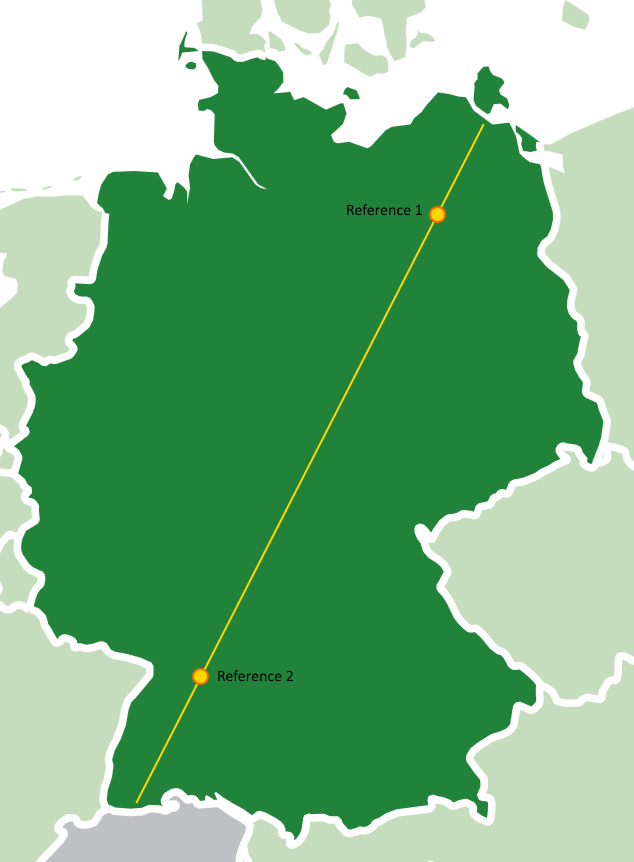
A while ago, I reviewed the code of a map tool. The user viewed a map and could click on it to mark a certain location. The geo coordinates of this location would be used as an input for further computations. The map was restricted to a fixed area, so the developer wrote the code in the easiest way possible: He chose well-known geographic landmarks on the map and determined their geo coordinates and pixel locations. map-with-referenceThose were the reference points in the code that every click would be related to. Using easy mathematic (rule of three), each point on the map could be calculated. Clever trick and totally working! The code practically wrote itself and the reference points only needed to be determined once.

Until the map was changed. The code contained some obscure constants that described the original landmarks, but the whole concept of arbitrary reference points was alien to the next developer. He was used to the classic concept of two reference points: top left and bottom right, with their respective geo coordinates and pixel locations. What seemed like a quick task turned into a stressful reclaiming of the clever trick during production.

In this example, the production (initial development) was easy, straight-forward and natural, but not easily reproducible during the maintenance phase (subsequent modification). The algorithm used a clever approach, but this cleverness isn’t necessarily available “under combat conditions”.

Go the extra mile

Most machines are designed so that wearing parts can be easily replaced. Think of batteries in electronic gagdets (well, at least before the gadget’s estimated lifetime was lower than the average battery life) or light bulbs in cars (well, at least before LED headlights were considered cool). Thing is, engineers usually know the wear effects their designs have to endure. There is no “usual wear effect” on software, due to lack of natural forces like gravitation. Everything could change, so it’s better to be prepared for all sorts of change. That’s the theory, but it’s not economically sound to develop software that is prepared for any circumstance. Pragmatic reasoning calls for compromise, like supporting changes that

  • are likely to happen (this needs to be grounded in domain knowledge and should be documented in the code)
  • are not expensive to arrange beforehands (the popular “low-hanging fruits”)
  • are expensive to implement afterwards

The last aspect might be a bit of a surprise, but it’s the exact aspect that came to play in the example above: To recreate the knowledge about the clever trick of landmark choices needed more time than implementing the classic interpolation taking the edge points.

So if you see a possible (and not totally unlikely) change that will be expensive to implement once the intimate knowledge of the code you have during the initial development, go the extra mile and prepare for it right now. Leave a comment, implement some kind of extension mechanism or just mind the code seams. In our example, slightly complicating the initial development led to a dramatically less clever and more accessible code.

Conclusion

You should consider writing your code for easy maintenance, even if that means additional effort during the initial implementation. Imagine that you yourself have to do the future change, stressed, over-worked and under time pressure, without any recollection about your thoughts today, lacking your familiar tools while your customer waits impatiently by your side. With proper preparation, even this scenario is feasible.