How to Lay a Minefield

… in Minesweeper, of course.

One of the basic building blocks of my hands-on software development workshops are Coding Katas. Minesweeper, the classic game that every Microsoft Windows user knows since 1992, is one of the “medium everything” Katas: Medium scope, medium complexity, medium demand. One advantage is that virtually nobody needs any more explanation than “program a Minesweeper”.

The first milestone when programming a Minesweeper game is to lay the mines on the field in a random fashion. And to my continual surprise, this seems to be a hard task for most participants. Not hard in the sense of giving up, but hard in the sense that the solution lacks suitability or even correctness.

So in order to have a reference point I can use in future workshops and to discuss the usual approaches, here is how you lay a minefield in an adequate way.

The task is to fill a grid of tiles or cells with a predefined amount of mines. Let’s say you have a grid of ten rows and ten columns and want to place ten mines randomly.

Spoiler alert: If you want to think about this problem on your own, don’t read any further and develop your solution first!

Task analysis

If you pause for a moment and think about the ingredients that you need for the task, you’ll find three things:

  • A die (in the form of a random number generator)
  • An amount of mines to place (maybe just represented by a counter variable)
  • An amount of tiles (stored in a data structure)

Each solution I’ll present uses one of these things as the primary focus of interest. My language for this effect is that the solution “takes the thing into the hands”, while the other two things “lay on the table”. That’s because if you simulate how the solution works with real objects like paper and dice, you’ll really have one thing in your hands and the others on the table most of the time.

Solution #1: The probability approach

One way to think about the task of placing 10 mines somewhere on 100 tiles is to calculate the probability of a mine being on a tile and just roll the dice for every tile.

Here’s some code that shows how this approach might look like in Java:

private static final int fieldWidth = 10;
private static final int fieldHeigth = 10;

public static Set<Point> placeMinesOn(Set<Point> field) {
	Random rng = new Random();
	final double probability = 0.1D;
	for (int column = 0; column < fieldWidth; column++) {
		for (int row = 0; row < fieldHeigth; row++) {
			if (rng.nextDouble() < probability) {
				field.add(new Point(row, column));
			}
		}
	}
	return field;
}

Before we discuss the effects of this code, let’s have a little talk about the data structure that I use for the tiles:

The most common approach to model a two-dimensional grid of tiles in software is to use a two-dimensional array. There is nothing wrong with it, it’s just not the most practical approach. In reality, it is really cumbersome compared to its alternatives (yes, there are several). My approach is to separate the aspect of “two-dimensionalness” from my data structure. That’s why I use a set of points. The set (like a HashSet) is a one-dimensional data structure that more or less can only say “yes, I know this point” or “no, I never heard of this point”. To determine if a certain point (or tile at this coordinate) contains a mine, it just needs to be included in the set. An empty set represents an empty field. If you remove “cleared” mines from the set, its size is the number of remaining mines. With a two-dimensional array, you probably write several loop-in-loop structures, one of them just to count non-cleared mines.

Ok, now back to the solution. It is the approach that holds the die in the hands and uses it for every tile. The problem with it is that our customer didn’t ask for a probability of 10 percent for a mine, he/she asked for 10 mines. And the code above might place 10 mines, or 9, or 11, or even 14. In fact, the code places somewhere between 0 and 100 mines on the field.

The one thing this solution has going for it is the guaranteed runtime. We roll the dice 100 times and that’s it.

So we can categorize this solution as follows:

  • Correctness: not guaranteed
  • Runtime: guaranteed

If I were the customer, I would reject the solution because it doesn’t produce the outcome I require. A minesweeper contest based on this code would end in a riot.

Solution #2: Sampling with replacement

If you don’t take up the die, but the mines and try to dispense them on the field, you implement our second solution. As long as you have mines on hand, you choose a field at random and place it there. The only exception is that you can’t place a mine above a mine, so you have to check for the presence of a mine first.

Here’s the code for this solution in Java:

public static Set<Point> placeMinesOn(Set<Point> field) {
	Random rng = new Random();
	int remainingMines = 10;
	while (remainingMines > 0) {
		Point randomTile = new Point(
			rng.nextInt(fieldHeigth),
			rng.nextInt(fieldWidth)
		);
		if (field.contains(randomTile)) {
			continue;
		}
		field.add(randomTile);
		remainingMines--;
	}
	return field;
}

This solution works better than the previous one for the correctness category. There will always be 10 mines on the field once we are finished. The problem is that we can’t guarantee that we are able to place the mines in time before our player gets bored. Taking it to the extreme means that this code might run forever, especially if your random number generator isn’t up to standards.

So, the participants of your minesweeper contest might not protest the arbitrary number of mines on their field, but maybe just because they don’t know yet that they’ll always get 10 mines dispersed.

  • Correctness: guaranteed
  • Runtime: not guaranteed

This solution will probably work alright in reality. I just don’t see the need to utilize it when there is a clearly superior solution at hands.

Solution #3: Sampling without replacement

So far, we picked up the die and the mines. But what if we pick up the tiles? That’s the third solution. In short, we but all tiles in a bag and pick one by random. We place a mine there and don’t put it back into the bag. After we’ve picked 10 tiles and placed 10 mines, we solved the problem.

Here’s code that implements this solution in Java:

public static Set<Point> placeMinesOn(Set<Point> field) {
	List<Point> allTiles = new LinkedList<Point>();
	for (int column = 0; column < fieldWidth; column++) {
		for (int row = 0; row < fieldHeigth; row++) {
			allTiles.add(new Point(row, column));
		}
	}
	
	Collections.shuffle(allTiles);
	
	int mines = 10;
	for (int i = 0; i < mines; i++) {
		Point tile = allTiles.remove(0);
		field.add(tile);
	}
	return field;
}

The cool thing about this solution is that it excels in both correctness and runtime. Maybe we use some additional memory for our bag and some runtime for the shuffling, but both can be predefined to an upper limit.

Yet, I rarely see this solution in my workshops. It’s only after I challenge their first solution that people come up with it. I’m biased, of course, because I’ve seen too many approaches (successful and failed) and thought about the problem way longer than usual. But you, my reader, are probably an impartial mind on this topic and can give some thoughts in the comments. I would appreciate it!

So, let’s categorize this approach:

  • Correctness: guaranteed
  • Runtime: guaranteed

If I were the customer, this would be my anticipation. My minesweeper contest would go unchallenged as long as nobody finds a flaw in the shuffle algorithm.

Summary

It is suprisingly hard to solve simple tasks like “distribute N elements on a X*Y grid” in an adequate way. My approach to deconstruct and analyze these tasks is to visualize myself doing them “in reality”. This is how I come up with the “thing in hands” metaphor that help me to imagine new solutions. I hope this helps you sometimes in the future.

How do you lay a minefield and how do you find your solutions? Write a blog post or leave a comment!
A small example of domain analysis

One thing I’ve learned a lot about in recent years is domain analysis and domain modeling. Every once in a while, an isolated piece of code or a separable concept shows me just how much I’ve missed out all the years before. A few weeks ago, I came across such an example and want to share the experience and insight. It’s a story about domain exploration with heightened degree of difficulty – another programmer had analyzed it before and written code that I should replace. But first, let’s talk about the domain.

The domain

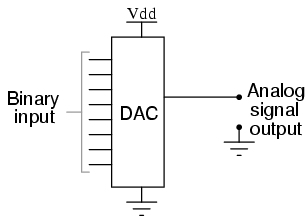
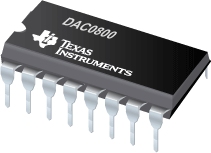
04250The project consisted of a machine control software that receives commands and alters the state of a complex electronic circuitry accordingly. The circuitry consists of several digital-to-analog converters (DAC), among other parts. We will concentrate on the DACs in this story. In case you don’t know what a DAC is, let me explain. Imagine a little integrated circuit (IC), the black bug-like electronic parts on a circuit board. On one side, you provide it a digital number in binary representation and on the other side, you’ll get an analog voltage that represents your number. Let’s say you drive a 8-bit DAC and give it a digital zero, the output will be zero volt. If you give the same DAC the number 255, it will output the maximum possible voltage. This voltage is given by the “reference voltage” pin and is usually tied to 5 V in traditional TTL logic circuits. If you drive a 12-bit DAC, the zero will still yield 0 V, while the 255 will now only yield about 0,3 V because the maximum digital number is now 4095. So the resolution of a DAC, given in bits, is a big deal for the driver.

DAC0800How exactly you have to provide that digital number, what additional signals need to be set or cleared to really get the analog voltage is up to the specific type of DAC. So this is the part of behaviour that should be encapsulated inside a DAC class. The rest of the software should only be able to change the digital number using a method on a particular DAC object. That’s our modeling task.

The original implementation

My job was not to develop the machine control software from scratch, but re-engineer it from existing sources. The code is written in plain C by an electronics technician, and it really shows. For our DAC driver, there was a function that took one argument – an integer value that will be written to the DAC. If the client code was lazy enough to not check the bounds of the DAC, you would see all kinds of overflow effects. It worked, but only if the client code knew about the resolution of the DAC and checked the bounds. One task the machine control software needed to do was to translate the command parameters that were given in millivolts to the correct integer number to feed it into the DAC and receive the desired millivolts at the analog output pin. This calculation, albeit not very complicated, was duplicated all over the place.


writeDAC(int value);

My original translation

One primary aspect when doing re-engineering work is not to assume too much and don’t change too many places at once. So my first translation was a method on the DAC objects requiring the exact integer value that should be written. The method would internally check for the valid value range because the object knows about the DAC resolution, while the client code should subsequently lose this knowledge. The original code translated nicely to this new structure and worked correctly, but I wasn’t happy with it. To provide the correct integer value, the client code needs to know about the DAC resolution and perform the calculation from millivolts to DAC value. Even if you centralize the calculation, there are still calls from everywhere to it.


dac.write(int value);

My first relevation

When I finally had translated all existing code, I knew that every single call to the DAC got their parameter in millivolts, but needed to set the DAC integer. Now I knew that the client code never cared about DAC integers at all, it cared about millivolts. If you find such a revelation, act on it – even just to see where it might lead you to. I acted and replaced the integer parameter of the write method on the DAC object with a voltage parameter. I created the Voltage domain type and had it expose factory methods to be easily created from millivolts that were represented by integers in the commands that the machine control software received. Now the client code only needed to create a Voltage object and pass it to the DAC to have that voltage show up at the analog output pin. The whole calculation and checking part happened inside the DAC object, where it belongs.


dac.write(Voltage required);

This version of the code was easy to read, easy to reason about and worked like a charm. It went into production and could be the end of the story.

The second insight

But the customer had other plans. He replaced parts of the original circuitry and upgraded most of the DACs on the way. Now there was only one type of DAC, but with additional amplifier functionality for some output pins (a typical DAC has several output pins that can be controlled by a pin address that is provided alongside the digital number). The code needed to drive the DACs, that were bound to 5 V reference voltage, but some channels would be amplified to double the voltage, providing a voltage range from 0 V to 10 V. If you want to set one of those channels to 5 V output voltage, you need to write half the maximum number to it. If the DAC has 12-bit resolution, you need to write 2047 (or 2048, depending on your rounding strategy) to it. Writing 4095 would yield 10 V on those channels.

Because the amplification isn’t part of the DAC itself, the DAC code shouldn’t know about it. This knowledge should be placed in a wrapper layer around the DAC objects, taking the voltage parameters from the client code and changing it according to the amplification of the channel. The client code would want to write 10 V, pass it to the wrapper layer that knows about the amplification and reduces it to 5 V, passing this to the DAC object that transforms it to the maximum reference voltage (5 V) that subsequently gets amplified to 10 V. This sounded so weird that I decided to review my domain analysis.

It dawned on me that the DAC domain never really cared about millivolts or voltages. Sure, the output will be a specific voltage, but it will be relative to your input in relation to the maximum value. The output voltage has the same percentage of the maximum value as the input value. It’s all about ratios. The DAC should always demand a percentage from the client code, not a voltage. This way, you can actually give it the ratio of anything and it will express this ratio as a voltage compared to the reference voltage. The DAC is defined by its core characteristics and the wrapper layer performs the translation from required voltage to percentage. In case of amplification, it is accounted for in this translation – the DAC never needs to know.


dac.write(Percentage required);

Expressiveness of the new concept

Now we can really describe in code what actually happens: A command arrives, requiring us to set a DAC channel to 8 volt. We create the voltage object for 8 volt and pass it on to the DAC wrapper layer. The layer knows about the 2x amplification and the reference voltage. It calculates that 8 volt will be 80% of the maximum DAC value (80% of 5 V being 4 V before and 8 V after amplification) and passes this information to the DAC object. The DAC object, being the only one to know its resolution, sets 0.8 * maximum_DAC_value to the required register and everything works.

The new concept of percentages decouples the voltage information from the DAC resolution information and keeps both informations where they belong. In fact, the DAC chip never really knows about the reference voltage, either – it’s the circuit around it that knows.

Conclusion

While it is easy to see why the first version with voltages as parameters has its charms, it isn’t modeling the reality accurately and therefor falls short when flexibility is required. The first version ties DAC resolution and reference voltage together when in fact the DAC chip only knows the resolution. You can operate the chip with any reference voltage within a valid range. By decoupling those informations and moving the knowledge about reference voltages outside the DAC object, I modeled the reality more accurate and every requirement finds its natural place. This “natural place finding” is what makes a good model useful for reasoning. In our case, the natural place for the reference voltage was outside the DAC in the wrapper layer. Finding a real name for the wrapper layer was easy, I called it “circuit board”.

Domain analysis is all about having the right abstractions for your model. Your model is suitable for your task when everything fits and falls into place nearly automatically. When names needn’t be found but kind of obtrude themselves from the real domain. The right model (for the given task) feels good and transports a lot of domain knowledge. And domain knowledge is the most treasurable knowledge for any developer.

The power of analysis

A short story about the power of good analysis. Thinking in terms of the problem domain is a key ingredient.

Quite some years ago, I heard a story about the power of analysis that happened even deeper in the past. Its moral holds true until today, though. It’s the insight that to fully analyse a particular challenge or task, you have to think outside your own box. Let’s hear the story before we analyse it:

The problem

A small company for sensor technology usually solved customer problems like distance measurement without contact or gas mixture control. The team was informed about all the latest sensors and trained to come up with solutions even to really challenging tasks. This lead to a word of mouth recommendation for a new customer that promptly described his problem.

christmas-star-lamp-smallThe customer ran a workshop for physically handicapped people that mostly worked with wood and produced a wide variety of products that got sold on various markets. One product was the Christmas lamp in shape of a star. It proved to be a best-seller and had a good economic ratio. At least it could have, if only the rejects rate would be lower. To assemble the lamp from little wooden laths was difficult for skilled workers and even harder for skilled handicapped workers. The main difficulty was to glue the laths in just the right angle to result in the desired star shape. The customer needed some set-up of sensors that would indicate to the worker when the angle was right. He imagined something like a cheap navigation system that would yell/display “left” and “right” until the angle was “correct”.

The solution finding

The team accepted the task and started the creative solution process that lasted several days of thinking, doodling, researching and scribbling. Then, the team gathered for a solution finding session. A multitude of ideas were presented and almost instantly rejected. From laser distance measurement over acoustic ultrasonic sensors to camera-based image evaluation, everything cool and remotely feasible was presented and rejected because nothing had an even remote chance to succeed outside of laboratory settings. Not one approach survived the applicability check. The team was devastated and returned to the creative phase, if not as reckless as the first time.

The solution

A few days later, the second solution finding session had only a few new ideas, none standing a chance. Finally, a student spoke up: “This isn’t a problem that should be solved with sensors!”. Well, this was a bold sentence in a team of sensor technologists. The student explained: “The real problem is the placement of the small laths, not the correct angle itself. Even if we build a sensor that can reliably indicate right and wrong angles, it would just tell the worker that whatever he tries, he won’t get it right. These workers don’t need supervision, they need assistance. No sensor is going to deliver that.” The team was baffled. The student went on: “I thought about a solution that will assist the worker during the assembly, but it’s nothing we will get rich with. A simple mould in the right shape, perhaps non-adhering to the glue they use for the wood, would let them produce one half of the lamp. Glue two of those halves together and everything fits. No need for batteries even.”

christmas-lamp-star-sideWhen the sensor technology company proposed this solution to the customer, he laughed loud and long. It was the most elegant and inexpensive solution he never thought of. It was exactly what was needed. It worked perfectly from the first prototypes onward. The Christmas lamp rejects rate dwindled to almost zero instantly. In short: perfect score. Just that the sensor technology company wouldn’t earn anything with maintenance or improvements was a minor drawback.

Good analysis

This story is my illustrative material when I have to explain what good analysis is. Let’s take a look at the bafflement of the team: They had all started their solution finding with the premise that this was a problem inside their area of expertise. Even the customer said so. Good analysis works out the real nature of a problem regardless of what anybody says about it. This includes any description given by the customer or even the wood workers in charge of the actual work. Good analysis finds a solution that fits the problem, not the field of expertise of the analyst.

Analysis is the process of thinking in terms of the problem space. In this story, an important part of the analysis was already done by the customer: Most of the rejects have wrong angles, so we need to make sure the angles are correct and we need a machine to tell us, because apparently the workers themselves can’t. The machine needs sensors, so lets assign a sensor company on the task. This was the initial premise that nobody except the student questioned. And this was half of the analysis that nobody bothered to repeat. You cannot really understand the problem if you begin your thinking mid-flight.

Applying good analysis

It’s easy to tell a story (even if it really happened) and derive insights from it. It’s much harder to apply these insights in the own work. The crucial step is to fully understand the actual problem that should be solved (in the story: correct justification instead of correct angle). The next step is to incorporate the value system of the customer: if I alter some key characteristics of the solution, will it still serve the customer’s actual needs? In the story: A cheap aluminium mould serves the customer even better than some expensive fancy machine. The mould can be duplicated nearly infinitely, the machine probably not. The mould is grasped instantly, the machine needs instructions. The mould keeps working long after the machine ran out of battery. The mould assists, the machine merely scolds.

If, after thoroughly working on these two steps, the solution lies still inside your field of expertise, you can proceed to design the solution. You’ve just left the analysis process to concentrate on one possible solution. That’s all right, but remember to return to the earliest steps of analysis when you get stuck. Designing a solution for a falsely analysed premise almost always leads nowhere in the long run.