Why we can’t dispose of every Manager, even in Tech fields

The world is in a place in which we gradually learn to question old patterns of societal behaviour and to look deeply into the meaning of what it is that we actually do. Especially in the technical / digital field, we see that our hands are not tied – most of the things we do, we can decide to do for an actual reason, or to find a way of disposing of exactly that – in what speed or level of disruption we consider appropriate.

While this holds for any level of detail, it is especially fruitful in these patterns where we do something for historical reason; the patterns that emerged as seeming to hold true for generation after generation – why should the present days be any different?

Now, I do not hate any traditions just for the reason of them being traditions. That stance is not useful, as a significant number of traditions have some underlying reasons why they work. Sometimes these are not obvious at all, and worse, sometimes everyone around us thinks they can tell use these reasons, while what they tell is are mostly empty phrases, placeholders, tranquilizers, red herrings, tautologies. But I digress.

One of the largest volume of “what we do” revolves around our work. Not only in a “this is a German clichee” sense, but the universal “what we deliver to sustain our livelihood”. And one of the most profitable discussions are these at the intersections of that work and of our inner state of being, our emotions, attitudes, values, interpersonal relations. The stuff that plays no role in traditional work.

To clarfiy, the world has not yet gone to a magical sphere of enlightenment where we’re just so incredibly smarter than our ancestors, but at least the reasoning takes place, and is within reach to be emplaced.

But there is little insight in only asking “what have they thought wrong?”. You have to also ask “what have they gotten right?” to get to the next level.

The Question: “What is Management?”

It’s not as simple to tell, because if you just look at what most Managers do, you can only answer “What is Mismanagement?”. Think of any fictional CEO, and chances are you will imagine one of these movie stereotypes, the people who put more work in buttering their insecure ego with layers of self-importance and complacency until the whole package somewhat sticks.

As such, there appears to be a current trend in Management Consultants that actually do God’s work in trying to correct that view. Do any internet search, there is plenty of quotable verdict on that field – “As a manager, you should trust your people and get out of their way. They work with you for a reason” – Even if they might not convince many Executives in changing their ways, more lower-employed people lose their tolerance for such mannerisms.

This means, that in a job interview, a Newcomer can very well ask – “Tell me, what do we need you for? Under the assumption that I’m the right person for this job, what is there I could possibly need an Executive for without invalidating the former assumption?” (… is not something your average applicant would say, but it’s the core of that idea that matters.)

So, there’s the obvious bulk of organisational overhead, outside representation, legal matters, ensuring-everyone-gets-paid-on-time, duties about Datenschutz & friends, i.e. tasks that are most efficiently handled by as few hands as possible. (Depending on how American you feel, there you might also need to constantly insult your competitors publicly.) But other than that, do you just hang around and ask your employees about their favorite variety of coffee once in a while?

  • Yes, in some instances that is the most preferable conduct for your Manager,
  • Generally, it’s not.

Where you can really reap the crops

Basically, you are deployed to optimize every flow of any relevant currency. These might change over time, but it is not only the regular appearance of some money in some accounts and it’s also not only the getting out of your way to let the recipients of said money do their magic. It’s also not about everyone feeling absolutely smart and awesome on every occasion. Neither the opposite.

You can be of actual use. Here’s three points that come to my mind.

  • 1.) Define the Culture, especially its Boundaries
  • 2.) Evaluate the Direction of Motion
  • 3.) Advertise that Words can have an Actual Meaning

Now I guess I have written a lot already, so I will have to delve into details in some upcoming posts. But let me summarize.

@1.) Defining the culture of your work place is something you either do conciously or fail miserably, but it gets exponentially more important over time.

  • Some obvious things you might not need to define (e.g.” no physical assault”)
  • Then there’s potential for micromanagent or personal overreach. These you should never interfere with or only decide case-by-case.
  • But some decisions in between have many options, still someone needs to break the symmetry. E.g. “use this particular tool for XYZ”. This can change, and you should always be able to give actual reasons, but if you don’t limit this choice, your people will waste their focus on the wrong questions, and one can only handle a certain number of question marks in their day. It’s about focus.

@2.) Evaluating the direction of motion of your business also sounds obvious. It more or less is. But there is not only motion in the sense of business output, e.g. “we focus on software that…” but inner direction, e.g. “we aim to recruit people who…”. These will change by factors outside your control and if you choose not to change course, you should do it on purpose, not by not thinking about it.

@3.) Knowing what you do (see 2) and how you do it (see 1) is quite nice already. Some focus is even nicer, but even more important than that is guaranteeing a level of consistency that guarantees that the foresaid boundaries are not subject to momentary reassessment. Do not think that one can ever act on a purely ration basis – this does not work ever – but treat your word very deliberate. This does not mean every actual vocabulary, but their fundamental underpinning. Not every attitude can hold forever either. Neither can you be perfect and never forget a thing. But if you appear careless in your word, people will notice that you consider them merely pawns in a game, and they might see that you don’t actually know how to play.

Now this became longer than intended. Anyway, I wish you a happy <legal reason why there’s no work next Monday>!

PS: this blog post is not sponsored or otherwise favorably promoted by the Softwareschneiderei management level 😉

The year 2022 in tickets

We are a company of software developers that decided to run the company itself similar to a typical software project. All company documents are put under version control, most things that can be automated are automated (or listed on a backlog and estimated for their business value), a wiki contains all relevant information and is continually updated and extended and, most important, everything is an issue. The word “issue” is the developer synonym for “ticket”, so what I’m really saying is: “Every activity in our company has a ticket number”. Just like you don’t change the source code of a software project without an issue that motivates the change, we don’t perform work for the company without a motivating ticket. This means that you can review the company’s progress, performance and efforts by at least three activity streams or history tracks:

  • The commit history of the version control system tells the story from the viewpoint of documents. Company documents are mostly the beginning or the result of activity of our administration department. Typical documents that start processes are project orders or letters from official agencies. Typical documents that are created as a result of processes include invoices, filled in forms and more letters.
  • The edit history of the wiki tells the story from the viewpoint of process learning. We document our actual administrative processes in a structured way that might be seen as “source code for humans”. Everything we change in our approach to process and create documents can be traced in this source code. Additionally created business processes indicate a growth in business scope or complexity – or the payback of “business process debt”, the administrative equivalent to “technical debt” in a software project.
  • The resolution history of the ticket system tells the story from the actual footwork. Every activity has its ticket, so we can measure how much activity was necessary to run the company, where this activity was invested and how much regular versus extraordinary work occurred.

There are more “story lines” in our company and I could probably talk for days about how to read them and set them into context with one another, but in this blog post, I try to visualize only the footwork of the year 2022 for our small company by showing the ticket numbers. But before I can do that, we need one more piece of theory about our tickets:

We have two kind of tickets in our system:

  • Manually created tickets accompany activities that occurred “without a schedule”. A human being recognized the need for some work and wrote a ticket to document the motivation and track the progress of this work.
  • Automatically created tickets denote recurring activities that are handled by some form of automation in our company. We have developed a tool to manage the schedules of these “recurring activities”. Our job as humans is to recognize the recurring character of some of our activities, estimate a suitable schedule for it and tell the tool about it. The tool then creates tickets based on that schedule and we need to deal with them. The simplest form to deal with a recurring ticket is to close it as “won’t fix” because there is nothing to do in its regard yet.

Just keep in mind that manually created tickets always denote required activity while automatically created tickets “only” denote the need to check for required activity, but not always to perform it.

Let’s look at some numbers!

The most obvious ticket section is of course the tickets for our blog entries (you are reading BLOG-368). Because we publish one entry each week, there will be at least 52 tickets for 2022. In fact, we have fixed 54 tickets this year, with only one ticket manually created. There are not many surprises with such a strict schedule.

A less predictable topic is the purchase department (don’t be too impressed, the “department” is just its own section in the ticket system). Every purchase is tracked by its own ticket. In 2022, we had 113 purchase activities, with 94 of them manually created. This means that the non-automation ratio for our purchases is above 80 percent. We bought two different things every week and most of it was “on demand”.

The most important section of tickets for me as the CEO is the “business administration” section which encompasses all necessary non-specialized work to keep our company afloat. Let’s dissect it for the year 2022:

956 tickets were resolved over the course of the year. That’s a lot of work for a small company! Luckily, 865 tickets were created by our tool, so they don’t always require actual activity. But 91 tickets were things we needed to do but couldn’t anticipate this need (or else we would have created a schedule for it). This is two things per week that “surprised” us.
If you look at these numbers with a different mindset, you can see the effects of consequent automation: Our administration has an automation factor of 90 percent! We mostly deal with routine tasks and can rely on defined, documented and automated processes. That’s quite an achievement and I still remember the times when we had lower factors. They were more “interesting” (in the asian curse sense).
I want to add another perspective to these numbers: We also track our work time and assign it to different projects, with “administration” being one of them. In the year 2022, we booked approximately 600 person hours of work for “administration” of the company. So we spent circa 35 minutes on each ticket. This is a misleading number, because there were lots of tickets that require no more than a few minutes and some that can hog our attention for days. We also track detailed “time per ticket” numbers, but only use this data to extract “expected durations” for the most important and time-consuming tasks. This helps us to plan our administrative work around the customer project schedules.

I could write a lot more about our different topics in the adminstration section of our ticket system. We have identified around 20 distinguishable topics. But it would become more boring over time, so I close this blog entry with one last topic that is very important for an IT company: the “IT administration” or “operations”.

To keep our IT systems up and running, we worked on 48 different tickets, but only 13 of them were automatically created. This seems rather low when compared to the adminstration with around 1000 tickets, but it is very misleading. Our IT administration is nearly fully automated, so that routine work doesn’t create tickets, but starts automation runs (Jenkins builds, Ansible playbooks and such). The 48 tickets were additional work or, in the case of the 13 tickets, recurring work that requires human oversight and interference.
I’m glad that this number is as low as it is. It means that the IT runs smooth and rather silent. The 115 person hours booked for it tell the same story: Our IT is low maintenance. A tad more than 2 hours per week is an affordable price.

I hope this blog entry was entertaining enough to give you an idea of how we make things visible in our company. We use the data to test hypotheses, expose problems and track our improvement efforts. Without this data, we could only rely on assumptions, feelings and spotty memory. By reading the numbers, we (or at least I) get a feeling for the intricacies of the company that translate down to the day-to-day work and makes intuitive and appropriate management possible.

If you want to know more, feel free to leave a comment!

How to approach big tasks

If you see a problem in your current project, don’t delay it – tackle it by going risk first.

In the heart of software development lies “the system”. The system is always complicated enough that you cannot fully grasp it and it is built by stacking parts on top of another that are just a tad too big to be called simple. The life of a software developer is an ongoing series of isolated projects that are at the threshold of his or her capabilities. We call these projects “epics”, “stories” or just “issues”. The sum of these projects is a system.

Don’t get me wrong – there a tons of issues that just require an hour, a cup of coffee and a few lines of code. This is the green zone of software development. You cannot possibly fail these issues. If you require twice the time, it’s still way before lunchtime. And even if you fail them, a colleague will have your back.
I’m talking about those issues that appear on your to-do list and behave like roadblocks. You dread them from far away and you know that this isn’t smooth sailing for an hour, this will be tough work for several days. This isn’t just an issue, it is an issue by itself for you. You are definitely unsure if you can make it.

Typical small project management

How do you approach such a project? It isn’t an issue anymore, as soon as you get emotionally involved, it becomes a project. Even if your emotion is just dread or fear, it is still involvement. Even if your management style is evasion, it is still project management. Sure, you can reassign a few of these icebergs, but they will always be there. You need to learn to navigate and to tackle them. Hitting an iceberg in the “frontal collision”-style isn’t a good idea.

On closer inspection, every project consists of numerous parts that you already know a solution for – typical one-hour issues – and just a few parts that you cannot estimate because you don’t know how to even start. Many developers in this situation take the route of least resistance and start with the known pieces. It’s obvious, it feels good (you are making good progress, after all!) and it defers failure into an uncertain future (aka next work week). Right now, the project is under control and on its way. We can report 80% finished because we’ve done all the known parts. How hard can the unknown parts be anyway? Until they strike hard and wreck your estimates with “unforeseen challenges” and “sudden hardships”. At least this is what you tell your manager.

Risk first!

My preferred way to approach those projects is to reveal the whole map, to estimate all parts before I delve into the details. I already know most of the easy parts, but what about the unknown and/or hard parts? I don’t know their solution so I cannot reliably estimate their size. So I sit down and try to extract the core problem that I don’t know how to solve yet. This is the thing that prohibits an estimate. This is the white area on my map. This is the “here be dragons” area. If I spend my resources doing all the work other than this, I will succeed until I stand on the border of this area and see the dragon. And I will not have sufficient resources left. My allies (like my manager and colleagues) will grow weary. I will have to fight my hardest battle in the most inconvenient setting.

My approach is to take the risk upfront. Tackle the core problem and fail. Get up and tackle it again. Fail once more. And again. If you succeed with your task, the war is won. Your project will still require work, but it’s the easy kind of work (“just work”). You can estimate the remaining tasks and even if you’ve overspent in your first battle, you reliably know how much more resources you will need.

Fail fast

And if you don’t succeed? Well, then you know it with the least damage done. Your project will enter crisis mode, but in a position when there is still time and resources left. This is the concept of “fail fast”. To be able to fail fast, you need choose the “risk first” approach of task selection. To tackle the risk first, you need to be able to quantify the “risk” of your upcoming work.

Assessing risk

There are whole books about risk assessment that are interesting and helpful, but as a starter, you only need to listen to your stomach. If your stomach tells you that you are unsure about a specific part of your project, put that part on the “risky” list. If you don’t have a reliable stomach, try to estimate the part’s size. Do the estimation game with your colleagues. Planning poker, for example, is a great tool to uncover uncertainty because the estimates will differ. Just remember: Risk isn’t correlated with size. Just because a part is big doesn’t mean it is risky, too. Your crucial part can maybe be developed in an hour or two, given an inspiration and a cup of coffee.

Failing late means you’re out of options. Failing fast means you’ve eliminated an option and moved on.

Got issues? Treat them like micro-projects

Issues should be the smallest work unit available. But what if it is still larger than you can manage? Here’s a standard process for self-management while working on an issue.

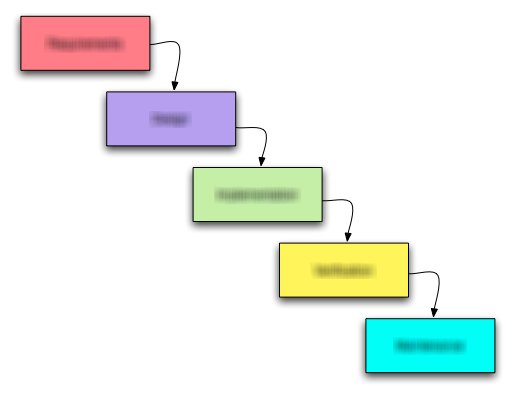
Waterfall_modelEvery professional software developer organizes his work in some separable work tasks. These tasks are called issues and often managed in an issue tracker like Bugzilla or JIRA. In bigger teams, there is a separate project role for assigning and supervising work on the issue level, namely the project manager. But below the level of a single issue, external interference would be micro-management, a state that every sane manager tries to avoid at all costs.

Underneath the radar

But what if a developer isn’t that proficient with self-management? He will struggle on a daily basis, but underneath the radar of good project management. And there is nearly no good literature that deals specifically with this short-range management habits. A good developer will naturally exhibit all traits of a good project manager and apply these traits to every aspect of his work. But to become a good developer, most people (myself included!) need to go through a phase of bad project management and learn from their mistakes (provided they are able to recognize and reflect on them).

An exhaustive framework for issue processing

This blog entry outlines a complete set of rules to handle an work task (issue) like a little project. The resulting process is meant for the novice developer who hasn’t established his successful work routine yet. It is exhaustive, in the sense that it will cover all the relevant aspects and in the sense that it contains too much management overhead to be efficient in the long run. It should serve as a starting point to adopt the habits. After a while, you will probably adjust and improve it on your own.

A set of core values

The Schneide standard issue process was designed to promote a set of core values that our developers should adhere to. The philosophy of the value set itself contains enough details to provide another blog entry, so here are the values in descending order without further discussion:

  • Reliability: Your commitments need to be trustworthy
  • Communication: You should notify openly of changes and problems
  • Efficiency: Your work needs to make progress after all

As self-evident as these three values seem to be, we often discuss problems that are directly linked to these values.

The standard issue process

The aforementioned rules consist of five steps in a process that need to be worked on in their given order. Lets have a look:

  1. Orientation
  2. Assessment
  3. Development
  4. Feedback
  5. Termination

Steps three and four (development and feedback) actually happen in a loop with fixed iteration time.

Step 1: Orientation phase

In this phase, you need to get accustomed to the issue at hand as quickly as possible. Read all information carefully and try to build a mental model of what’s asked of you. Try to answer the following questions:

  • Do I understand the requirements?
  • Does my mental model make sense? Can I explain why the requirements are necessary?
  • Are there aspects missing or not sufficiently specified?

The result of this phase should be the assignment of the issue to you. If you don’t feel up to the task or unfamiliar with the requirements (e.g. they don’t make sense in your eyes), don’t accept the issue. This is your first and last chance to bail out without breaking a commitment.

Step 2: Assessment phase

You have been assigned to work on the issue, so now you need a plan. Evaluate your mental model and research the existing code for provisions and obstacles. Try to answer the following questions:

  • Where are the risks?
  • How can I partition the work into intermediate steps?

The result of this phase should be a series of observable milestones and a personal estimate of work effort. If you can’t divide the issue and your estimate exceeds a few hours of work, you should ask for help. Communicate your milestones and estimates by writing them down in the issue tracker.

Step 3: Development phase

You have a series of milestones and their estimates. Now it’s time to dive into programming. This is the moment when most self-management effort ends, because the developer never “zooms out” again until he is done or hopelessly stuck. You need periodic breaks to assess your progress and reflect on your work so far. Try to work for an hour (set up an alarm!) and continue with the next step (you will come back here!). Try to answer the following questions:

  • What is the most risky milestone/detail?
  • How long will the milestone take?

The result of this phase should be a milestone list constantly reordered for risk. We suggest a “cover your ass” strategy for novices by tackling the riskiest aspects first. After each period of work (when your alarm clock sets off), you should make a commit to the repository and run all the tests.

Step 4: Feedback phase

After you’ve done an hour of work, it’s time to back off and reflect. You should evaluate the new information you’ve gathered. Try to answer the following questions:

  • Is my estimate still accurate?
  • Have I encountered unforeseen problems or game-changing information?
  • What crucial details were discovered just yet?

The result of this phase should be an interim report to your manager and to your future self. A comment in the issue tracker is sufficient if everything is still on track. Your manager wants to know about your problems. Call him directly and tell him honestly. The documentation for your future self should be in the issue tracker, the project wiki or the source code. Imagine you have to repeat the work in a year. Write down everything you would want written down.
If your issue isn’t done yet, return to step three and begin another development iteration.

Step 5: Termination phase

Congratulations! You’ve done it. Your work is finished and your estimation probably holds true (otherwise, you would have reported problems in the feedback phases). But you aren’t done yet! Take your time to produce proper closure. Try to answer the following questions:

  • Is the documentation complete and comprehensible?
  • Have you thought about all necessary integration work like update scripts or user manual changes?

The result of this phase should be a merge to the master branch in the repository and complete documentation. When you leave this step, there should be no necessity to ever return to the task. Assume that your changes are immediately published to production. We are talking “going gold” here.

Recapitulation

That’s the whole process. Five steps with typical questions and “artifacts”. It’s a lot of overhead for a change that takes just a few minutes, but can be a lifesaver for any task that exceeds an hour (the timebox of step three). The main differences to “direct action” processes are the assessment and feedback phases. Both are mainly about self-observation and introspection, the most important ingredient of efficient learning. You might not appreciate at first what these phases reveal about yourself, but try to see it this way: The revelations set a low bar that you won’t fall short of ever again – guaranteed.