Look into the past, become more agile: egoless programming

Agile software development methods like extreme programming and Scrum have been around for almost 20 years now. Many think of them as “the right way” or some kind of “holy grail”. So it is no wonder that many companies try to hop on the agile train to improve quality and efficiency of their software development.

Why is it that I hear of failures in adopting/switching to agile most of the time?

In my experience there are two main reasons why implementing agile methods does not work as expected:

  1. It is the management deciding to change the development process, not the developers. After a short while many aspects – especially using rigid methods like Scrum – do not seem to fit the organisation and therefore are changed. This leads to process implementations like ScrumBut
  2. Many developers do not have the mindset for the interactive, open and collaborative work style required by agile methods. Too often developers try to secure their job by isolating themselves and their solutions. Or they are doing stuff the way they are used to for many years not willing to learn, change and improve. Communication is hard, especially for programming nerds…

What can be done about it?

I would suggest trying to slowly change the culture in the company based on concepts from the 1970’s: egoless programming. In essence you have to let developers become more open and collaborative by internalising the Ten Commandments of Egoless Programming:

  1. Understand and accept that you will make mistakes.
  2. You are not your code.
  3. No matter how much “karate” you know, someone else will always know more.
  4. Don’t rewrite code without consultation.
  5. Treat people who know less than you with respect, deference, and patience.
  6. The only constant in the world is change.
  7. The only true authority stems from knowledge, not from position.
  8. Fight for what you believe, but gracefully accept defeat.
  9. Don’t be “the guy in the room.”
  10. Critique code instead of people—be kind to the coder, not to the code.

There is a PDF version of the commandments with some amplifying sentenctes from Builder.com published on techrepublic in 2002. If you manage to create a development culture based on these values you are more than half-way down the agile road and can try to implement one of the popular agile methods – or your own!

Three essential developer values

We reflected on the inner values of our team and came up with a short list that might sound trivial to you, but is honest in its motivation.

value-coinThere is the notion of “professional attitude” in software development. In the recent years, the agile movement, the craftsmanship philosophy, the pragmatic approach and the clean code developer initiative all tried (and certainly kind of accomplished) to install a set of values in developers. Most of these values are important and probably self-evident to those of us that can transcribe them into actual work decisions. It just feels right to do certain things or do something a certain way.

Local values

But what if you are challenged to articulate your own core values without using a common template like “the values of the clean code developer”? Let’s say that recurring conflicts force you to spell out the (in your view) most self-evident things to be able to describe the root of your unease. Every group of collaborators shares a set of “unspoken laws” and common beliefs that lay below the threshold of conscious application and are hard to describe to outsiders. We reflected on these core values in the last time and came up with a set of “local values” that are important to us. This blog post tries to explain them.

Probably trivialities

Before I list our three essential developer values, I want to damp your expectation about a great revelation and a whole new set of values that nobody’s ever thought about. All the value set templates listed above had and still have a great influence on us and are explored in our daily work. So you’ve probably already heard about every thought we could come up with. And our results are probably trivialities to most of you. That’s great! We didn’t set out to research something new, we tried to articulate our most mundane motivations and standards.

The three values

The following list is ordered. I start with the least of the three values and end with the most important one. That’s not to say that this list includes all values of ours, it just lists the three most important ones to adhere to the spirit of brevity (and relevance).

Efficiency

Yes, efficiency is the third most important skill to master when working with us. It’s a platitude in the sense that “you should be efficient” – of course you should. But we defined some aspects of efficiency that are vital to our work culture. Our developers need a heightened capability of self-inspection in regard of “being stuck”. You know that feeling when your work breaks apart into an overwhelming amount of tedious little steps? Or when you always feel like success is right around the corner, but always just out of reach? That’s just two of many aspects of getting stuck. We expect our developers to raise their hands and ask for help as soon as they sense the faintest amount of “stuckness” in their work. It takes a lot of self-confidence to admit that the task at hand is too much to handle alone, at least right now. We don’t count your report of being stuck as a personal failure, but a team-wide possibility to gain efficiency by reducing waste (wasted time in this case).
To avoid getting overwhelmed by a task in the first place, we expect our developers to assess their abilities and “readiness” towards a specific task and give an honest evaluation if they think to be “the right one for the task”. There again, pride and over-confidence can prove utterly destructive and diminish overall efficiency.

Communication

While communication itself is a tool, not a value, we rely on the proper application of this tool enough to value it our second most important trait to master. The most important question to ask is “has anybody done something similar yet?”. There is no point in re-inventing the wheel or re-learning the same lessons again and again. Don’t make assumptions – ask for specific details if necessary. Don’t be afraid to appear dumb – you’ll look even dumber if you didn’t ask and screw up. There are many aspects to communication that can go wrong.
In accordance with the efficiency value, we also expect you to be proactive to report problems or even uncertainty. Every failure contains a failure in communication. Even if you can just announce that everything goes smoothly up to this point, this is an information worth noting. After each waypoint or iteration in your current task, make a commit and leave a comment in your issue. Stay in touch with your team and don’t retreat into a “me against the world” kind of solitude. In short, we expect our developers to be open, honest and proactive in their communication.

Reliability

Our most important value is reliability in the sense of trustworthiness. We want and need to trust our developers, their estimations and commitments and the repeatability of their successes. There is no benefit in “faking it” or taking credit for something you achieved by pure luck. We try to have a working atmosphere were we can rely on another, trust another and also be open with our shortcomings. There is no need to pretend, for we will ultimately see through the ruse. We want our developers to contribute to the team, not to groom their ego. In a reliable work relation, you can trust the other to deliver what was mutually agreed upon or report problems at the first moment possible. And you can expect to be valued and commended for “just doing your job”. There is a lot of the craftsman ideology in this approach and it ultimately resolves to the commandments of egoless programming. The result is a fearless, positive environment for everybody to develop their unique abilities and strength. And don’t you worry about your weak points – the team got you covered.

Epilogue

I hope that my shortcomings with the english language didn’t stop you from grasping the core concepts of our local value set. We mostly apply it subconsciously and definitely aren’t perfect in any aspect. But just to articulate our deeper motives helped a lot to dissect certain conflicts and gain a broader understanding exactly why we do certain things. I don’t suggest you should adopt our values, that wouldn’t probably work out. But I encourage you and your team to invest some time to reflect on your local value set and try to find a mutually understood verbalization of them. If you can share your insights on this topic, please leave a comment! We would love to hear from you.

Our recruitment process

We are a small company that doesn’t hire often. But when we do, we try to make the process as effective and pleasant for everybody involved as possible. Here’s what we do.

huerdenlaufWe are a small company with a focus on delivering high quality software to our customers. Therefore every developer represents a substantial share of our organization. Every time we hire, we need to make sure that the decision in favor or against a new employee is profound. So we established a recruitment process that tries to evaluate and communicate both our requirements and the possibilities of the candidate. Without going into details, this is how we will interact with you if you apply for a job.

First contact

The first contact is usually an application including a curriculum vitae sent to us by the candidate. We will read your application and look for possible matches with our required skill set. If there is a chance to work together in the future, we will answer back with an invitation for a first talk, usually done via telephone.

The first talk is mostly a getting to know each other on a communicative level. We might ask some questions about your curriculum or past jobs, but the main purpose is to establish a mutual understanding. We probably end the talk with an appointment for a first meeting.

First meeting

We really want to know who you are, not only what you can offer on a professional level. Remember that you will represent our company substantially if we hire you. Both sides need to be sure that they understand what they commit to. Because it always is a real commitment and a substantial investment for us to hire a new developer.

The first meeting will be rather short and kept on a casual level. We don’t want to build up pressure, we don’t want to judge your abilities as a developer, we want to get a first impression of you in person. And you will get a full tour of our company and get to know the whole development team, also as a first impression. If you like what you see, we will make an appointment for a second meeting that will go into the details.

Detailed meeting

The second meeting will be much longer and more stressful than the first meeting. The goal of this meeting is the examination of your professional skills. Most companies use trick questions or “how to approach this?” tasks to challenge your abilities to solve difficult problems and deduce your skills from that. We decided not to do that.

We want to see your performance in a normal work situation – as normal as it can be under the circumstances. So you will have to program a non-trivial assignment, with the help of the whole team. The assignment doesn’t contain any “tricks” or common pitfalls that you can fall into and a lot of different solutions are possible without us wanting to see exactly one (the “best”). If you are an experienced developer, you will feel at ease with the task.

Another important skill of every developer is the quick assessment of existing code in regard to bugs, security risks and bad practices. We have prepared a piece of code riddled with all kinds of quirks and will review it with you. None of us finds them all, too.

We orient our work around a set of core values that are very congruent with the values of the Clean Code Developer Initiative. So it helps tremendously if you are firm with the practices of a clean code developer. But we also want to know if you can convey the ideas and principles behind the actual practices, so you will have to explain some of them to us.

These are the three parts that we want to see of your professional skills:

  • Programming
  • Analysis
  • Introspection

After this meeting, we will have a fairly detailed picture of your abilities and you will know a lot about the level of skill that we require for daily work. If we come to the conclusion that everything matches, we will invite you to the last official step of our recruitment process, the recruitment internship or probationary work.

Internship

In the previous steps of our recruitment process, it was mostly us that examined your skills. Now, after we are sure that you might complete us, it’s time that you get a chance to examine us. So we invite you to accompany us for several days in our normal work. You can team up with whoever you want and join in his (or her) development task. You can ask questions. You can just watch. You can complete your picture of us. You can make sure that you will feel comfortable when joining us.

Welcome aboard

If you’ve seen nothing that scares you during your internship, we will discuss the details of your employment, but that’s a topic for another blog post.

Inspirational source

We don’t hire very often and couldn’t sustain the process for a large number of applicants because the effort required from everyone involved is substantial. But we wanted to make sure that we don’t hire blind and don’t torture our applicants. We compiled our process from a lot of sources, mostly blog posts around the internet and one noteworthy book by Johanna Rothman: “Hiring The Best Knowledge Workers, Techies & Nerds”. That’s exactly what we set out to do!

Prioritizing: order of tasks

This is an entry that extends the post on microprojects by two additional prioritizing strategies.

Strategy: Cover your ass

This is the strategy suggested by the previous post. After preparing a list of milestones and their estimates, you pick the next most problematic milestone and work on it. A list of tasks ordered by this strategy helps you to “fail fast”: in less than half of estimated time you will know, whether you will succeed or bust the budget – even when little is known about the concrete implementation or the esimates are off by some amount.

Strategy: Most value first

In lot of projects, this is the strategy used by customers. All features not absolutely necessary to achieve the goal are cut or declared optional. If you look at minesweeper: you can play it without the highscore, the timer, the modifiable field side or even probably without the random component (i.e. make 99 fields), but not without the mines. After you determined that your budget is too small, you know what the customer can live without and if you have the option to cut features, then this is probably the strategy for you.

Strategy: Most painful, when omitted

This is the strategy best applied before the pain is real. In contrast to other two strategies, it does contain hard to quantify criteria like:

  • Quality
  • Security
  • Performance

The cost to implement them is non-linear and not directly visible. The temptation is big to use time and money to create more profitable features instead. They can be prioritized by:

  • probability of occurence
  • damage in the case of occurence
  • implementation cost
  • growth of the above factors with time

This is a lot of work for a single task – most likely you will setup project wide guidelines and default scenarios that will be reviewed by recurring audits.

Got issues? Treat them like micro-projects

Issues should be the smallest work unit available. But what if it is still larger than you can manage? Here’s a standard process for self-management while working on an issue.

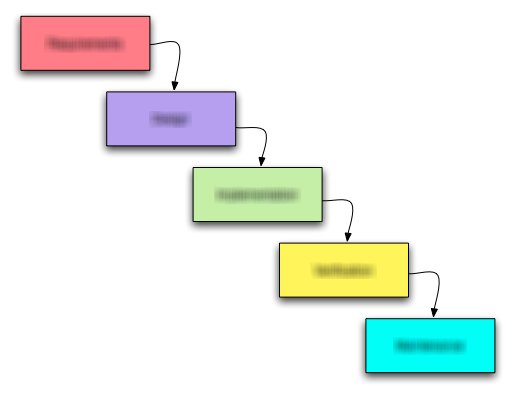
Waterfall_modelEvery professional software developer organizes his work in some separable work tasks. These tasks are called issues and often managed in an issue tracker like Bugzilla or JIRA. In bigger teams, there is a separate project role for assigning and supervising work on the issue level, namely the project manager. But below the level of a single issue, external interference would be micro-management, a state that every sane manager tries to avoid at all costs.

Underneath the radar

But what if a developer isn’t that proficient with self-management? He will struggle on a daily basis, but underneath the radar of good project management. And there is nearly no good literature that deals specifically with this short-range management habits. A good developer will naturally exhibit all traits of a good project manager and apply these traits to every aspect of his work. But to become a good developer, most people (myself included!) need to go through a phase of bad project management and learn from their mistakes (provided they are able to recognize and reflect on them).

An exhaustive framework for issue processing

This blog entry outlines a complete set of rules to handle an work task (issue) like a little project. The resulting process is meant for the novice developer who hasn’t established his successful work routine yet. It is exhaustive, in the sense that it will cover all the relevant aspects and in the sense that it contains too much management overhead to be efficient in the long run. It should serve as a starting point to adopt the habits. After a while, you will probably adjust and improve it on your own.

A set of core values

The Schneide standard issue process was designed to promote a set of core values that our developers should adhere to. The philosophy of the value set itself contains enough details to provide another blog entry, so here are the values in descending order without further discussion:

  • Reliability: Your commitments need to be trustworthy
  • Communication: You should notify openly of changes and problems
  • Efficiency: Your work needs to make progress after all

As self-evident as these three values seem to be, we often discuss problems that are directly linked to these values.

The standard issue process

The aforementioned rules consist of five steps in a process that need to be worked on in their given order. Lets have a look:

  1. Orientation
  2. Assessment
  3. Development
  4. Feedback
  5. Termination

Steps three and four (development and feedback) actually happen in a loop with fixed iteration time.

Step 1: Orientation phase

In this phase, you need to get accustomed to the issue at hand as quickly as possible. Read all information carefully and try to build a mental model of what’s asked of you. Try to answer the following questions:

  • Do I understand the requirements?
  • Does my mental model make sense? Can I explain why the requirements are necessary?
  • Are there aspects missing or not sufficiently specified?

The result of this phase should be the assignment of the issue to you. If you don’t feel up to the task or unfamiliar with the requirements (e.g. they don’t make sense in your eyes), don’t accept the issue. This is your first and last chance to bail out without breaking a commitment.

Step 2: Assessment phase

You have been assigned to work on the issue, so now you need a plan. Evaluate your mental model and research the existing code for provisions and obstacles. Try to answer the following questions:

  • Where are the risks?
  • How can I partition the work into intermediate steps?

The result of this phase should be a series of observable milestones and a personal estimate of work effort. If you can’t divide the issue and your estimate exceeds a few hours of work, you should ask for help. Communicate your milestones and estimates by writing them down in the issue tracker.

Step 3: Development phase

You have a series of milestones and their estimates. Now it’s time to dive into programming. This is the moment when most self-management effort ends, because the developer never “zooms out” again until he is done or hopelessly stuck. You need periodic breaks to assess your progress and reflect on your work so far. Try to work for an hour (set up an alarm!) and continue with the next step (you will come back here!). Try to answer the following questions:

  • What is the most risky milestone/detail?
  • How long will the milestone take?

The result of this phase should be a milestone list constantly reordered for risk. We suggest a “cover your ass” strategy for novices by tackling the riskiest aspects first. After each period of work (when your alarm clock sets off), you should make a commit to the repository and run all the tests.

Step 4: Feedback phase

After you’ve done an hour of work, it’s time to back off and reflect. You should evaluate the new information you’ve gathered. Try to answer the following questions:

  • Is my estimate still accurate?
  • Have I encountered unforeseen problems or game-changing information?
  • What crucial details were discovered just yet?

The result of this phase should be an interim report to your manager and to your future self. A comment in the issue tracker is sufficient if everything is still on track. Your manager wants to know about your problems. Call him directly and tell him honestly. The documentation for your future self should be in the issue tracker, the project wiki or the source code. Imagine you have to repeat the work in a year. Write down everything you would want written down.
If your issue isn’t done yet, return to step three and begin another development iteration.

Step 5: Termination phase

Congratulations! You’ve done it. Your work is finished and your estimation probably holds true (otherwise, you would have reported problems in the feedback phases). But you aren’t done yet! Take your time to produce proper closure. Try to answer the following questions:

  • Is the documentation complete and comprehensible?
  • Have you thought about all necessary integration work like update scripts or user manual changes?

The result of this phase should be a merge to the master branch in the repository and complete documentation. When you leave this step, there should be no necessity to ever return to the task. Assume that your changes are immediately published to production. We are talking “going gold” here.

Recapitulation

That’s the whole process. Five steps with typical questions and “artifacts”. It’s a lot of overhead for a change that takes just a few minutes, but can be a lifesaver for any task that exceeds an hour (the timebox of step three). The main differences to “direct action” processes are the assessment and feedback phases. Both are mainly about self-observation and introspection, the most important ingredient of efficient learning. You might not appreciate at first what these phases reveal about yourself, but try to see it this way: The revelations set a low bar that you won’t fall short of ever again – guaranteed.

An experiment on recruitment seriousness

I had the chance to witness an experiment about the seriousness of companies to attract new developers. The outcome was surprisingly accurate.

Most software development companies in our area are desperately searching for additional software developers to employ. The pressure rose until two remarkable recruiting tools were installed. At first, every tram car in town was plastered with advertisement shouting “we search developers” as the only message. These advertisement have a embarrassing low average appeal to the target audience, so the second tool was a considerable bonus for every developer that was recruited by recommendation. This was soon called the “headhunter’s reward” and laughed upon.

Testing the prospects

The sad thing isn’t the current desperation in the local recruitment efforts, it’s the actual implementation of the whole process. Let’s imagine for a moment that a capable software developer from another town arrives at our train station, enters a tram and takes the advertisement serious. He discovers that the company in question is nearby and decides to pay them a visit – right now, right here. What do you think will happen?

I had the fortune to talk to a developer who essentially played the scenario outlined above through with five local software development companies that are actively recruiting and advertising. His experiences differed greatly, but gave a strangely accurate hint of the potential future employer’s actual company culture. And because the companies’ reactions were utmost archetypical, its a great story to learn from.

Meeting the company

The setting for each company was the same: The developer chose an arbitrary date and appeared at the reception – without an appointment, without previous contact, without any documents. He expressed interest in the company and generally in any open developer position they had open. He also was open to spontaneous talks or even a formal job interview, though he didn’t bring along a resume. It was the perfect simulation of somebody who got instantaneously convinced by the tram advertisement and rushed to meet the company of his dreams.

The reactions

Before we take a look at the individual reactions, lets agree to some acceptable level of action from the company’s side. The recruitment process of a company isn’t a single-person task. The “headhunter’s reward” tries to communicate this fact through monetary means. Ideally, the whole company staff engages in many little actions that add up to a consistent whole, telling everybody who gets in contact with any part of the company how awesome it is to work there. While this would be recruitment in perfection, it’s really the little actions that count: Taking a potentially valuable new employee serious, expressing interest and care. It might begin with offering a cool beverage on a exceptionally hot day or giving out the company’s image brochure. If you can agree to the value of these little actions, you will understand my evaluation scheme of the actual reactions.

The accessible boss

One company won the “contest” with great distance to all other participants. After the developer arrived at the reception, he was relayed to the local boss who really had a tight schedule, but offered a coffee talk for ten minutes after some quick calls to shift appointments. Both the developer and the company’s boss exchanged basic informations and expectations in a casual manner. The developer was provided with a great variety of company print material, like the obligatory image brochure, the latest monthly company magazine and a printout of current open job offerings. The whole visit was over in half an hour, but gave a lasting impression of the company. The most notable message was: “we really value you – you are boss level important”. And just to put things into perspective: this wasn’t the biggest company on the list!

The accessible office

Another great reaction was the receptionist who couldn’t reach anybody in charge (it was generally not the most ideal timing) and decided to improvise. She “just” worked in the accounting department, but tried her best to present the software development department and explain basic cool facts about the company. The visit included a tour through the office space and ended with providing generic information material about the company. The most notable message was: “We like to work here – have a look”.

The helpless reception

Two companies basically reacted the same way: The receptionist couldn’t reach anybody in charge, decided to express helplessness and hope for sympathy. Compared to the reactions above, this is is a rather poor and generic approach to the recruitment effort. In one case, the receptionist even forgot basic etiquette and didn’t offer the obligatory coffee or image brochure. The most notable message was: “We only work here – and if you join, you will, too”. To put things into perspective: one of them was the biggest company on the list, probably with rigid processes, highly partitioned responsibilities and strict security rules.

The rude reception

The worst first impression made the company with the reception acting like a defense position. Upon entering, the developer was greeted coldly by the two receptionists. When he explained the motivation of his visit, the first receptionist immediately zoned out while the second one answered: “We have an e-mail address for applications, please use it” and lost all interest in the guest. The most notable message was: “Go away – why do you bother us?”.

What can be learnt?

The whole experiment can be seen from two sides. If you are a developer looking for a new position in a similar job market situation, you’ll gain valuable insights about your future employer by just dropping by and assessing the reactions. If you are a software development company desperately looking out for developers, you should regard your recruitment efforts as a whole-company project. Good recruitment is done by everybody in your company, one thing at a time. Recruitment is a boss task, but to be handled positively, it has to be accompanied by virtually everybody from the whole staff. And a company full of happy developers will attract more happy developers just by convincing recruitment work done by them in the spare time, most of the time without being explicitly aware of it.

A minimal set of skills for software development contractors

You aren’t sure if your developer is professional enough? Here are seven topics you can ask him about to find it out. It’s the minimal skill set a modern developer should use.

“Our company is specialized in providing professional software development for our customers”. That’s a nice statement to inspire your customers with. The only problem with it is: every contractor claims to be professional. You wouldn’t even get a project if you admitted to be “unprofessional”. But how can a customer, mostly unaware of the subtleties in the field of software development, decide if his contractor really works professionally? A lot of money currently spent on projects doomed from the beginning could be saved if the answer was that easy. But there’s a lower limit of skills that have to be present to pass the most minimal litmus test on developer professionality. This blog article gives you an overview about the things you should ask from your next software development contractor.

First a disclaimer: I’ve compiled this list of skills with the best intentions. It is definitely possible to develop software without some or even any of these skills. The development can even be performed in a very professional manner. So the absence of a skill doesn’t reveal an unprofessional contractor without fail. And on the other side, the clear presence of all skills doesn’t lead to glorious projects. The list is a rule of thumb to distinguish the “better” contractor from the “worse”. It’s a starting ground for the inexperienced customer to ask the right questions and get hopefully insightful answers.

Let’s assume you are a customer on the lookout for a suitable software development contractor, maybe a freelancer or a company. You might take this list and just ask your potential developer about every item on it. Listen to their answers and let them show you their implementation of the skill. In my opinion, the last point is the most crucial one: Don’t just talk about it, let them demonstrate their abilities. You won’t be able to differentiate the best from the most trivial implementation at first, but that’s part of the learning process. The thing is: if the developer can readily demonstrate something, chances are he really knows what he is talking about.

The minimal skills

The list is sorted by their direct impact on the overall development quality. This includes the quality perceived by you (the customer), the end user and the next developer who inherits the source code once the original developer bails out. This doesn’t mean that the topics mentioned later are “optional” in the long run.

Source code management system

This tool has many different names: source code management (SCM), revision control system (RCS) and version control system (VCS) are just a few of them. It is used to track the changes in the code over time. With this tool, the developer is able to tell you exactly which change happened when, for what version and by whom. It is even possible to undo the change later on. If your developer mentions specific tool names like Git, Subversion, Perforce or Mercurial, you are mostly settled here. Let him show you a typical sync-edit-commit cycle and try to comprehend what he’s telling you. Most developers love to brag about their sophisticated use of version control abilities.

Issue tracking

An issue or bug tracker is a tool that stores all inquiries, bug reports, wishes and complaints you make. You can compare it to a helpdesk “trouble ticket” system. The issue tracker provides a todo list for the developer and acts as an impartial documentation of your communication with the developer. If you can’t get direct access to the issue tracker on their website, let them demonstrate the usage by playing through a typical scenario like a bug report. At least, the developer should provide you with a list of “resolved” issues for each new version of your software.

Continuous integration

This is a relatively new type of tool, but a very powerful one. It can also be named a “build server” or (less powerful) a “nightly build”. The baseline is that your project will be built by an automated process, as often as possible. In the case of continuous integration, the build happens after each commit to the source code management system (refer to the first entry of this list). Let your developer show you what happens automatically after a commit to the source code management system. Ask him about the “build time” of your project (or other projects). This is the time needed to produce a new version you can try out. If the build time is reasonably low (like a few minutes), ask for a small change to your project and wait for the resulting software.

There is a fair chance that your developer not only talks about “continuous integration”, but also “continuous delivery”. This includes words like “staging”, “build queue”, “test installation”, etc. Great! Let them explain and demonstrate their implementation of “continuous delivery”. You’ll probably be impressed and the developer had another chance to brag.

Verification (a.k.a. Testing)

This is a delicate question: “Will the source code contain automated tests?”. Our industry’s expectancy value for any kind of automated tests in a project is still dangerously near absolute zero. If you get blank stares on that question, that’s not a good sign. It doesn’t really matter too much if the answer contains the words “unit test”, “integration test” or even “acceptance test”. Most important again: Let your developer show you their implementation of automated tests in your (or a similar) project. Make sure the continuous integration server (refer to entry number three) is aware of the tests and runs them on every build. This way, everything that’s secured by tests cannot break without being noticed immediately. You probably won’t have to deal with reappearing bugs in every other version, a symptom known as “regression”.

Your developer might be really enthusiastic about testing. While every developer hour costs your precious money, this is money well spent. Think of it as an insurance against unpredictable behaviour of your software in the future. Over the course of development, you won’t notice these tests directly, as they are used internally for development. Talk to your developer about some form of reporting on the tests. Perhaps a “test coverage” report that accompanies the issue list (refer to the second entry)? Just don’t go overboard here. A low test coverage percentage is still better than no tests.

If your developer states that he is “test driven”, that’s not a psychological condition, but a modern attempt to test really thoroughly. Let him demonstrate you the advantages of this approach by playing through an implementation cycle of a small change to your project. It may foster your confidence in the insurance’s power.

Project documentation

Every software project above the trivial level contains so many details that no human brain is able to remember them all after some time. Your developer needs some place to store vital information about the project other than “in the code” and “in the issue tracker”. A popular choice to implement this requirement is providing a Wiki. You probably already know a Wiki from Wikipedia. Think about a web-based text editing tool with structuring possibilities. If you can’t access the documentation tool yourself, let your developer demonstrate it. Ask about an excerpt of your project documentation, perhaps as a PDF or HTML document. Don’t be too picky about the aesthetics, the main use case is quick and easy information retrieval. Even handwritten project documentation may pass your test, as long as it is stored in one central place.

Source code conventions

Nearly all source code is readable by a machine. But some source code is totally illegible by fellow developers or even the original author. Ask your developer about their code formatting rules. Hopefully, he can provide you with some written rules that are really applied to the code. For most programming languages, there are tools that can check the formatting against certain rules. These programs are called “code inspection tools” and fit like hand in glove with the continuous integration server (refer to the third entry). Some aspects of source code readability cannot be checked by algorithms, like naming or clarity of concepts. Good developers perform regular code reviews where fellow developers discuss the code critically and suggest improvements. The best customers explicitely ask for code reviews, even if they won’t participate in them. You will feel the difference in the produced software on the long run.

Community awareness

Software development is a rapidly advancing profession, with game-changing discoveries every other year. One single developer cannot track all the new tools, concepts and possibilities in his field. He has to rely on a community of like-minded and well-meaning experts that share their knowledge. Ask your developer about his community. What (technical) books did he read recently? What books are known by the whole development team? As a customer, you probably can’t tell right away if the books are worth their paper, but that’s not the main point of the question. Just like with tests, the amount of books read by the average programmer won’t make a very long list. If your development team is consistent enough to share a common literature ground, that’s already worth a lot.

But it’s not just books. Even books are too slow for the advancement! Ask about participation in local technical events, like user groups of the programming language of your project. What about sharing? Does the developer share his experiences and insights? The cheapest way to do that is a weblog (you’re reading one right now). Let him show you his blog. How many articles are published in a reasonable timespan, what’s the feedback? Perhaps he writes articles for a technical magazine or even a book? Now you can ask other developers for their opinion on the published work. You’ve probably found a really professional developer, congratulations.

There is more, much more

This list is in no way exhaustive in regard to what a capable developer uses in concepts, skills and tools. This is meant as the minimal set, with a lot of room for improvement. There are compilations of skills like the Clean Code Developer that go way beyond this list. Ask your developer about his personal field of interest. Hopefully, after he finished bragging and techno-babbling for some time, you’re convinced that your developer is a professional one. You shouldn’t settle for less.


Depth-first programmers

Depth-first programmers are always busy creating horribly complicated solutions that are somehow off the mark. Here’s why and what to do against it.

Just as there are at least two fundamentally different approaches for searching, namely depth-first and breadth-first search, there are also different types of programmers. The depth-first programmer is a dangerous type, as he is prone to yak shaving and reinvention of the wheel.

The depth-first programmer

Let me try to define the term of a “depth-first programmer” by a little (true) story. A novice java programmer should make some changes to an existing code. To secure his work, he should and wanted to write unit tests in JUnit. He started the work and soon enough, first results could be seen. But when he started to write his tests, the progress notifications stopped. The programmer worked frantically for hours and then days to write what appeared to be some simple data-driven tests.

Finally, the novice java programmer reported success and showed his results. He wrote his tests and “had to extend JUnit a bit to do it right”. Wait, what? Well, in JUnit, the test methods cannot have parameters, but the programmer’s tests needed to be parametrized. So he replaced the part of JUnit that calls the test methods by reflection with an “improved” algorithm that could also inject parameters. His implementation relied on obscure data structures that provided the actual parameter values and only really worked for his needs. The whole mess was nearly intangible, a big bloat and needed most of the development time for the unit tests.

And it was totally unnecessary once you learn about “Parameterized” JUnit4 tests or build light-weight data drivers instead of changing the signature of the test method itself. But this programmer dove deep into JUnit to adjust the framework itself to his needs. When asked about it, he stated that “he needed to pass the parameters somehow”. That’s right, but he choose the most expensive way to do so.

He exhibited the general behaviour of a depth-first programmer: whenever you face a problem, take the first possible solution to a problem you can come up with and work on it without evaluation against other possibilities. And continue on the path without looking back, no matter how long it takes.

Stuck in activism

The problem with this approach should be common sense. The obvious option isn’t always the best or even a good one. You have to evaluate the different possible solutions by their advantages and drawbacks. A less obvious solution might be far better in every aspect but obviousness. Another problem with this approach is the absence of internal warning signs.

Getting stuck is an internal warning sign every programmer understands. You’ve worked your way in a certain direction and suddenly, you cannot advance further. Something blocks your anticipated way of solving the problem and you cannot think of an acceptable way past it. A depth-first programmer never gets stuck this way. No matter how expensive, he will pursue the first thing that brings him closer to the target. A depth-first programmer always churns out code at full speed. Most of it isn’t needed on second thought and can be plain harmful when left in the project. The depth-first programmer will always report progress even when he needs days for a task of minutes. He is stuck in activism.

Progress without guidance

This isn’t a rant about incompetent programmers. Every good programmer knows the situation when you suddenly realize that you’re shaving a yak when all you wanted to do is to add a feature to the code base. This is your self-guidance system regaining consciousness after a period of auto-piloting in depth-first mode. Every programmer behaves depth-first sometimes.

This can be explained with the Dreyfus Model of Skill Acquisition. On the first stage, called “Beginner”, you are simply not capable of proper self-evaluation. You cannot distinguish between good and not so good approaches beforehands or even afterwards. Your expertise in the narrow field of the problem at hand isn’t broad enough to recognize an error even when you are working on the error yourself for prolonged times.

In the Dreyfus Model, a beginner needs external guidance. Somebody with more experience has to point out errors for you and formulate alternatives as clearly and specific as possible. Without external guidance, a beginner will become a depth-first programmer. We’ve all been there.

 Be a guide

The real failure in the story above was done by me. Instead of interacting with the novice java programmer after a few hours when I thought he should be done by now, I let him “advance”. I could have avoided the resulting mess by providing guidance and a few alternate solutions for the immediate problem. I would give an overview of the problem’s context and some hints about the general direction this task should be solved.

Every depth-first programmer works in a suboptimal environment. The programmer tries his best, it’s really the environment that could do better.

So, the next time you see somebody working frantically on a problem that should be rather easy to solve, lend him a hand. Be gentle and empathic about his attempt and work with proposals, not with instructions. Perhaps you’ve spared yourself a mess like an unnecessarily extended JUnit library and the depth-first programmer the frustration when his hard work of several days is silently discarded.

Get the basics right

Nowadays with all the fancy stuff around, with features over features, bells and whistles it is even more important to get the basics right.

Nowadays with all the fancy stuff around, with features over features, bells and whistles it is even more important to get the basics right. But what are the basics?
If you apply for a job the first basic would be to read the job posting carefully. Many corporations require you to use a special keyword or cite the reference in a certain way. This is an easy way to avoid that the email ends up in the spam folder and it shows that you can also see who really read the job posting. But many get this wrong. Why? For me that’s one of the basics. Another basic breaker is many or highly visible typos. Once in a while we get some unusual and fancy looking applications with typos in the job title or in headlines. Hmmm.. why bother with time-consuming layouts and colors and have typos all over the place?
This trend can be seen in many places. We have a new and modern door opener. The buttons are in white and pastel colors. Which ruins the contrast. When the light is dim, I cannot make out a difference between the one for opening the door and switching on the light in the hallway. Looking fancy but useless.
The IT business is also good in breaking the basics. In the last weeks some of the major IDEs or frameworks brought out versions which had regression in one of the most basic places: version control. Why didn’t they catch it before release?
Why are features nowadays more important than the basics?

Give open source some love back!

Like many others our work is enabled by open source software. We make a heavy use of the several great open source projects out there. Since they help us doing our business and doing it in a productive way, we want to give some love aehmm work back. So we decided to dedicate one day per month to open source contributions. These can be bug fixes, new features, even documentation or bug reports. I believe that every contribution helps an open source project and many projects need help.
The whole development team will work on projects they like. One day per month does not sound much but I think even starting small helps. And maybe you can suggest a similar day in your company, too ?
Besides the obvious boost in developer motivation (and therefore productivity) there are several things your company will benefit from:

  • help in your own projects: fixing bugs in the open source projects you use is like fixing bugs in your own project
  • image for your company: being active in open source gives a better image regarding potential future employees and also shows responsibility in the field they work in
  • PR for your company and an edge over your competition: writing about your contributions and your insights in your company blog, remember: out teach your competition

So get your company to spend just one day per month or so for open source. It may not be much but every little bit helps!