The perils of \u0027

Adventures (read: pitfalls) of internationalization with Struts2, concerning the principle “stacked smartness doesn’t add up”.

u0027Struts2 is a framework for web application development in Java. It’s considered mature and feature-rich and inherits the internationalization (i18n) capabilities of the Java platform. This is what you would expect. In fact, the i18n features of Struts2 are more powerful than the platform ones, but the power comes with a price.

Examples of the sunshine path

If you read a book like “Struts 2 in Action” written by Donald Brown and others, you’ll come across a chapter named “Understanding internationalization” (it’s chapter 11). You’ll get a great overview with a real-world example of what is possible (placeholder expansion, for example) and if you read a bit further, there is a word of warning:

“You might also want to further investigate the MessageFormat class of the Java platform. We saw its fundamentals in this chapter when we learned of the native Java support for parameterization of message texts and the autoformatting of date and numbers. As we indicated earlier, the MessageFormat class is much richer than we’ve had the time to demonstrate. We recommend consulting the Java documentation if you have further formatting needs as well. “

If you postpone this warning, you’re doomed. It’s not the fault of the book that their examples are the sunshine case (the best circumstances that might happen). The book tries to teach you the basics of Struts2, not its pitfalls.

A pitfall of Struts2 I18N

You will write a web application in Struts2, using the powerful built-in i18n, just to discover that some entries aren’t printed right. Let’s have an example i18n entry:

impossible.action.message=You can't do this

If you include this entry in a webpage using Struts2 i18n tags, you’ll find the apostrophe (unicode character \u0027) missing:

You cant do this

What happened? You didn’t read all about MessageFormat. The apostrophe is a special character for the MessageFormat parser, indicating regions of non-interpreted text (Quoted Strings). As there is only one apostrophe in our example, it just gets omitted and ignored. If there were two of them, both would be omitted and all expansion effort between them would be ceased.

How to overcome the pitfall

You’ll need to escape the apostrophe to have it show up. Here’s the paragraph of the MessageFormat APIDoc:

Within a String, "''" represents a single quote. A QuotedString can contain arbitrary characters except single quotes; the surrounding single quotes are removed. An UnquotedString can contain arbitrary characters except single quotes and left curly brackets. Thus, a string that should result in the formatted message “‘{0}'” can be written as "'''{'0}''" or "'''{0}'''".

That’s bad news. You have to tell your translators to double-type their apostrophes, else they won’t show up. But only the ones represented by \u0027, not the specialized ones of the higher unicode regions like “grave accent”  or “acute accent”. If you already have a large amount of translations, you need to check every apostrophe if it was meant to be printed or to control the MessageFormat parser.

The underlying principle

This unexpected behaviour of an otherwise powerful functionality is a common sign of a principle I call “stacked smartness doesn’t add up”. I will blog about the principle in the near future, so here’s just a short description: A powerful (smart) behaviour makes sense in the original use case, but when (re-)used in another layer of functionality, it becomes a burden, because strange side-effects need to be taken care of.

How to find the HTML Entity you look for

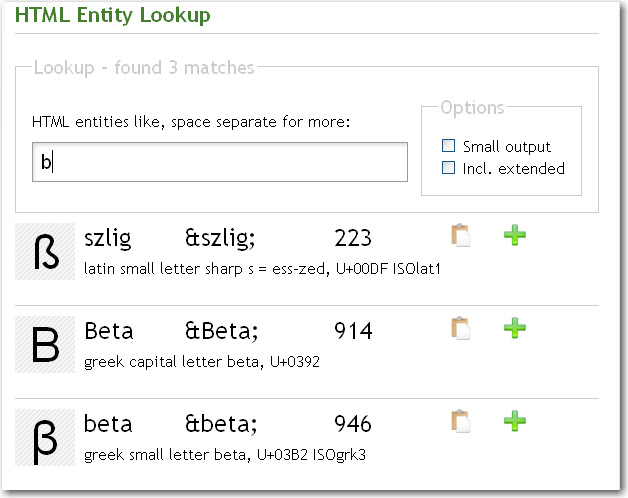
As a webdeveloper have you ever wondered how a special character has to be encoded as a html entity? There is a nice little tool available online that will answer your call for help.EntityLook for 'b' What makes the tool really rock is the simplicity and great incremental search. Typing in the letter ‘c’ will present you entities for “cent”, “copyright”, the greek “sigma” and mathematical entities like “superset” because the basic shape of the resulting special character is also considered. Upon entering a ‘b’ you will get the german ß as one of the results.This kind of search is almost a “do what I mean” feature and very helpful if you do not know exact substrings or meaning of your special character.

There is a Firefox-Extension and as a special goodie for our beloved Mac-users there is even a dashboard widget available that works without internet connection and is a bit more convenient to use than the web application.

Paging with different DBs

Sometimes you cannot or do not want to use an object-relational mapping tool. When not using an OR-mapper like Hibernate or Oracle Toplink you have to deal with database specifics. One common case especially for web applications is limiting the result set to a number of items that fit nicely on a web. You then often want to allow the users to navigate between these “pages” of items aka “paging”.

This type of functionality became part of SQL only as of SQL2008 in the following form:
SELECT * FROM t WHERE ... ORDER BY c OFFSET start_row FETCH count ONLY

Since most popular database management systems (DBMSes) do not yet implement this syntax you have to implement paging in propriatory ways.

My experience with an Oracle DBMS and the frustrating and comparatively long time it took to find the correct™ solution inspired me to write this post. Now I want to present you the syntax for some widely used DBMSes which we encounter frequently in our projects.

  • MySQL, H2 and PostgreSQL (< 8.4 which will also implement the SQL2008 standard) use the same syntax:
    SELECT * FROM t WHERE ... ORDER BY c LIMIT count OFFSET start
  • Oracle is where the fun begins. There is actually no easy and correct way of doing this. So you will end up with a mess like:
    SELECT col1 FROM (SELECT col1, ROWNUM r FROM (SELECT col1 FROM table ORDER BY col1)) WHERE r BETWEEN start AND end
  • DB2 AFAIK uses the syntax proposed in SQL2008 but correct me if I am wrong because we do not yet work with DB2 databases.
  • As we did not need paging with MS SQLServer as of now I did not bother to look for a solution yet. Hints are very welcome.

With all solutions the ORDER BY clause is critical because SQL does not guarantee the order of the returned rows.

Wikipedia delivers some additional and special case information but does not really explain the general, real world case the specific DBMSes.

I hope that I raised some awareness about database specifics and perhaps saved you some time trying to find a solution the problem using your favorite DBMS.

A DSL for deploying grails apps

Everytime I deploy my grails app I do the same steps over and over again:

  • get the latest build from our Hudson CI
  • extract the war file from the CI archive
  • scp the war to a gateway server
  • scp the war to the target server
  • run stop.sh to shutdown the jetty
  • run update.sh to update the web app in the jetty webapps dir
  • run start.sh to start the jetty

Reading the Productive Programmer I thought: “This should be automated”. Looking at the Rails world I found a tool named Capistrano which looked like a script library for deploying Rails apps. Using builders in groovy and JSch for SSH/scp I wrote a small script to do the tedious work using a self defined DSL for deploying grails apps:

Grapes grapes = new Grapes()
def script = grapes.script {
    set gateway: "gateway-server"
    set username: "schneide"
    set password: "************"
    set project: "my_ci_project"
    set ciType: "hudson"
    set target: "deploy_target.com"
    set ci_server: "hudson-schneide"
    set files: ["webapp.war"]

    task("deploy") {
        grab from: "ci"
        scp to: "target"
        ssh "stop.sh"
        ssh "update.sh"
        ssh "start.sh"
    }
}

script.tasks.deploy.execute()

This is far from being finished but a starting point and I think about open sourcing it. What do you think: may it help you? What are your experiences with deploying grails apps?