
At the end of 2018, I searched for new software development books to read and came across a list that spiked my interest. My impulse was to buy and read all five books. I’ve bought them all, but only read four of them yet. You can read another book review from this list in a previous blog post.
 The book I was most sceptical about came with a black cover and the menacing title “Developer Hegemony” by Erik Dietrich. It’s not a book about software development, it is a book about the industry of software development and why it is fundamentally different than “traditional” industries. And it is a book that promises an outlook on “the future of labor”, at least for us developers. Spoiler: It’s not about taking over the world, as the cover image suggests. It’s about finding your way in an industry that is in very high demand and mostly consists of players that play by the rules of an entirely different game: industrial manufacturing.
Let’s have a short overview about the content: My impression of the book was that it consists of three parts, even if there are five distinct parts in the table of contents:
- The first part takes a good hard look on the current situation and identifies the losers and “winners” of the game. It introduces a taxonomy of industry employees that all give up on something in exchange for some personal gain. What that something is depends on the worker type. This is like the setting up on a chess board. You get to know the pieces and their characteristics and realize that they are mostly pawn cannon fodder.
- The second part puts the taxonomy in action and describes the carnage unfolding on the chess board. The grim message is that the only winning move is to own the board itself and make up the rules, but never participate in the game. And if you find yourself on the board, keep moving sideways like the bishop and change your color often. Don’t associate with any team and don’t engage in any stalemate situations. The author describes the “delivery game” very illustrative: If you are responsible of delivering something, you might succeed, but you can also fail. If you are only responsible of counseling a delivery, you can attach yourself to success and detach from failure more easily. Be the bishop and evade delivery responsibility by an elegant sidestep. This part is especially gruesome because it describes in detail how technical expertise in software development is a recipe to remain at the center of the delivery game. It makes every passionate developer’s heart ache.
- The third and last part shows an alternative to the “own the board or be a pawn” dichotomy. Emotionally, it rescues the developer enthusiast. The message is soothing: You can continue to develop software, but you have to step up and own the results of your development, too. This means effectively being self-employed and acting like a business entity. Yes, I’ve said it wrong: I meant being self-employed and being a business entity. You can probably count on being in high demand for years to come, so the step from “developer” to “entrepreneur” is not as big as you probably are afraid of. And you don’t need to be strictly alone: Find partners and associate with them. But don’t stop being your own business entity. Don’t shed your self-confidence: You are the world’s most sought-after expert.
This book left me speechless. I’ve founded my company nearly twenty years ago without Erik Dietrich’s experience, just based on my beliefs that I couldn’t even articulate. And now he spelled them out for me in detail. Don’t get me wrong: My company is different from Erik Dietrich’s ideal of an “efficiencer company” in many details, but in the root of the matter, this book describes my strategic business alignment and my reasons for it perfectly.
But even besides my own affection to the topic, the book provides a crystal clear view on the software industry and a lot food for thought. Even if you don’t plan to leave your corporate job anytime soon, you should at least be clear about the mechanics of the game you participate in. The rules might differ from company to company, but the mechanics stay the same.
Do yourself a favor and read this book. You don’t have to change anything about your job situation, but you are invited to think about your stance and position in this industry. For my last sentence in this blog entry, let me spoil you one main difference of our industry in comparison to others: If all you need to develop first-class software is a decent notebook and some coffee, why are you still depending on your employer to provide both for you in exchange of all the surplus of your work? That’s the world’s most expensive coffee.
 If we were to choose the holy book of software development, we probably couldn’t agree on one or even a dozen titles. And that is a good thing, because there is no one true way of software development. Clean Code by Robert C. Martin would maybe show up in the late contenders. But if we were to choose the most preachy book of software development, well, I have a favorite. This book is so loud that you cannot ignore it. And it is so opinionated that you’re either nodding your head like a heavy metal fan or writhing in averseness. That’s a good thing, too. Because it forces you to think. Your immediate emotional answer needs support by rational arguments and this book will provide you with ample opportunity to gather arguments for your consent or rejection. What this book probably won’t do is leave you unaffected. When it came out in 2008, it was an instant classic. You could spice up any gathering of software developers by making a statement about this book, be it pro or contra. And even today, ten years later, I would say that even if the loudness is deafening, the clarity of the messages makes this book a worthwhile read for every software developer. My grief with it is foremost that for a book called “Clean Code”, some examples of actual code are quite dirty or even plain wrong. Read it with an active mind and it will be a cornerstone of your professional career. But be careful, it seems that currently printed instances have physical quality problems.
 Ever since Extreme Programming hit the (european) scene in 1999, I was curious about Test Driven Development (TDD). I tried automated testing and unit tests whenever I could, read books and later watched videos about the topic. But I never grokked it. It just didn’t work for me and I didn’t even know why. My most feared trap was the one-two-everything syndrome, where you write two simple tests and then have to implement the whole algorithm to fulfill the third test. It was always the third test that broke my rhythm. I tried to exchange experience with TDD practitioners, but their own examples were mostly trivial and my examples always led nowhere (for reference: Try a simple Game of Life in TDD style). I felt dumb and inadequate. When Robert C. Martin (the author of Clean Code) told the developer world that you are either “TDD or not professional” (read
 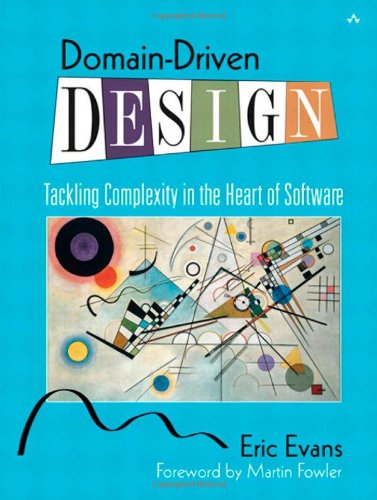 Some years after the GOOS experience, another summer beach holiday was due and as usual, I included a software development book in my luggage. “Domain Driven Design” by Eric Evans came out in 2003 and was praised by some and ignored by most, including me. It took me ten years to finally read it and when I did, it hit me hard. Since my early days as a programmer, I tried to build a meaningful data model with actual types for each program I developed. But it occurred to me that I did it half-heartedly all the time. It shouldn’t stop at a data model, it should be a complete domain model. And for that to work, you need to grok the domain. I review a lot of my code before that insight and always find it funny how I invested effort in my models but more often than not stayed in the technical realm. I cannot say that my programming has changed much from the book, as most concepts meandered through the community since 2003 and were picked up by me mostly under different names. But my software development approach has changed dramatically. I don’t start my thinking from the technical side anymore. And that helps with “business alignment” and all the other magic words that finally have real tangible benefit. And I can now pinpoint when that alignment loosens and employ counter-measures instead of ending up in a special case hell. The best thing was that this book doesn’t require a laptop so I got to sit on the beach that summer with the book in my hands and my head in the clouds. It might be old, but it’s still gold.
 I anxiously waited for this book to be printed. Not because I pre-ordered, but because I held talks, workshops and lectures about the topic before the book was available. And I wanted to make sure that I’m not telling nonsense. But Robert C. Martin took his time and delayed the deadline month after month. Then, nearly a year later, the book reached the stores in late 2017. So I would have to wait for my winter holiday to read it. I couldn’t wait and began right away. The book is a slow burner and feels like a long introduction. By the time the central proposition is revealed (and yes, it reads like good unagitated spy thriller at times), you’ve probably already figured it out yourself. And that’s a good thing in my mind, because it feels as if it was your idea and Uncle Bob is just there to nod and congratulate you for your intellect. This book is so many times less preachy than “Clean Code”. If we compare spy thriller literature, this is a John le Carré while Clean Code would be an Ian Fleming (James Bond). “Clean Architecture” is not about programming, it talks about software architecture, a topic that I missed greatly in my early developer years. I liked this book so much
  All the other books talk about different aspects of programming, software development or related technical topics. But what about a book that raises a simple question: “Why is IT technology so complicated?”. And gives the answer: “Because we want it this way.”. That’s actually true. In a world without most of the restrictions of the physical world, we were unable to build solutions that actually helped us and came up with machines and software that overwhelmed most people. It needed a whole new generation of “digital natives” until concepts like internal operation modes (e.g. insert vs. overwrite) were intuitively understood. Not because they became simpler, we were just used to the complexity. Alan Cooper described the problem and gave at least hints for solutions in 1999, nearly 20 years ago. That’s the timespan of a generation. This book made me think hard about the status quo I silently had accepted with technology. It just was like it was, what else could there be? If I reveal a tiny bit of different approaches I can think of now, I’m often confronted with incomprehension. Not because I’m particularly clever and everyone else is dumb, but because there seems to be no problem if you’ve grown accustomed to it. If you want to see some of the pain other (older) people feel when interacting with technology and software, read this book. It is an eye-opener to common problems no software developer ever had. It is the first step into the world of UX (user experience), where it’s not as important if the developer feels alright but if the user feels at least adequate. It might be a classic and feel a bit outdated and weak on the solution side, but to understand the problem properly is the first step to appreciate possible answers. And Alan Cooper didn’t stop there. Read his
 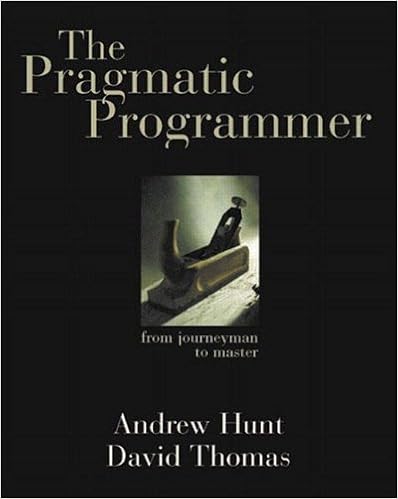 More by chance, my co-founder stumbled upon “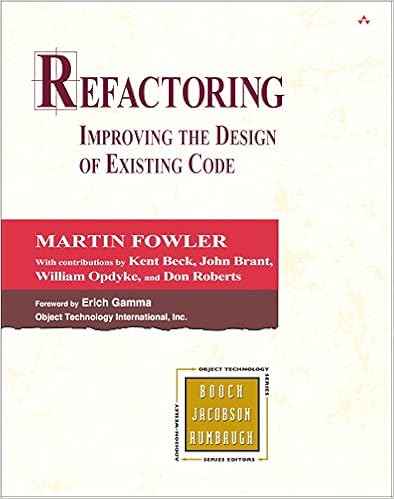
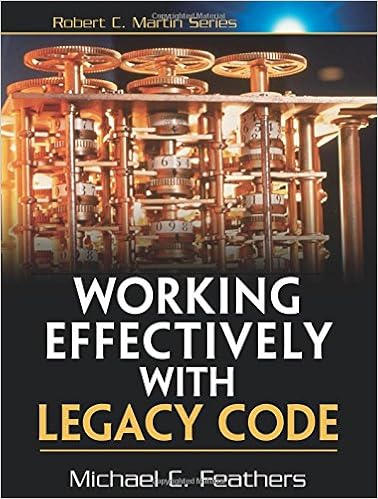 In 2004, Michael Feathers wrote a book that contains his 20+ years of experience with software development and named it “
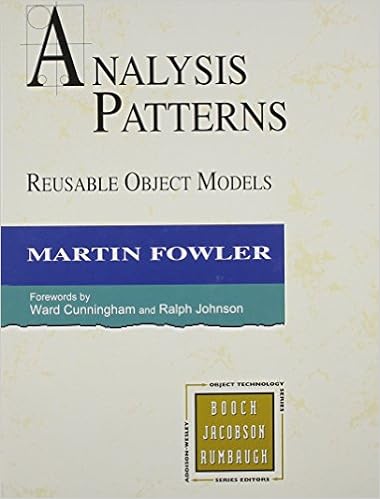 Martin Fowler was a very productive author in the late nineties. I’ve read most of his books from this period, if maybe with a few years delay. “
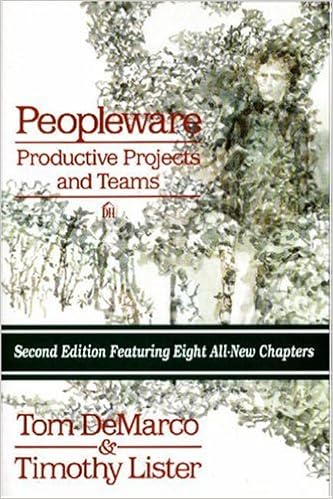 Since the late 80’s, Tom DeMarco and Timothy Lister wrote one book after the other. Each book describes a common business-oriented problem and at least one working solution for it. And yet, the very same problems still persist in the business world. It’s as if nobody reads books. “

 Schneide Blog