Every Unit Test Is a Stage Play – Part V

In this series about describing unit tests with the metaphor of a stage play that tells short stories about your system, we already published four parts:

Today, we look at the critics.

An integral part of the theater experience is the appraisal of the critics. A good review of a stage play can multiply the viewer count manyfold, while a bad review can make avid visitors hesitate or even omit the visit.

In our world of source code and unit tests, we can define the whole team of developers as critics. If they aren’t fond of the tests, they will neglect or even abandon them. Tests need to prove their worth in order to survive.

Let us think a little deeper about this aspect: Test code is evaluated more critically than any other source code! Normal production code can always claim to be wanted by the customer. No matter how bad the production code may look and feel like, it cannot just be deleted. Somebody would notice and complain.

Test code is not wanted by the customer. You can delete a test and it would not be noticed until a regression bug raises the question why the failing functionality wasn’t secured by a test. So in order to survive, test code needs a stakeholder inside the development team. Nobody outside the team cares about the test.

There is another difference between production code and test code: Production code is inherently silent during development. In contrast to this, test code is programmed to drive the developer’s attention to it in case of a crisis. It is code that tries to steal your focus and cries wolf. It is the messenger that delivers the bad news.

Test code is the code you’ll likely read in a state of irritation or annoyance.

Think about a theater critic that visits and rates a stage play in a state of irritation and annoyance. That wanted to do something else instead and probably has a deadline to meet for that other thing. His opinion is probably biased towards a scathing critique.

We talked about several things that test code can do to be inviting, concise, comprehendible and plausible. What it can’t do is to be entertaining. Test code is inherently boring. Every test is a short story that seems trivial when seen in isolation. We can probably anticipate the critique about such a play: “it meant well, but was ultimately forgettable”.

What can we do to make test code more meaningful? To convey its impact and significance to the critics?

In the world of theater (and even more so: movies), one strategy is to add “big names” to the production: “From the director of Known Masterpiece” or “Part III of the Successful Series”.

Another strategy is to embellish oneself with other critiques (hopefully good ones): “Nominated for X awards” or “Praised by Grumpy Critic”.

Let’s translate these two strategies into the world of unit tests:

Strategy 1: Borrow a stakeholder by linking to the requirement

I stated above that test code has no direct stakeholder. That’s correct for the code itself, but not for its motivation to exist. We don’t write unit tests just to have them. We write them because we want to assert that some functionality is present or some bug is absent. In both cases, we probably have a ticket that describes the required change in depth. We can add the “big name” of the ticket to the test by adding its number or a full url as a comment to the test:

/**
 * #Requirement http://issuetracker/TICKET-3096
 */
@Test
public void understands_iso8601_timestamp() {
    final LocalDateTime actual = SomeController.dateTimeFrom(
        "2023-05-24T17:30:20"
    );
    assertThat(
        actual
    ).isEqualTo(
        "2023-05-24T17:30:20"
    );
}

The detail of interest is the comment above the test method. It explains the motivation behind authoring the test. The first word (#Requirement) indicates that this is a new feature that got commissioned by the customer. If it was a bugfix test instead, the first word would be #Bugfix. In both cases, we tell future developers that this test has a meaning in the context of the linked ticket. It isn’t some random test that annoys them, it is the guard for a specific use case of the system.

Strategy 2: Gather visible awards for previous achievements

Once you get used to the accompanying comment to a test method, you can see it as some kind of billboard that displays the merit of the test. Why not display the heroic deeds of the test, too? I’ve blogged about the idea a decade ago, so this is just a quick recap:

/**
 * #Requirement http://issuetracker/TICKET-3096
 * @lifesaver by dsl
 * @regression by xyz
 */
@Test
public void understands_iso8601_timestamp() {
    /* omitted test code */
}

Every time a test does something positive for you, give it a medal! You can add it right below the ticket link and document for everybody to see that this test has earned its place in the code base. Of course, you can also document your frustrating encounters with a specific test in the same way. Over time, the bad tests will exhibit several negative awards, while your best tests will have several lifesaver medals (the highest distinction a test can achieve).

So, to wrap up this part of the metaphor: Pacify the inevitable critics of your test code by not only giving them pleasant code to look at but also context information about why this code exists and why they should listen to it if it happens to have grabbed their attention, even with bad news.

Epilogue

This is the fifth part of a series. All parts are linked below:

Every Unit Test Is a Stage Play – Part IV

In this series about describing unit tests with the metaphor of a stage play that tells short stories about your system, we already published three parts:

Today, we look at the story.

When you visit a theater, you probably expect to be entertained. You expect some level of preparation and presentation. You might not enjoy every aspect of the stage play, but you can cherish the overall experience.

When you read an unit test as a developer, you should not expect to be entertained. But you can expect some level of presentation and you should be able to endure the overall experience.

In both cases, a great factor to success is how the story is presented to you.

Imagine trying to follow a stage play that is in rehearsal mode. Constant interruptions and corrections from outside the stage, repetitions of scenes and single sentences and sometimes omissions that everybody is clued in on except you. And of course, nobody is dressed for their role. It would be hard to follow the plot and piece the story together.

Unit test code often reads like an early rehearsal. The code is stitched together by copy & paste, some details are modified but not emphasized and the point of the story is only revealed at the end, oftentimes told indirectly by convoluted assertions. When the test runs green for the first time, it is abandoned and left as an exercise in improvement for the next reader.

The next reader is a developer that made a change to the production code that got red-flagged by the unit test. He or she tries to find out why the jury of assertions is against the change and what the test is all about. It’s like the first visitor of a stage play has to tell the lighting technician where to point the spotlights without knowing how the story will play out.

If we accept the metaphor and view unit tests as stage plays that tell a short story, we should try to tell the story in a clear and concise manner. Giving standard names to the participating roles is an important first step to clue in the visitor/reader. But the last part of a story is the most crucial one. You are expected to tie the story threads together and provide a resolution that can be followed.

In unit testing, we express the resolution of the unit test’s short story as assertions:

public void parsingOfErroneousODLState() {
    final SerialODL target = new SerialODL(Z, "19");
    
    final ODLState actual = target.getCurrentState();
    
    Assert.assertFalse(
        actual.isNormalOperation()
    );
    Assert.assertEquals(
        3,
        IterableUtil.getSizeFor(actual.getErrorStates())
    );
    Assert.assertEquals(
        ODLErrorState.TEST_ERROR,
        IterableUtil.getElementAt(0, actual.getErrorStates())
    );
    Assert.assertEquals(
        ODLErrorState.INVALID_VALUE_DUE_TO_INITIALIZING,
        IterableUtil.getElementAt(1, actual.getErrorStates())
    );
    Assert.assertEquals(
        ODLErrorState.VALUE_GREATER_ALARM_THRESHOLD,
        IterableUtil.getElementAt(2, actual.getErrorStates())
    );
}

This unit test consists of one line of preparation (“arrange”), one line of code under test that produces the “actual” (“act”) and five assertions on several lines each (“assert”). Nearly 80 percent of this unit test are assertions. And they try to express something, but it gets drowned in noise.

One key to a better story is the usage of a more fitting form of expression, in our case a more natural way to write assertions:

public void parsingOfErroneousODLState() {
    final SerialODL target = new SerialODL(Z, "19");

    final ODLState actual = target.getCurrentState();

    assertThat(
        actual.isNormalOperation()
    ).isFalse();

    assertThat(
        actual.getErrorStates()
    ).containsExactly(
        ODLErrorState.TEST_ERROR,
        ODLErrorState.INVALID_VALUE_DUE_TO_INITIALIZING,
        ODLErrorState.VALUE_GREATER_ALARM_THRESHOLD
    );
}

In this example, we used assertj fluent assertions. As you can see, you can shrink the assertions part of your story down to the essence. You can state what you really want to see and not hide it behind indices and size comparisons that only exist because of the indices.

Another way to guide your reader is by structuring your test story into a standard form. From classic storytelling, we know about the hero’s journey that consists of three sections (departure, initiation, return) and can be found in countless books, movies and stage plays.

Our test’s journey is called AAA pattern. The three sections are:

  • Arrange
  • Act
  • Assert

Whenever you write an unit test, adhere to this pattern. If you find yourself tempted to add a second act or more assertions, break up your one unit test into two. You might want to think about extracting the arrange part into a common utility method (that is placed down below, behind the curtain). The story then says: The hero is in the same position both times, decides different (the two act sections) and has a different outcome (the two assertions) because of that.

There are probably countless things more that you can think of to make the story of your tests more compelling. Remember that test are not required to be entertaining or surprising. You can tell the same classic tale over and over again. The computer doesn’t mind and the next reader is glad when the test code is accessible right away because the structure and phrasing is on point.

Nobody would pay to see a confusing stage play. And nobody wants to decipher extravagant test code that just broke in an unexpected way. Give your readers what they hope for: Plain short stories about your system.

Epilogue

This is the fourth part of a series. All parts are linked below:

Every Unit Test Is a Stage Play – Part III

In the first and second parts of this series, I talked about describing unit tests with the metaphor of a stage play that tells short stories about your system.

This metaphor is really useful in many aspects of unit testing, as we have seen with naming variables and clearing the test method. In each blog entry of the series, I’m focussing on one aspect of the whole.

Today, we look at the theater.

If you go to the theater as a guest, you are greeted by a pompous entrance with a luxurious stairway that lead you to your comfy seat. You don’t get to see all the people and things behind the heavy curtains. You don’t need to recognize any details of the floor, the walls or the ceiling as you make your way into the auditorium. They don’t matter for the play.

If you enter the theater as an actor or a stage help, you slip into the building by the back entrance and make your way through a series of storage rooms. Or at least that is the cliché in many movies (I’m thinking about Birdman, but you probably have your own mental image at hands). You need to recognize all the details and position yourself according to your job. Your preparation matters for the play.

I described the test methods as single stage plays in earlier blog posts. Today, I want you to think about a test class as a theater. We need to agree on the position of the entrance. In my opinion, the entrance is where I’m starting to read – at the top of the file.

In my opinion, as a reader of the test class, I’m one of the guests. My expectation is that the test class is designed to be inviting to guests.

This expectation comes from a fundamental difference between production code classes and test classes: Classes in production code are not meant to be read. In fact, if you tailor your modules right and design the interface of a class clearly and without surprises, I want to utilize your class, but don’t read it. I don’t have to read it because the interface told me everything I needed to know about your class. Spare me the details, I’ve got problems to solve!

Test classes, on the other hand, are meant to be read. Nobody will call a test method from the production code. The interface of a test class is confusing from the outside. To value a test class is to read and understand it.

Production code classes are like goverment agencies: They serve you at the front, but don’t want you to snoop around the internals. Test classes are like a theater: You are invited to come inside and marvel at the show.

So we should design our test classes like theaters: An inviting upper part for the guests and a pragmatic lower part for the stage hands behind the curtain.

Let’s look at an example:

public class UninvitingTest {
	
    public static class TestResult {
        private final PulseCount[] counts;
        private final byte[] bytes;

        public TestResult(
            final PulseCount count,
            final byte[] bytes
        ) {
            this(
                new PulseCount[] {
                    count
                },
                bytes
            );
        }

        public TestResult(	
    	    final PulseCount[] counts,
            final byte[] bytes
        ) {
            super();
            this.counts = counts;
            this.bytes = bytes;
        }

        public PulseCount[] getCounts() {
            return this.counts;
        }

        public byte[] getBytes() {
            return this.bytes;
        }
    }
	
    private static final TestResult ZERO_COUNT = 
	new TestResult(
            new PulseCount(0),
            new byte[] {0x0, 0x0, 0x0, 0x0}
        );
    private static final TestResult VERY_SMALL_COUNT = 
	new TestResult(
            new PulseCount(34),
            new byte[] {0x0, 0x0, 0x22, 0x0}
        );
    private static final TestResult MEDIUM_COUNT_BORDER = 
	new TestResult(
            new PulseCount(65536),
            new byte[] {0x1, 0x0, 0x0, 0x0}
        );
    
    public UninvitingTest() {
    	super();
    }

    @Test
    public void serializeSingleChannelValues() throws Exception {
        SPEChannelValuesSerializer scv = 
            new SPEChannelValuesSerializer();
        Assertion.assertArrayEquals(
            ZERO_COUNT.getBytes(),
            scv.serializeCounts(ZERO_COUNT.getCounts())
        );
        Assertion.assertArrayEquals(
    	    VERY_SMALL_COUNT.getBytes(),
            scv.serializeCounts(VERY_SMALL_COUNT.getCounts())
        );
        Assertion.assertArrayEquals(
    	    MEDIUM_COUNT_BORDER.getBytes(),
            scv.serializeCounts(MEDIUM_COUNT_BORDER.getCounts())
        );
    }
}

In fact, I hope you didn’t read the whole thing. There are lots of problems with this test, but let’s focus on the entrance part:

  • Package declaration (omitted here)
  • Import statements (omitted here)
  • Class declaration
  • Inner class definition
  • Constant definitions
  • Constructor
  • Test method

The amount depends on the programming language, but some ornaments at the top of a file are probably required and can’t be skipped or moved around. We can think of them as a parking lot that we require, but don’t find visually appealing.

The class declaration is something like an entrance door. Behind it, the theater begins. And just by looking at the next three things, I can tell that I took the wrong door. Why am I burdened with the implementation details of a whole other class? Do I need to remember any of that? Are the constants important? Why does a test class require a constructor?

In this test class, I need to travel 50 lines of code before I reach the first test method. Translated into our metaphor, this would be equivalent to three storage rooms filled with random stuff that I need to traverse before I can sit into my chair to watch the play. It would be ridiculous when encountered in real life.

The solution isn’t that hard: Store your stuff in the back rooms. We just need to move our test method up, right under the class declaration. Everything else is defined at the bottom of our class, after the test methods.

This is a clear violation of the Java code conventions and the usual structure of a class. Just remember this: The code conventions and structures apply to production code and are probably useful for it. But we have other requirements for our test classes. We don’t need to know about the intrinsic details of that inner class because it will only be used in a few test methods. The constants aren’t public and won’t just change. The only call to our constructor lies outside of our code in the test framework. We don’t need it at all and should remove it.

If you view your test class as a theater, you store your stuff in the back and present an inviting front to your readers. You know why they visit you: They want to read the tests, so show them the tests as proximate as possible. Let the compiler travel your code, not your readers.

And just so show you the effect, here is the nasty test class from above, with the more inviting structure:

public class UninvitingTest {
    
    @Test
    public void serializeSingleChannelValues() throws Exception {
        SPEChannelValuesSerializer scv = 
            new SPEChannelValuesSerializer();
        Assertion.assertArrayEquals(
            ZERO_COUNT.getBytes(),
            scv.serializeCounts(ZERO_COUNT.getCounts())
        );
        Assertion.assertArrayEquals(
            VERY_SMALL_COUNT.getBytes(),
            scv.serializeCounts(VERY_SMALL_COUNT.getCounts())
        );
        Assertion.assertArrayEquals(
            MEDIUM_COUNT_BORDER.getBytes(),
            scv.serializeCounts(MEDIUM_COUNT_BORDER.getCounts())
        );
    }

    private static final TestResult ZERO_COUNT = 
        new TestResult(
            new PulseCount(0),
            new byte[] {0x0, 0x0, 0x0, 0x0}
        );
    private static final TestResult VERY_SMALL_COUNT = 
        new TestResult(
            new PulseCount(34),
            new byte[] {0x0, 0x0, 0x22, 0x0}
        );
    private static final TestResult MEDIUM_COUNT_BORDER = 
        new TestResult(
            new PulseCount(65536),
            new byte[] {0x1, 0x0, 0x0, 0x0}
        );

    public static class TestResult {
        private final PulseCount[] counts;
        private final byte[] bytes;

        public TestResult(
            final PulseCount count,
            final byte[] bytes
        ) {
            this(
                new PulseCount[] {
                    count
                },
                bytes
            );
        }

        public TestResult(  
            final PulseCount[] counts,
            final byte[] bytes
        ) {
            super();
            this.counts = counts;
            this.bytes = bytes;
        }

        public PulseCount[] getCounts() {
            return this.counts;
        }

        public byte[] getBytes() {
            return this.bytes;
        }
    }

    public UninvitingTest() {
        super();
    }
}

Show your readers the test methods and don’t burden them with details they just don’t need (yet).

Epilogue

This is the third part of a series. All parts are linked below:

Every Unit Test Is a Stage Play – Part II

In the first part of this series, I talked about describing unit tests with the metaphor of a stage play that tells short stories about your system.

This metaphor holds its water in nearly every aspect of unit testing and guides my approach from each single line of code to the whole concept of test coverage. In this series, I’m focussing on one aspect in each part.

Today, we look at the backdrop.

We learnt from the first part that most unit tests are performed by four roles that appear on stage. In a theater, the stage is oftentimes decorated by additional items that facilitate the story. This is the backdrop (or the coulisse) of the play. We have the same thing in unit tests.

In a unit test, the stage is the code inside the test method:

@Test
public void rounds_up_to_the_next_decimal_power() {
    final Configuration given = new Configuration(
        StringVirtualFile.createFileFromContent(
            "report.config",
	    "scale.maximum=2E5"
	)
    );
    final ReportConfiguration target = new ReportConfiguration(
        given
        SuffixProvider.none
    );
    final Optional<Double> actual = target.scaleMaximum();
    final double expected = 1E6;
    assertThat(actual).contains(expected);
}

A good director is very picky about every detail that appears on stage. There should be no incidental item visible for the audience. In the case of an unit test, the audience is the next developer that reads the test code.

The stage doesn’t need to be devoid of “extras” and furniture, but it should be limited to the essential. A theater play isn’t a movie set where eye candy is seen as something positive. During the play, the audience should recognize the actors (and their roles) easily and without searching between all the clutter.

So we need to do two things: Declutter the stage and identify the extras.

Decluttering the stage

In our example above, there is a mismatch between the code required to instantiate the given role and the rest of the whole test. If this were a real play, half the time would be spent on an extra that doesn’t even speak a line. It is implied that the target gets some information from the given, but it isn’t shown. We need to remove some details from the stage that aren’t even relevant to the story, but introduced in detail just like the essential things. It might be fun and suspenseful to guess if the “report.config” detail in line three is more meaningful than the “scale.maximum” specified in line four, but unit test stories are not meant to be mysterious or even entertaining. They are meant to inform the audience about a little fact of the tested system. There will be thousands of little stories about the system. Make them trivial to read and easy to understand.

We need to move the stage props off the stage:

@Test
void rounds_up_to_the_next_decimal_power() {
    Configuration given = givenScaleMaximumOf("2E5");
    final ReportConfiguration target = new ReportConfiguration(
        given,
        irrelevant()
    );
    final Optional<Double> actual = target.scaleMaximum();
    final double expected = 1E6;
    assertThat(actual).contains(expected);
}

private Configuration givenScaleMaximumOf(
    String scaleMaximum
) {
    return new Configuration(
        StringVirtualFile.createFileFromContent(
            "report.config",
            "scale.maximum=" + scaleMaximum
        )
    );
}

private SuffixProvider irrelevant() {
    return SuffixProvider.none;
}

By moving the initialization code of the Configuration object to a new private method, we employ the storytelling device of “conveniently prepared circumstances”. The private method is moved to the “lower decks” or the “backstage” area of our test class. “The stage is on top” might be our motto. Everything “private” or not-Test-annotated should not be visible first and should not be required reading.

Notice how I introduced a parameter to the new “givenScaleMaximumOf” method in order to keep the necessary test details on stage. The audience should not have to look behind the curtains to gather important information about the story. I made the parameter a string (and not a double or integer) because it is just a prop. The story doesn’t benefit from it being typecasted correctly. And if you look back, it was a string before, too.

Identifying the extras

I’ve also extracted the “magic number” or “silent extra” SuffixProvider.none into its own method. This method adds nothing but a name that conveys the meaning of the value to the story instead of the value itself. If I were a directory in a theater, this actor would have a plain and bland costume in contrast to the bright colored main roles. Maybe the stage lighting would illuminate the main roles and keep the extra in the shadowy area, too.

Now, the focus of our test method is back on the main story. The attention of our audience will be on the stage and it will not be burdened by irrelevant details. We will even label props as dispensable if they are.

Keep your stages free from clutter and the eyes of your audience on the story. Test code is boring by nature. It doesn’t have to be plodding, too.

Epilogue

This is the second part of a series. All parts are linked below:

Every Unit Test Is a Stage Play – Part I

At the last dev brunch, I got the recommendation about a talk that tries to explain functional programming differently. What really got me was the effectiveness of the changed vocabulatory. I’ve seen this before, in the old talk about test driven development and behaviour driven development. But in my head, I think about unit tests with another overarching metaphor that I’m trying to explain in this blog post series:

Every unit test is a stage play that tells a short story about your system.

And this metaphor really guides my approach to nearly any aspect of unit testing, from each single line of code to the whole concept of test coverage. So I’m breaking my explanation into (at least) five parts and focus on one aspect in each part.

Today, we look at the actors.

In each classic play, there are well-known roles that can be played by nearly any human, but always stay the same role. There’s the hero, the (comedic) sidekick and of course, the villain or antagonist. In every show of Romeo and Juliet, there will be a Romeo. It might not be the most convincing Romeo ever, but the role stays the same, no matter the cast.

The same thing is true for every well-formed unit test. There are four roles that always appear on stage:

  • target: This is the object under test or the code under test if you don’t use objects. The target is probably different for every unit test you write, but the role is always present. I’ve seen it being called “cut” for “code under test”, but I prefer “target”. If you see a reference named “target” in my test code, you can be sure about the role it plays in the story.
  • actual: If you can design your code to adhere to the simple “parameters in, result out” call pattern, the “result out” is the “actual”. It is what your target produced when challenged by the specific parameters of your test. One trick to testable code is to design the “actual” role as being quite simple and “flat”.
  • expected: This might be the closest thing to an antagonist in your play. The “expected” role is filled with the value (or values) that your “actual” is measured against. If your “actual” is simple, your “expected” will be simple, too. If your “actual” is too complex, the “expected” role will be overbearing. In any case, the “expected” role is what drives your assertions.
  • given: Our hero, the “target”, is often dependent on entry parameters or secondary objects (mocked or not). These sidekicks are part of the “given” role. You might think about the “given-when-then” storytelling structure of behaviour driven design for the name. If you strive for a simple code structure, the required “given” in your unit test should be manageable.

As you can see, the story of a typical unit test is always the same: The target, with the help of the given, produces an actual that competes against the expected.

If this story has a happy end, your test runs green. If the actual fails the expectation, your test runs red. If the target fails to produce an actual at all (think about an exception or error), your whole play falls apart and the test runs red.

Enough theory, let’s look at an unit test that uses the four roles:

@Test
public void rounds_up_to_the_next_decimal_power() {
    final Configuration given = new Configuration(
        StringVirtualFile.createFileFromContent(
            "report.config",
	    "scale.maximum=2E5"
	)
    );
    final ReportConfiguration target = new ReportConfiguration(
        given
        SuffixProvider.none
    );
    final Optional<Double> actual = target.scaleMaximum();
    final double expected = 1E6;
    assertThat(actual).contains(expected);
}

I’ve highlighted the roles for better visibility. Note that for a role to appear in the play, it doesn’t really have to be named explicitely. Most of the time, the last two lines would be collated into one:

assertThat(actual).contains(1E6);

You can still see the “expected” role play its part, but not as prominent as before.

You also probably saw the extra “given” that wasn’t highlighted:

SuffixProvider.none

It might be relevant to the story or really be an uncredited extra that is not crucial in the target’s journey to produce the correct actual. If that’s the case, it seems appropriate not to name it. We will learn about techniques that I use to make these extras more nondescript in a later part. Right now, we can differentiate between main roles that are named and secondary roles that are just there, as part of the scenery. Just don’t fool your audience by having an unnamed actor contribute an important piece to the story’s success. That might be a cool plot twist, but I’m not here to be surprised.

Let your tests perform boring plays, but lots of them.

By using the four roles of test play, you make it clear to the reader (your real audience) what to expect from your test code parts. Don’t name irrelevant test code parts and only omit the role names if there are no extras on stage.

Your audience will still find your play boring (that’s the fate of nearly all test code), but it won’t feel disregarded or, even worse, deceived.

Epilogue

This is the first part of a series. All parts are linked below:

A neat trick for finding dates

One of my fundamental driving forces for designing a suitable user experience is the motto of “no scrolling”. It is not a hard principle in the sense of Bret Victor’s “Inventing on Principle”, but it is motivation enough to always look for context-aware ordering of lists and tables.

One of the cornerstones of such “scrolling-free” or “scrolling-reduced” applications is a possibility for the user to define a context of work. You might call it an ordinary search field, but it is highly interactive (immediate feedback, as mandated by Bret Victor) and doesn’t lead to a special result view. It just reduces the amount of data that is presented to the user. The idea behind the context field is that the user has some idea about the piece of work she wants to edit. So, if for example she remembers that the customer of an order was named “Miller”, she would type “mil” in the context field and have the list of orders reduced to just the “Millers” and “Camilles” (the latter contains “mil” in the middle).

This works fine for text-based information, but less so for numerical data. Most users typically remember text like names better than numbers like values or phone numbers, so it fits the natural inclination of humans. And then there is a form of data that is remembered easily and used for orientation, but presented as numbers: dates.

If you store a date in a persistent storage, it is probably stored as a number, several numbers or a short piece of text like “2024-12-24”. To make a date searchable, the textual representation of “2024-12-24” is a good start, but we can do better with a simple trick:

Instead of just using one textual representation for the search index (or whatever search functionality you use), you can append several representations of the same date at once:

“2024-12-24 Tuesday, December 24, 2024”

Here, we’ve used a code like this:

String searchtext = xmas.toString() + " " + xmas.format(DateTimeFormatter.ofLocalizedDate(FormatStyle.FULL));

This enables your user to restrict to a context of “dec” for “December” or even “tue” for “Tuesday”.

This search-extended representation of the date is never shown on screen, so it doesn’t have to be readable or brief. It should contain the concepts of managing dates that your users will facilitate during their normal interaction with the data (not with your application!). So it might even be useful to add several more representations like a relative period (“in 5 months, 16 days”) and maybe special date names (“christmas, xmas”). It might be useful to cut down on filler words like “months” or “days”, because they are included in virtually every date you’ll search. So the relative period might come down to “5 five, 16 sixteen”. If your search allows for multiple texts that all need to be present (which I would encourage because in my experience, that’s how people triangulate: “It was Miller and at the end of the year”), you might add the filler words again, because it allows for a context string like “5 mo” with matches with “in 5 months” (and “5 months ago”, but that’s another topic).

In a nutshell, my trick is to craft the textual representation of data for the search (not the visualisation!) in accordance to the navigation patterns of my users. If they can rely on the data being focussed effectively, they won’t miss the scrollbars.

End each business process with a report

There is the internet saying of “pictures or it didn’t happen”. In the business world, you can translate it to “report or it didn’t happen”. Let me explain.

The concept of a business process is important for this blog post. My impression is that the concept is underrepresented in the business world. I can recall a time where I wasn’t familiar with it. Work occurred and had to be done. No need to make it more complicated than that. Well, it won’t really get more complicated with a business process, just more defined.

A business process is a series of tasks that are directed to a “business objective” or some desirable goal. Everything you do in the context of professional work is probably a task in a business process. The difference to “just work” is that the process is defined in a repeatable manner. There is a description of the necessary steps to do it again. Let’s take a bugfix in a software as an example. The actual content of the bug is different for every iteration of the process. But the basic steps are always the same:

  • A bug report is written by a customer
  • The bug is verified by a developer
  • A test case is written that reveals the bug’s minimal cause
  • The code is changed to fix the bug
  • The test case is changed to protect against the bug
  • The changeset is merged into the upstream code
  • The bug report is marked as fixed
  • The bugfix is released

This might be the rudimentary description of this business process. Note that while all the details of verification effort and code changes are omitted, the process can be repeated on this level of detail many times without variation.

In our company, we describe our business processes as “text with media content” in our wiki. The basic structure of each process consists of four parts that each hold a number of steps:

  • E (Event) – Something happened that requires an iteration of the process
  • A (Actions) – A series of things we need to do to reach the objective, described in varied detail
  • R (Result) – The stop condition for the process. What have we achieved when we perform the actions successfully?
  • B (Report) – Who do we need to inform about the process iteration?

The name for the last part might look strange to you: B for report is only explainable if you translate it into german: “Bericht” means report and starts with a B.

Let’s project these four parts to the example above:

The bug report by the customer is the event. Then follow five steps that are actions (verification, test case, code change, test change, upstream merge). The next step can be interpreted as the report. If you close the bug report ticket, that is the notification that things just got better. The problem here is that the result (the bugfix is released) occurs after the report. This often leads to irritation on the side of the customer that still has the problem even if the ticket is marked as “resolved”.

But this blog post is not about the unfortunate process design that puts the report before the result. It is about the report itself. In my experience, this crucial part of the process is often missing from the description or willfully omitted by the process operator. And that is a problem that can and should be fixed.

A report doesn’t need to be a piece of paper or an e-mail, though it often is. Let me give you two examples of other forms of reports:

  • In hotels, the toilet paper is often folded in a certain way. It indicates that somebody has cleaned this room and it wasn’t used since.
  • The dishwasher in our company is equipped with a new cleaning tab as soon as it was emptied. This indicates that it can be loaded with dirty dishes again. The machine will never close the tab compartment by itself, so if it is closed, it was loaded by a human (who put the clean dishes away beforehands, hopefully).

Without such a report, a business process like the room cleaning or the dishwasher emptying might have occurred, but everybody has to check again on their own.

In the digital world, we often try to automate the reporting by sending out e-mails to ticket reporters and the like. That’s fine. The report step doesn’t need to create extra effort, but it needs to happen.

If you can “think in processes”, you can ask yourself the question “who do I need to inform at the end of this process?”. Who has an interest in the result? Let them know that it is available now! You can’t reach everybody with an interest directly? Think of a way to leave a clue like the folded toilet paper.

In our company, most of our processes are accompanied by a digital ticket, so the resolution of the ticket often triggers the necessary report e-mails. But even in this situation, there are many processes left that require explicit thought and effort to inform the right people.

What is your most clever way to report the end of a business process? Tell us in the comments!

Separation of Intent and Implementation

Last week, my colleague wrote about building blocks and how to achieve a higher-level language in your code by using them. Instead of talking about strings and files, you change your terms to things like coordinates and resources.

I want to elaborate on one aspect of this improvement, that aims at the separation of your intent from the current implementation. Your intent is what you want to achieve with the code you write. The current implementation is how you achieve it right now. I point out the transience of the implementation so clearly because it is most likely the first (and maybe even only) thing to change.

I have an example of this concept that is hopefully understandable enough. Let’s say that you build a system that gathers a lot of environmental data and stores it for later analysis and introspection. Don’t worry, the data consists mostly of things like air pressure, temperature and radioactive load. Totally harmless stuff – unless you find the wrong isotopes. In that case, you want to have a closer look and understand the situation. Most temporarily increased radioactivity in the air is caused by a normal thunderstorm. Most temporarily decreased radioactivity in the air is caused by a normal rain.

Storing all the data requires something like an archive. We want to store the data separated by the point of measurement (a “station”), the type of data (let’s call it “data entry type” because we aren’t very creative with names here) and by the exact point in time the measurement took place. To make matters a little bit more complicated, we might have more than one device in a station that captures a specific data entry type. Think about two thermometers on both sides of the station to make local heatup effects visible.

In order to reference a definite entry in our archive, we need a value for four aspects or dimensions :

  • The station
  • The data entry type
  • The device
  • The date and time

Thinking from the computer

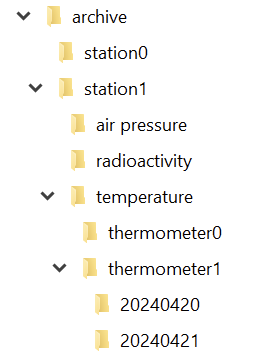
If you implement your archive in the file system, you can probably see the directory structure right before you:

And in each directory for the day, we have a file for each hour:

So we can just write a class that takes our four parameters and returns the corresponding file. That is a straighforward and correct implementation.

It is also one of the implementations that couples your intent (an archive with four dimensions of navigability) nearly inseparably with your decisions on how to use your computer’s basic resources.

Thinking from the algorithms point of view

In order to separate your intent from your current implementation, you need to specify your intent as unencumbered from details as possible. Let’s specify our 4-axis archive nagivation system as a coordinate:

public record ArchiveCoordinate(
    StationId station,
    DataEntryType type,
    DeviceId device,
    LocalDateTime measurementTime
) {
}

There is nothing in here that point towards file system things like directories or files. We might have a hunch of the actual hierarchy by looking at the order of the parameters, but it is easy to implement a hierarchy-free nagivation between coordinates:

public record ArchiveCoordinate([...]) {
    public ArchiveCoordinate withStationChangedTo(
        StationId newStation
    ) {
        [...]
    }
    
    public ArchiveCoordinate withTypeChangedTo(
        DataEntryType newType
    ) {
        [...]
    }
    
    public ArchiveCoordinate withDeviceChangedTo(
        DeviceId newDevice
    ) {
        [...]
    }
    
    public ArchiveCoordinate withMeasurementTimeChangedTo(
        LocalDateTime newMeasurementTime
    ) {
        [...]
    }
}

The concept is that if you know one coordinate, you can navigate relative to it through the archive, without knowingly changing the directory or whatever implementation structure lies beneath your model layer. Let’s say we have the coordinate of a particular measurement of one thermometer. How do we get the same measurement of the other thermometer?

ArchiveCoordinate measurementForThermometer0 = new ArchiveCoordinate([...]);
ArchiveCoordinate measurementForThermometer1 = measurementForThermometer0.withDeviceChangedTo(thermometer1);

We can provide methods that allow us to step forward and backward in time. We can provide our application code with everything it requires to implement clear and concise algorithms based on our model of the archive.

But there will be the moment where you want to “get real” and access the data. You might decide to let your current implementation shine through to your intent layer and provide an actual file:

public interface Archive {
    Optional<File> entryFor(ArchiveCoordinate coordinate);
}

That’s all you need from the archive to get your file. But you might also decide to prolong your intent layer and wrap the file in your own data type that provides everything your algorithms need without revealing that it is really a file that lies underneath:

public interface Archive {
    Optional<ArchiveResource> entryFor(ArchiveCoordinate coordinate);
}

The new ArchiveResource is a thin, but effective veneer (some might call it a wrapper or a facade) that gives us the required information:

public interface ArchiveResource {
    String name();
    long size();
    InputStream read();
}

Of course, we need to provide an implementation for all of this. But by staying vague in the intent layer, we open the door for an implementation that has nothing to do with files. Instead of a file system, there could be a relational database underneath and we wouldn’t notice. Our algorithms would still work the same way and read their data from ArchiveResources that aren’t FileArchiveResources anymore, but DatabaseArchiveResources.

You can probably imagine how you can provide the intent for data writing using the example above. If not, let me show you the necessary additions:

public interface Archive {
    Optional<ArchiveResource> entryFor(ArchiveCoordinate coordinate);
    ArchiveResource createEntryFor(ArchiveCoordinate coordinate) throws IOException;
}
public interface ArchiveResource {
    String name();
    long size();
    InputStream read();
    OutputStream write();
}

Now you can store additional data to the archive without ever knowing if you write to a file or a database or something completely different.

Summary

By separating your intent from your current actual implementation, you gain at least three things for the cost of more work and some harder thinking:

  1. Your algorithms only use your intent layer. You design it exclusively for your algorithms. It will fit like a glove.
  2. The terms you use in your intent layer shape the algorithm metaphors way better than the terms of your current implementation. You can freely decide what terms you’ll use.
  3. The algorithms and your intent layer are designed to last. Your current implementation can be swapped out without them noticing.

If this sounds familiar to you, it is a slightly different take on the “ports and adapters” architecture. The important thing is that by starting with the intent and naming it from the standpoint of your algorithms (application code), you are less prone to let your implementation shine through.

Spicing up the Game of Life Kata – Part I

Conway’s Game of Life is a worthwhile coding kata that I’ve implemented probably hundreds of times. It is compact enough to be completed in 45 minutes, complex enough to benefit from Test First or Test Driven Development and still maintains a low entry barrier so that you can implement it in a foreign programming language without much of a struggle (except if the foreign language is APL).

And despite appearing to be a simple 0-player game with just a few rules, it can yield to deep theory, as John Conway explains nicely in this video. Oh, and it is turing complete, so you can replicate a Game of Life in Game of Life – of course.

But after a few dozen iterations on the kata, I decided to introduce some extra aspects to the challenge – with sometimes surprising results. This blog series talks about the additional requirements and what I learnt from them.

Additional requirement #1: Add color to the game

The low effort user interface of the Game of Life is a character-based console output of the game field for each generation. It is sufficient to prove that the game runs correctly and to watch some of the more advanced patterns form and evolve. But it is rather unpleasing to the human eye.

What if each living cell in the game is not only alive, but also has a color? The first generation on the game field will be very gaudy, but maybe we can think about “color inheritance” and have the reproducing cells define the color of their children. In theory, this should create areas of different colors that can be tracked back to a few or even just one ancestor.

Let’s think about it for a moment: When all parent cells are red, the child should be red, too. If a parent is yellow and another one is red, the child should have a color “on the spectrum” between yellow and red.

Learning about inheritance rules

One specific problem of reproduction in the Game of Life is that we don’t have two parents, we always have three of them:

Any dead cell with exactly three live neighbors becomes a live cell, as if by reproduction.

Rule #4 of Game of Life

We need to think about a color inheritance rule that incorporates three source colors and produces a target color that is somehow related to all three of them:

f(c1, c2, c3) → cn

A non-harebrained implementation of the function f is surprisingly difficult to come up with if you stay within your comfort zone regarding the representation of colors in programming languages. Typically, we represent colors in the RGB schema, with a number for the three color ingredients: red, green and blue. If the numbers range from zero to one (using floating-point values) or from zero to 255 (using integer values) or even some other value range doesn’t really matter here. Implementing the color inheritance function using RGB colors adds so many intricacies to the original problem that I consider this approach a mistake.

Learning about color representations

When we search around for alternative color representations, the “hue, saturation and brightness” or HSB approach might capture your interest. The interesting part is the first parameter: hue. It is a value between 0 and 360, with 0 and 360 being identically and meaning “red”. 360 is also the number of degrees in a full circle, so this color representation effectively describes a “color wheel” with one number.

This means that for our color inheritance function, the parameters c1, c2 and c3 are degrees beween 0 and 360. The whole input might look like this:

Just by looking at the graphics, you can probably already see the color spectrum that is suitable for the function’s result. Instead of complicated color calculations, we pick an angle somewhere between two angles (with the third angle defining the direction).

And this means that we have transformed our color calculation into a geometric formula using angles. We can now calculate the span between the “leftmost” and the “rightmost” angle that covers the “middle” angle. We determine a random angle in this span and use it as the color of the new cell.

Learning about implicit coupling

But there are three possibilities to calculate the span! Depending on what angle you assign the “middle” role, there are three spans that you can choose from. If you just take your parent cells in the order that is given by your data structure, you implement your algorithm in a manner that is implicitly coupled to your technical representation. Once you change the data structure ever so slightly (for example by updating your framework version), it might produce a different result regarding the colors for the exact same initial position of the game. That is a typical effect for hardware-tied software, as the first computer games were, but also a sign of poor abstraction and planning. If you are interested in exploring the effects of hardware implications, the game TIS-100 might be for you.

We want our implementation to be less coupled to hardware or data structures, so we define that we use the smallest span for our color calculation. That means that our available colors will rapidly drift towards a uniform color for every given isolated population on our game field.

Learning about long-term effects (drifts)

But that is not our only concern regarding drifts. Even if you calculate your color span correctly, you can still mess up the actual color pick without noticing it. The best indicator of this long-term effect is when every game you run ends in the green/cyan/blue-ish region of the color wheel (the 50 % area). This probably means that you didn’t implement the equivalence of 0° and 360° correctly. Or, in other words, that your color wheel isn’t a wheel, but a value range from 0 to 360, but without wrap-around:

You can easily write a test case that takes the wrap-around into account.

But there are other drifts that might effect your color outcomes and those are not as easily testable. One source of drift might be your random number generator. Every time you pick a random angle from your span, any small tendency of the random number generator influences your long-term results. I really don’t know how to test against these effects.

A more specific source of drift is your usage of the span (or interval). Is it closed (including the endpoints) or open (not including the endpoints)? Both options are possible and don’t introduce drift. But what if the interval is half-open? The most common mistake is to make it left-closed and right-open. This makes your colors drift “counter-clockwise”, but because you wrapped them correctly, you don’t notice from looking at the colors only.

I like to think about possible test cases and test strategies that uncover those mistakes. One “fun” approach is the “extreme values random number generator” that only returns the lowest or highest possible number.

Conclusion

Adding just one additional concept to a given coding kata opens up a multitude of questions and learnings. If you add inheritable colorization to your Game of Life, it not only looks cooler, but it also teaches you about how a problem can be solved easier with a suitable representation, given that you look out for typical pitfalls in the implementation.

Writing (unit) test cases for those pitfalls is one of my current kata training areas. Maybe you have an idea how to test against drifts? Write a comment or even a full blogpost about it! I would love to hear from you.

If You Teach It, Teach It Right

Recently, I gained a glimpse of source code that gets taught in beginner’s developer courses. There was one aspect that really irked me, because I think it is fundamentally wrong from the pedagogical point of view and disrespectful towards the students.

Let me start with an abbreviated example of the source code. It is written in Java and tries to exemplify for-loops and if-statements. I omitted the if-statements in my renarration:

Scanner scanner = new Scanner(System.in);

int[] operands = new int[2];
for (int i = 0; i < operands.length; i++) {
    System.out.println("Enter a number: ");
    operands[i] = Integer.parseInt(scanner.nextLine());
}
int sum = operands[0] + operands[1];
System.out.println("The sum of your numbers is " + sum);

scanner.close();

As you can see, the code opens a possibility to input characters in the first line, asks for a number twice and calculates the sum of both numbers. It then outputs the result on the console.

There are a lot of problems with this code. Some are just coding style level, like using an array instead of a list. Others are worrisome, like the lack of exception handling, especially in the Integer.parseInt() line. Well, we can tolerate cumbersome coding style. It’s not that the computer would care anyway. And we can look over the missing exception handling because it would be guaranteed to overwhelm beginning software developers. They will notice that things go wrong once they enter non-numbers.

But the last line of this code block is just an insult. It introduces the students to the concept of resources and teaches them the wrong way to deal with them.

Just a quick reminder why this line is so problematic: The java.util.Scanner is a resource, as indicated by the implementation of the interface java.io.Closeable (that is a subtype of java.lang.AutoCloseable, which will be important in a minute). Resources need to be relased, freed, disposed or closed after usage. In Java, this step is done by calling the close() method. If you somehow fail to close a resource, it stays open and hogs memory and other important things.

How can you fail to close the Scanner in our example? Simple, just provoke an exception between the first and the last line of the block. If you don’t see the output about “The sum of your number”, the resource is still open.

You can argue that in this case, because of the missing exception handling, the JVM exits and the resource gets released nonetheless. This is correct.

But I’m not worried about my System.in while I’m running this code. I’m worried about the perception of the students that they have dealt with the resource correctly by calling close() at the end.

They learn it the wrong way first and the correct way later – hopefully. During my education, nobody corrected me or my peers. We were taught the wrong way and then left in the belief that we know everything. And I’ve seen too many other developers making the same stupid mistakes to know that we weren’t the only ones.

What is the correct way to deal with the problem of resource disposal in Java (since 2011, at least)? There is an explicit statement that supports us with it: try-with-resources, which leads to the following code:

try (
    Scanner scanner = new Scanner(System.in);
) {
int[] operands = new int[2];
for (int i = 0; i < operands.length; i++) {
        System.out.println("Enter a number: ");
        operands[i] = Integer.parseInt(scanner.nextLine());
}
int sum = operands[0] + operands[1];
System.out.println("The sum of your numbers is " + sum);
}

I know that the code looks a lot more intimidating at the beginning now, but it is correct from a resource safety point of view. And for a beginning developer, the first lines of the full example already look dreading enough:

import java.util.Scanner;

public class Main {

    public static void main(String[] arguments) {
        // our code from above
    }
}

Trying to explain to an absolute beginner why the “public class” or the “String[] arguments” are necessary is already hard. Saying once more that “this is how you do it, the full explanation follows” is doing less damage on the long run than teaching a concept wrong and then correcting it afterwards, in my opinion.

If you don’t want to deal with the complexity of those puzzling lines, maybe Java, or at least the “full-blown” Java isn’t the right choice for your course? Use a less complex language or at least the scripting ability of the language of your choice. If you want to concentrate on for-loops and if-statements, maybe the Java REPL, called JShell, is the better suited medium? C# has the neat feature of “top-level statements” that gets rid of most ritual around your code. C# also calls the try-with-resources just “using”, which is a lot more inviting than the peculiar “try”.

But if you show the complexity to your students, don’t skimp on overall correctness. Way too much bad code got written with incomplete knowledge from beginners that were never taught the correct way. And the correct way is so much easier today than 25 years ago, when I and my generation of developers scratched their heads why their programs wouldn’t run as stable and problem-free as anticipated.

So, let me reiterate my point: There is no harm in simplification, as long as it doesn’t compromise correctness. Teaching incorrect or even unsafe solutions is unfair for the students.