Testing C programs using GLib

Writing programs in good old C can be quite refreshing if you use some modern utility library like GLib. It offers a comprehensive set of tools you expect from a modern programming environment like collections, logging, plugin support, thread abstractions, string and date utilities, different parsers, i18n and a lot more. One essential part, especially for agile teams, is onboard too: the unit test framework gtest.

Because of the statically compiled nature of C testing involves a bit more work than in Java or modern scripting environments. Usually you have to perform these steps:

  1. Write a main program for running the tests. Here you initialize the framework, register the test functions and execute the tests. You may want to build different test programs for larger projects.
  2. Add the test executable to your build system, so that you can compile, link and run it automatically.
  3. Execute the gtester test runner to generate the test results and eventually a XML-file to you in your continuous integration (CI) infrastructure. You may need to convert the XML ouput if you are using Jenkins for example.

A basic test looks quite simple, see the code below:

#include <glib.h>
#include "computations.h"

void computationTest(void)
{
    g_assert_cmpint(1234, ==, compute(1, 1));
}

int main(int argc, char** argv)
{
    g_test_init(&argc, &argv, NULL);
    g_test_add_func("/package_name/unit", computationTest);
    return g_test_run();
}

To run the test and produce the xml-output you simply execute the test runner gtester like so:

gtester build_dir/computation_tests --keep-going -o=testresults.xml

GTester unfortunately produces a result file which is incompatible with Jenkins’ test result reporting. Fortunately R. Tyler Croy has put together an XSL script that you can use to convert the results using

xsltproc -o junit-testresults.xml tools/gtester.xsl testresults.xml

That way you get relatively easy to use unit tests working on your code and nice some CI integration for your modern C language projects.

Update:

Recent gtester run the test binary multiple times if there are failing tests. To get a report of all (passing and failing) tests you may want to use my modified gtester.xsl script.

Testing antipatterns

Some testing anti patterns found in everyday code.

Catch all

try {
  callFailingMethod()
  fail()
} catch (Exception e) {
}

Problems:
When you look at the test code you cannot see which type of exception is thrown. First it is better for clarity to document which type is thrown and second any bugs in the called code who throw unintended exceptions are swallowed here.

Better:

try {
  callFailingMethod()
  fail()
} catch (ParseException e) {
}

Problems:
If it fails you don’t see why: so always use a message for fail.

Better:

try {
  callFailingMethod()
  fail('ParseException expected')
} catch (ParseException e) {
}

Problems:
If an exception is thrown, you don’t assert that it is the expected exception, so test for the exception message.

Solution:

try {
  callFailingMethod()
  fail('ParseException expected')
} catch (ParseException e) {
  assertEquals("Invalid character at line 2", e.getMessage())
}

Using assert

assert isOdd(3)

Problems:
If you do not enable assertions on the JVM (by passing -ea) this line does nothing and the test passes fine every time.

Better:

assertTrue(isOdd(3))

Problems:
If assertTrue or assertFalse fails, you just get a generic error message, better use a message which communicates the error/

Solution:

assertTrue("3 should be odd", isOdd(3))

AssertTrue instead of assertEquals

  assertTrue('Expected: 1+2 = 3', sum(1, 2) == 3)

Problems:
You don’t see the actual value here, you could include it in the message, but there is an assertion for that: assertEquals

Solution:

  assertEquals(3, sum(1, 2))

Conditional logic in tests

if (isOdd(value)) {
  assertEquals(5, calculate(value)) 
} else {
  assertEquals(6, calculate(value)) 
}

Problems:
Can you look at the test source code and tell me which branch is used? If only one is used all the time, erase the other. If both are used, first make the test deterministic and use two tests, one for each branch.

Summary of the Schneide Dev Brunch at 2012-07-15

If you couldn’t attend the Schneide Dev Brunch in July 2012, here are the main topics we discussed neatly summarized.

Two weeks ago, we held another Schneide Dev Brunch. The Dev Brunch is a regular brunch on a sunday, only that all attendees want to talk about software development and various other topics. If you bring a software-related topic along with your food, everyone has something to share. The brunch was so well attended that we had trouble to all find a chair and fit at the table. There were quite some new participants, so the introductory round was necessary again. Let’s have a look at the main topics we discussed:

Choosing Google Web Toolkit

If you start the development of a new web application today, there are many frameworks to call to aid. Most of them will not lend a hand, but mostly stand in the way. In a short presentation, we learnt about the arguments in favor and against the use of the Google Web Toolkit for the development of a highly customizable web application. The two most important aspects were that GWT enables desktop-like “real” (as opposed to “web”) development but still provides enough hooks to embrace the web-only developers.

Spock Framework

The Spock testing framework tries to bring natural and expressive syntax back to testing. It mixes the best of most current testing and specification frameworks together in a groovy-based domain specific language. The first contact with Spock of one of our attendees was very pleasant. The framework provides opiniated default tools for most modern testing aspects (e.g. mocking), but is extremely integrative with all current testing libraries. The take-away of this topic was: Try Spock for your next adventures in testing.

Schneide job offer

We from the Softwareschneiderei host the Dev Brunch for nearly six years now. In all these years, we grew slowly without the need to announce open job offers. Now is the time where even we have to insert a little bit of advertising into the brunch: we are hiring. Enough said.

SWT UI-based tests

The Standard Widget Toolkit is the graphical foundation of the Eclipse platform. It’s a bit dated (like most Java-based UI toolkits) and doesn’t really embrace automatic UI-based tests. There is SWTBot, but it doesn’t provide the power of a tool like FEST-Swing. We discussed the situation, but couldn’t offer much help.

Decorator pattern

Another question for discussion was the usage of the classic decorator design pattern in a rather twisted use case. Without going into much detail, the best option would have been the use of Mixins, but the environment (Java) doesn’t provide them. It was an interesting discussion with lots of different solution attempts. We didn’t find the definitive answer, but there was some good inspiration in the train of thoughts.

The programming language Go

One guest offered us a quick overview over the new programming language Go, developed by Google. To sum up a few aspects that were mentioned, Go is compiled to native code, doesn’t offer type inheritance but compile-time interface binding (if it matches, it binds) and so-called goroutines. The latter are slightly improved coroutines. The communication between objects is mostly done with channels, a very flexible event notification system. The feature with the most raised eyebrows was the visibility modifier: capitalization. If your name begins with a capital letter, it is exported. You can quickly learn the basics of the language with the web-based “Tour of Go”.

Summary of Java Forum Stuttgart

One attendee summed up his impressions and experiences with this year’s Java Forum Stuttgart, a local Java-based conference. The day was worthwile and informative, but some basic pieces went missing. For example, you weren’t provided with a notepad and a pen and had to go on a hunt at the exhibitor booths. The single extraordinary talk that you’ll remember for years didn’t happen, either. Most visited talks were solid, but not outstanding. Most noteworthy tools this year were Gerrit and Sonar.

Data loses its location

A final aspect for open discussion was the fact that stored data loses its location. With all modern web- or cloud-based services, the notion of a “storage medium” begins to lose meaning. And with the fast mobile internet access, you won’t have to reside at a specific location to access all your data. For the next generations of computer users (read: kids), data will behave like the notorious aether: always there, never affixable.

Epilogue

As usual, the Dev Brunch contained a lot more chatter and talk than listed here. The high number of attendees makes for an unique experience every time. We are looking forward to the next Dev Brunch at the Softwareschneiderei. And as always, we are open for guests and future regulars. Just drop us a notice and we’ll invite you over next time.

Building Windows C++ Projects with CMake and Jenkins

An short and easy way to build Windows C++ Software with CMake in Jenkins (with the restriction to support Visual Studio 8).

The C++ programming environment where I feel most comfortable is GCC/Linux (lately with some clang here and there). In terms of build systems I use cmake whenever possible. This environment also makes it easy to use Jenkins as CI server and RPM for deployment and distribution tasks.

So when presented with the task to set up a C++ windows project in Jenkins I tried to do it the same way as much as possible.

The Goal:

A Jenkins job should be set up that builds a windows c++ project on a Windows 7 build slave. For reasons that I will not get into here, compatibility with Visual Studio 8 is required.

The first step was to download and install the correct Windows SDK. This provides all that is needed to build C++ stuff under windows.

Then, after installation of cmake, the first naive try looked like this (in an “execute Windows Batch file” build step)

cmake . -DCMAKE_BUILD_TYPE=Release

This cannot work of course, because cmake will not find compilers and stuff.

Problem: Build Environment

When I do cmake builds manually, i.e. not in Jenkins, I open the Visual Studio 2005 Command Prompt which is a normal windows command shell with all environment variables set. So I tried to do that in Jenkins, too:

call “c:\Program Files\Microsoft SDKs\Windows\v6.0\Bin\SetEnv.Cmd” /Release /x86

cmake . -DCMAKE_BUILD_TYPE=Release

This also did not work and even worse, produced strange (to me, at least) error messages like:

‘Cmd’ is not recognized as an internal or external command, operable program or batch file.

The system cannot find the batch label specified – Set_x86

After some digging, I found the solution: a feature of windows batch programming called delayed expansion, which has to be enabled for SetEnv.Cmd to work correctly.

Solution: SetEnv.cmd and delayed expansion

setlocal enabledelayedexpansion

call “c:\Program Files\Microsoft SDKs\Windows\v6.0\Bin\SetEnv.Cmd” /Release /x86

cmake . -DCMAKE_BUILD_TYPE=Release

nmake

Yes! With this little trick it worked perfectly. And feels almost as with GCC/CMake under Linux:  nice, short and easy.

Better diagnostics in TDD

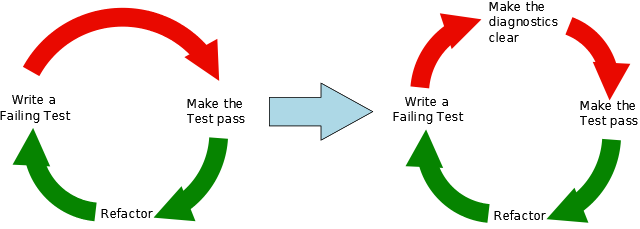
Automated tests gain more and more popularity in our field and our company. Avoiding being slowed down by tests becomes crucial. Steve Freeman has a nice talk on infoq.com with many advices for maintaining the benefits of automated testing without producing too much drag. One seldomly discussed topic is test diagnostics and immediately caught our attention. In short your aim is to produce as meaningful messages as possible for failing tests. This leads to the extended TDD cycle depicted below.

There are several techniques to improve the diagnostics of failing tests. Here is a short list of the most important ones:

  • Using assertion messages to make clear what exactly failed
  • Using “named objects” where you essentially just override the toString()-method of some type in your tests to provide meaning for the checked value
    Date startDate = new Date(1000L) {
        @Override
        public String toString() {
            return "startDate";
        }
    };
    
    
  • Using “tracer objects” by giving names to mocks/collaborators in the test, e.g. in Mockito-syntax:
    EventManager em1 = mock(EventManager.class, "Gavin");
    EventManager em2 = mock(EventManager.class, "Frank");
    // do something with them
    

Conclusion

By applying the extended TDD-cycle you can drastically reduce guessing of what went wrong and find regressions much faster without using debug messages or the debugger itself.

Why do (different) programming languages matter?

One common saying in software development is: use the best tool for the job. But what is the best tool? I think the best tool is determined by two things: how it fits the problem domain and how it fits your mental model.

One common saying in software development is: use the best tool for the job. But what is the best tool? I think the best tool is determined by two things: how it fits the problem domain and how it fits your mental model. Why your mental model? Just use the best language available! you might think. But as humans we think in languages and even inside these languages everybody has a typical way of expressing himself. Even own words and if they become common we even have a name for it: a dialect. But it is all that you should consider when choosing a programming language? Certainly there are the tools of the trade: the IDE, debugger, profiler, etc. Here is comes down to personal preferences and most of the shortcomings in this field are short term: better tool support is on the way.
There’s another more important aspect though: the community and therefore the mindset which is brought along. The communities form how the languages are used, where the most libraries and frameworks are developed, which problem domains are tackled and what the values are. Values can be testing, elegance, simplicity, robustness, …
Since communities are consisted of individuals, individuals form what the values are. But I think the language designer lays a foundation here: take Ruby for example, Ruby was designed with the intention to make programming fun. This is one of the things that appeals to many developers and the whole community which uses Ruby. Ruby is fun.
These environments spawn amazing things like Rails or more recently RubyMotion Because of the mindset of the community and the foundation inside the language there are these fruits. Last but not least another reason to choose a language is your familiarity with it. You might choose an inferior tool or language because you know it inside out.

A short story about priorities

When you mix your own priorities with the ones of your customers, embarrassing things might happen.

Before I can tell you the story, I have to add this disclaimer: The story is true, but it wasn’t us. To protect the identities, I’ve changed nearly all the details, hopefully without watering down the essence of the story.

The assignment

A few years ago, when developing software for mobile devices wasn’t as ordinary as it is today, a freelance developer got a call from a loyal customer. He should develop a little web application that could also be used on a smartphone. The functionality of the application was minimal: Show a neat image containing two buttons to download a song teaser in two different file formats, probably MP3 and WMA. That’s all. The whole thing was a marketing app that should be used a few weeks or months and then be mothballed. Being a marketing app, the payment was very decent.

The development

The freelancer was excited to say the least. This was his chance to enter the emerging field of mobile device software development. And because it should be a web application, he would try out all these new fancy mobile web frameworks and settle for the best. The image of the website should rotate and adjust to the device screen if the user tilted his phone. And because phone screens weren’t that well equipped with pixels as today and mobile internet was expensive, the image should be optimized for the best possible tradeoff between details and file size.

Some mobile web frameworks provided access to the device type, so there were all kinds of javascript magic tricks to be potentially applied. Well, they weren’t applied, but very well could have been. The freelancer prototyped most of them, out of curiosity.

The web application itself was completed in one session once the song files and the master image were provided by the customer. The freelancer installed everything on a staging web server and communicated back success. The customer was pleased by the quick reaction time and appointed a meeting to inspect the results.

The presentation

The customer gave the freelancer a notebook attached to a beamer to present the application. The notebook had a screen resolution many times the envisioned target platform, so the intro image was very pixellated and far from appealing. The freelancer used his smartphone to present the image on a smaller screen, but the customer only shook his head: “You should develop a web application for both phones and PCs. Most of our customers will use their PC to visit the site.” The freelancer apologized and promised to add another browser switch to present a full resolution image to PC users.

Now, the freelancer continued to present the web application on his phone. He invited the customer to tilt the device and was satisfied when the web site adjusted perfectly. The customer was pleased, too. Then, he tapped on one of the buttons. Nothing happened. The whole application consisted only of two buttons and one wasn’t working. The freelancer frantically tried to figure out what had gone wrong, when the customer tapped on the other button. No reaction from that one, too. “But I’ve uploaded both song files to the right location with the right access rights.”, the freelancer just said to himself when it dawned him: He forgot to insert the link tags in the HTML file. The buttons were just images. He never actually clicked on one of the buttons during development.

The moral of the story

Recapitulating, the freelancer was asked to develop a web application with an image and two download buttons, but he managed to cripple the image for the larger part of the anticipated users and never provide any download functionality at all. The customer’s requirements somehow got lost along the way.

This isn’t so much a story about a confused freelancer or improper requirement analysis. It’s a story about priorities. The customer expressed his priorities through the requirements. The freelancer superimposed his own priorities very early in the process (without telling anybody) and never returned to the original set until the presentation. And while it is granted to have a secondary agenda as a service provider, it should never interfere with the primary agenda – the one set by the customer.

Don’t fool yourself into thinking that this could never happen to you. It’s not always as obvious as in this story. Some, if not most of your customer’s priorities are unintentionally (or even intentionally) kept secret. They can only be traced during live exercises, which is why early prototyping and using the prototype in real scenarios is a good way to reveal them.

The 2012 Experience

Do you know that feeling when you use or look at some kind of device, software, technology or service and think that there is an easier, faster, nicer or simply better way to do it? To put it simply, when something is just inconvenient to use. Earlier this year, in a discussion we had about some inconvenient every day technology the phrase “That does not feel like 2012!” was used to describe this feeling. Since then, the “2012 experience” has become kind of an inofficial commendation we award in our discussions.

For me, this sentence says it all. In the year 2012 (that some claim to be our last) there are still more than enough products that make every day life and work unnecessarily complicated. Despite various existing techniques, good practices and, most important, lots of examples that can show producers how to create a good 2012 experience.

Even though the phrase was originally coined describing a scientific API, the last few weeks taught me that this phenomenon is by no means unique to our profession. The worst non-2012 experiences I had thus far were with service hotlines. While there are many examples of good 2012 experiences leaving me with the feeling that my issue is taken care of, there are also those that leave me with the urge to immediately dial again and hope for another service employee.

Regardless of the work I do, be it developing an API, designing a GUI or providing customer support, I always try to imagine how I would expect it to be done by someone else to leave me contended.

Basic Image Processing Tasks with OpenCV

2D detectors and scientific CCD cameras produce many megabytes of image data. Open source library OpenCV is highly recommended as your work horse for all kinds of image processing tasks.

For one of our customers in the scientific domain we do a lot of integration of pieces of hardware into the existing measurement- and control network. A good part of these are 2D detectors and scientific CCD cameras, which have all sorts of interfaces like ethernet, firewire and frame grabber cards. Our task is then to write some glue software that makes the camera available and controllable for the scientists.

One standard requirement for us is to do some basic image processing and analytics. Typically, this entails flipping the image horizontally and/or vertically, rotating the image around some multiple of 90 degrees, and calculcating some statistics like standard deviation.

The starting point there is always some image data in memory that has been acquired from the camera. Most of the time the image data is either gray values (8, or 16 bit), or RGB(A).

As we are generally not falling victim to the NIH syndrom we use open source image processing librarys. The first one we tried was CImg, which is a header-only (!) C++ library for image processing. The header-only part is very cool and handy, since you just have to #include <CImg.h> and you are done. No further dependencies. The immediate downside, of course, is long compile times. We are talking about > 40000 lines of C++ template code!

The bigger issue we had with CImg was that for multi-channel images the memory layout is like this: R1R2R3R4…..G1G2G3G4….B1B2B3B4. And since the images from the camera usually come interlaced like R1G1B1R2G2B2… we always had to do tricks to use CImg on these images correctly. These tricks killed us eventually in terms of performance, since some of these 2D detectors produce lots of megabytes of image data that have to be processed in real time.

So OpenCV. Their headline was already very promising:

OpenCV (Open Source Computer Vision) is a library of programming functions for real time computer vision.

Especially the words “real time” look good in there. But let’s see.

Image data in OpenCV is represented by instances of class cv::Mat, which is, of course, short for Matrix. From the documentation:

The class Mat represents an n-dimensional dense numerical single-channel or multi-channel array. It can be used to store real or complex-valued vectors and matrices, grayscale or color images, voxel volumes, vector fields, point clouds, tensors, histograms.

Our standard requirements stated above can then be implemented like this (gray scale, 8 bit image):

void processGrayScale8bitImage(uint16_t width, uint16_t height,
                               const double& rotationAngle,
                               uint8_t* pixelData)
{
  // create cv::Mat instance
  // pixel data is not copied!
  cv::Mat img(height, width, CV_8UC1, pixelData);

  // flip vertically
  // third parameter of cv::flip is the so-called flip-code
  // flip-code == 0 means vertical flipping
  cv::Mat verticallyFlippedImg(height, width, CV_8UC1);
  cv::flip(img, verticallyFlippedImg, 0);

  // flip horizontally
  // flip-code > 0 means horizontal flipping
  cv::Mat horizontallyFlippedImg(height, width, CV_8UC1);
  cv::flip(img, horizontallyFlippedImg, 1);

  // rotation (a bit trickier)
  // 1. calculate center point
  cv::Point2f center(img.cols/2.0F, img.rows/2.0F);
  // 2. create rotation matrix
  cv::Mat rotationMatrix =
    cv::getRotationMatrix2D(center, rotationAngle, 1.0);
  // 3. create cv::Mat that will hold the rotated image.
  // For some rotationAngles width and height are switched
  cv::Mat rotatedImg;
  if ( (rotationAngle / 90.0) % 2 != 0) {
    // switch width and height for rotations like 90, 270 degrees
    rotatedImg =
      cv::Mat(cv::Size(img.size().height, img.size().width),
              img.type());
  } else {
    rotatedImg =
      cv::Mat(cv::Size(img.size().width, img.size().height),
              img.type());
  }
  // 4. actual rotation
  cv::warpAffine(img, rotatedImg,
                 rotationMatrix, rotatedImg.size());

  // save into TIFF file
  cv::imwrite("myimage.tiff", gray);
}

The cool thing is that almost the same code can be used for our other image types, too. The only difference is the image type for the cv::Mat constructor:


8-bit gray scale: CV_U8C1
16bit gray scale: CV_U16C1
RGB : CV_U8C3
RGBA: CV_U8C4

Additionally, the whole thing is blazingly fast! All performance problems gone. Yay!

Getting basic statistical values is also a breeze:

void calculateStatistics(const cv::Mat& img)
{
  // minimum, maximum, sum
  double min = 0.0;
  double max = 0.0;
  cv::minMaxLoc(img, &min, &max);
  double sum = cv::sum(img)[0];

  // mean and standard deviation
  cv::Scalar cvMean;
  cv::Scalar cvStddev;
  cv::meanStdDev(img, cvMean, cvStddev);
}

All in all, the OpenCV experience was very positive, so far. They even support CMake. Highly recommended!

Your own CI-based RPM build farm, part 3

In my previous post we learned how to build RPM packages of your software for multiple versions of your target distribution(s). Now I want to present a way of automating the build process and building packages on/for all target platforms. You should have a look at the openSUSE build service to see if it already fits your needs. Then you can stop reading here :-).

We needed better control over the platforms and the process, so we setup a build farm based on the Jenkins continuous integration (CI) server ourselves. The big picture consists of the following components:

  • build slaves allowing a jenkins user to do unattended builds of the packages
  • Jenkins continuous integration server using matrix builds with build slaves for each target platform
  • build script orchestrating the build of all our self-maintained packages
  • jenkins job to deploy the packages to our RPM repository

Preparing the build slaves

Standard installations of openSUSE need some minor tweaks so they can be used as Jenkins build slaves doing unattended RPM package builds. Here are the changes we needed to make it work properly:

  1. Add a user account for the builds, e.g. useradd -m -d /home/jenkins jenkins and setup a password with passwd jenkins.
  2. Change sshd configuration to allow password authentication and restart sshd.
  3. We will link the SOURCES and SPECS directories of /usr/src/packages to the working copy of our repository, so we need to delete the existing directories: rm -r /usr/src/packages/SPECS /usr/src/packages/SOURCES /usr/src/packages/RPMS /usr/src/packages/SRPMS.
  4. Allow non-priviledged users to work with /usr/src/packages with chmod -R o+rwx /usr/src/packages.
  5. Copy the ssh public key for our git repository to the build account in ~/.ssh/id_rsa
  6. Test ssh access on the slave as our build user with ssh -v git@repository. With this step we confirm the host authenticity one time so that future public key ssh interactions work unattended!
  7. Configure git identity on the slave with git config --global user.name "jenkins@build###-$$"; git config --global user.email "jenkins@buildfarm.myorg.net".
  8. Add privileges for the build user needed for our build process in /etc/sudoers: jenkins ALL = (root) NOPASSWD:/usr/bin/zypper,/bin/rpm

Configuring the build slaves

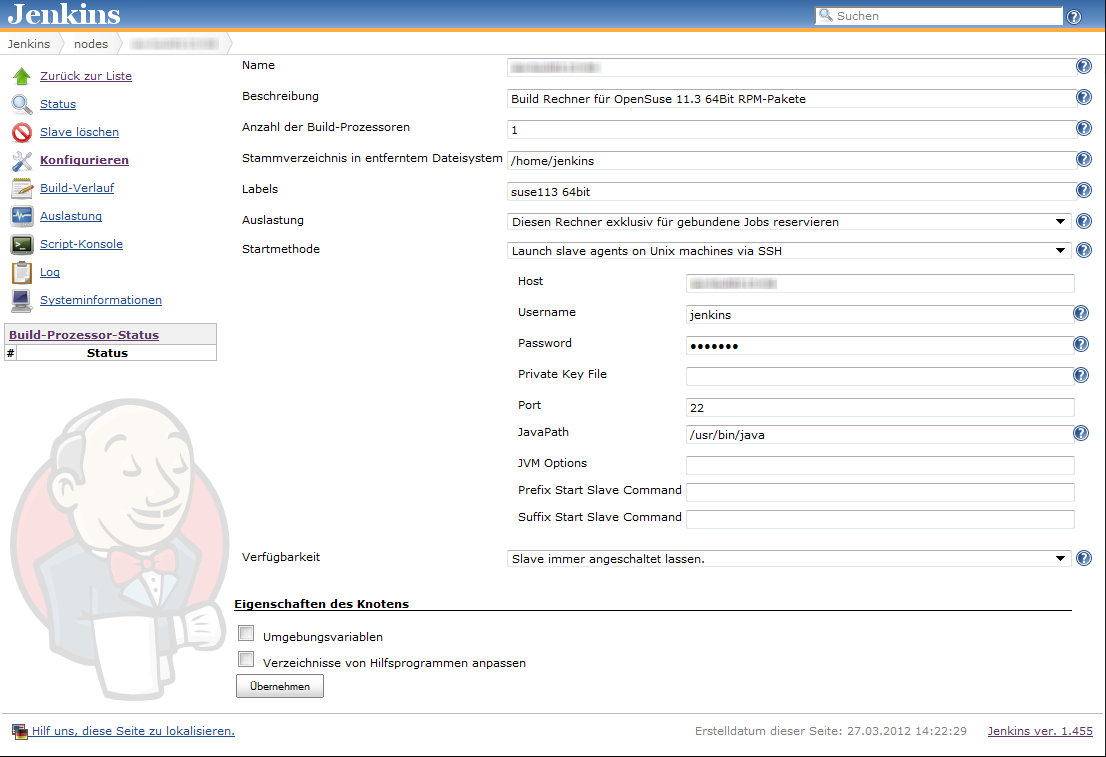
Linux build slaves over ssh are quite easily configured using Jenkins’ web interface. We add labels denoting the distribution release and architecture to be easily able to setup our matrix builds. Then we setup our matrix build as a new job with the usual parameters for source code management (in our case git) etc.

Our configuration matrix has the two axes Architecture and OpenSuseRelease and uses the labels of the build slaves. Our only build step here is calling the script orchestrating the build of our rpm packages.

Putting together the build script

Our build script essentially sets up a clean environment, builds package after package installing build prerequisites if needed. We use small utility functions (functions.sh) for building a package, installing packages from repository, installing freshly built packages and removing installed RPM. The script contains roughly the following phases:

  1. Figure out some quirks about the environment, e.g. openSUSE release number or architecture to build.
  2. Clean the environment by removing previously installed self-built packages.
  3. Setting up the build environment, e.g. linking folder from /usr/src/packages to our working copy or installing compilers, headers and the like.
  4. Building the packages and installing them locally if they are a dependency of packages yet to be built.

Here is a shortened example of our build script:

#!/bin/bash

RPM_BUILD_ROOT=/usr/src/packages
if [ "i686" = `uname -m` ]
then
  ARCH=i586
else
  ARCH=`uname -m`
fi
SUSE_RELEASE=`cat /etc/SuSE-release | sed '/^[openSUSE|CODENAME]/d' | sed 's/VERSION =//g' | tr -d '[:blank:]' | sed 's/\.//g'`

source functions.sh

# setup build environment
ensureDirectoryLinks
# force a repository refresh without checking the signature
sudo zypper -n --no-gpg-checks refresh -f OUR_REPO
# remove previously built and installed packages
removeRPM libomniORB4.1
removeRPM omniNotify2
# install needed tools
installFromRepo c++-compiler
if [ $SUSE_RELEASE -lt 121 ]
then
  installFromRepo java-1_6_0-sun-devel
else
  installFromRepo jdk
fi
installFromRepo log4j
buildRPM omniORB
installRPM $ARCH/libomniORB4.1
installRPM $ARCH/omniORB-devel
installRPM $ARCH/omniORB-servers
buildAndInstallRPM omniNotify2 $ARCH

Deploying our packages via Jenkins

We setup a second Jenkins job to deploy successfully built RPM packages to our internal repository. We use the Copy Artifacts plugin to fetch the rpms from our build job and put them into a directory like all_rpms. Then we add a build step to execute a script like this:

for i in suse-12.1 suse-11.4 suse-11.3
do
  rm -rf $i
  mkdir -p $i
  versionlabel=`echo $i | sed 's/[-\.]//g'`
  cp -r "all_rpms/Architecture=32bit,OpenSuseRelease=$versionlabel/RPMS" $i
  cp -r "all_rpms/Architecture=64bit,OpenSuseRelease=$versionlabel/RPMS" $i
  cp -r "all_rpms/Architecture=64bit,OpenSuseRelease=$versionlabel/SRPMS" $i
  rsync -e "ssh" -avz $i/* root@rpmrepository.intranet:/srv/www/htdocs/OUR_REPO/$i/
  ssh root@rpmrepository.intranet "createrepo /srv/www/htdocs/OUR_REPO/$i/RPMS"

Summary

With a setup like this we can perform an automatic build of all our RPM packages on several targetplatform everytime we update one of the packages. After a successful build we can deploy our new packages to our RPM repository making them available for our whole organisation. There is an initial amount of work to be done but the rewards are easy, unattended package updates with deployment just one button click away.