Bear up against static code analysis

If you ever had the urge to switch off a rule in your static code analysis tool, this article tries to convince you not to do it. By accepting challenges presented by your tools, you become a better developer and clean up your code on the run.

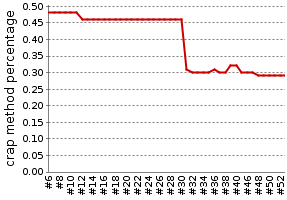
One of the first things we do when we join a team on a new (or existing) project is to set up a whole barrage of static code analysis tools, like Findbugs, Checkstyle or PMD for java (or any other for virtually every language around). Most of these tools spit out tremendous amounts of numbers and violated rules, totally overwhelming the team. But the amount of violations, (nearly) regardless how high it might be, is not the problem. It’s the trend of the violation curve that shows the problem and its solution. If 2000 findbugs violations didn’t kill your project yet, they most likely won’t do it in the future, too. But if for every week of development there are another 50 violations added to the codebase, it will become a major problem, sooner or later.

Visibility is key

So the first step is always to gain visibility, no matter how painful the numbers are. After the initial shock, most teams accept the challenge and begin to resolve issues in their codebase as soon as they appear and slowly decrease the violation count by spending extra minutes with fixing old code. This is the most valuable phase of static code analysis tools: It enables developers to learn from their mistakes (or goofs) without being embarrassed by a colleague. The analysis tool acts like a very strict and nit-picking code review partner, revealing every flaw in the code. A developer that embraces the changes implied by static analysis tools will greatly accelerate his learning.

But then, after the euphoric initial challenges that improve the code without much hassle, there are some violations that seem hard, if not impossible to solve. The developer already sought out his journey to master the tool, he cannot turn around and just leave these violations in the code. Surely, the tool has flaws itself! The analysis brought up a false positive here! This isn’t faulty code at all, it’s just an overly pedantic algorithm without taste for style that doesn’t see the whole picture! Come to think about it, we have to turn off this rule!

Leave your comfort zone

When this stage is reached, the developers have a deep look into the tool’s configuration and adjust every nut and bolt to their immediate skill level. There’s nothing wrong with this approach if you want to stay on your skill level. But you’ll miss a chance to greatly improve your coding skills by allowing the ruleset to be harder than you can cope with now. Over time, you will come up with solutions you now thought are impossible. It’s like fitness training for your coding skills, you should raise the bar every now and then. Unlike fitness training, nobody gets hurt if the numbers of your code analysis show more violations than you can fix up right now. The violations are in the code, if you let them count or not.

Once, a fellow developer complained really loud about a specific rule in a code analysis tool. He was convinced that the rule was pointless and should be switched off. I asked about a specific example where this rule was violated in his code. When reviewing the code, I thought that applying the rule would improve the code’s internal structure (it was a rule dealing with collapsible conditional statements). In the discussion on how to implement the code block without violating the rule, the real problem showed up – my colleague couldn’t think about a solution to the challenge. So we proceeded to implement the code block in a dozen variations, each without breaking the rule. After the initial few attempts that I had to lead program for him, he suddenly came up with even more solutions. It was as if a switch snapped in his head, from “I’m unable to resolve this stupid rule” to “Hey, if we do it this way, we even can get rid of this local variable”.

Embrace challenges

Don’t trick yourself into thinking that just because your analysis tool doesn’t bring up these esoteric violations anymore after you switched off the rules, they are gone. They are still in your code, just hidden and without your awareness. Bear up against your analysis tool and fix every violation it brings you, one after the other. The tools aren’t there to annoy you, they want to help you stay clear of trouble by pointing out the flaws in a clear and precise manner. Once you meet the challenges the tool presents you with, your skill level will increase automatically. And as a side effect, your code becomes cleaner.

Beyond clean code

Even if every analysis tool approves your code as being clean, it can still be improved. You might have a look at Object Calisthenics or similar code training rulesets. They work the same way as the analysis tools, but without the automatic enforcement (yet). The goal is always cleaner code and higher skilled developers.

Looping in C++

What is “the best” way to loop over collections in C++?

One recurring discussion point in one of our customers C++ project team is the following:

What is “the best” way to loop over collections?

In a typical scenario there is a standard container like std::list, or some equivalent collection, and the task is to do something with every element in the collection. The straight forward way would be like this:

std::list<std::string> mylist;
for (std::list<std::string>::iterator iter = mylist.begin(); iter != mylist.end(); iter++)
{
   ...
}

This code is correct and readable. But my guess is that most of you instantly see at least two possible improvements:

  1. the call to mylist.end() occurs in every loop an can be expensive e.g. in case of long std::lists
  2. iter++ creates one unnecessary intermediate object on the stack

So this

for (std::list<std::string>::iterator iter = mylist.begin(), end = mylist.end(); iter != end; ++iter)
{
   ...
}

would be much better but can already be seen as a little less readable.

Using BOOST_FOREACH can save you much of this still tedious code but has one nasty pitfall when it comes to std::maps.

In some places of the code base std::for_each is used together with a function, or function object.  The downside of this is that the function/function object code is not located where the loop occurs. However, this can be made “readable enough” when the function, or function object does only one thing and has a telling name.

Looping is sometimes done to create other collections of objects for each element. What to do there? Define the new collection use a for-loop of BOOST_FOREACH like above, or use std::transform with the same downside as std::for_each?

The other day one team member suggested to use boost::lambda expressions in loops. The initial usage examples where very promising but let me tell you – readability can drop dramatically very fast if you don’t be careful. It is very easy to get carried away with boost’s lambdas. I happened that we found ourselves having spent the last hour to carve out a super crisp lambda expression that takes anybody else another hour to read.

So the initial question remains undecided and will most likely stay like that. As for everything else in programming, there doesn’t seem to be a silver bullet for this task.

How do you go about looping in C++? Do you have some kind of coding style in place? Do you use std::for_each, BOOST_FOREACH, or some other means?

Looking forward to some feedback.

Simple code, subtle bugs: write unit tests!

We developed an applet some years ago that was supposed to run 24/7. Basically, it fetches some values periodically and plots them in a chart. It always shows the last 24 hours. Everything seemed to work fine but every few weeks it crashed. The problems were clouded by hardware instabilities and the use of some obscure JVM. After quite a bit of analysis it became clear that it was a bug in our applet: a memory leak. Here is the troublemaker code:

for (int i = 0; i < dataSeries.getItemCount(); i++) {
    XYDataItem dataItem = dataSeries.getDataItem(i);
    if (dataItem.getX().longValue() < startDate.getTime().getTime()) {
        dataSeries.remove(i);
    } else {
        break;
    }
}
dataSeries.add(newDataPoint);

This simple and innocently looking piece of code essentially removes old items from a list by index. Many of you may already have spotted the main problem leading to the leak. Removing items by index means that following items shift one place towards the head of the list. As the index is incremented one element is skipped by the next iteration. This added up over time and lead to an OutOfMemoryError after some weeks.

Now, even if the code is not great it does relatively look straightforward on first sight, yet it is not and is contains errors. Making things worse, the code was buried somewhere in some tangled logic. This leads me to the point of my post:

Write unit tests even for relatively simple code.

Most likely writing a unit test for this cleanup work would have led to a class that manages the dataSeries and nothing more. Quite easy to understand and test in isolation. The problem would never have slipped into production and caused months of  investigating different stability problems.

The programmer may not have been aware of iterators but he should have made sure that this block works as intended. The best way to do this is automated unit tests. They make sure that your building blocks are as solid as you expect them to be. Use acceptance testing to make sure you have put your building blocks together the right way. Together unit and acceptance tests will save countless hours hunting regressions.

Clean code is not enough

Not only well-crafted software, but useable and delightful software.

I keep hearing stuff like:
“we as software developers are craftsmen and should honor our craft and write clean code”

Using the metaphor of a craftsman we should also realize that we are building software for people (to use) not for its own sake.
Imagine a chair which is perfectly crafted and beautiful to look at but you can’t sit on it?
It might be art but nobody can use it for its original purpose.

Most if not all of the software we write is for people to use, to be empowered and yes, to be delighted.
But to what use (besides art) is a software which is cleanly built but unusable?
We as software developers have shied away for too long from learning to craft useable interfaces.
I think we should not neglect that we develop software for others to use.
A program is not an island, it only excels when it interacts with users or other programs.

Not only well-crafted software, but useable and delightful software.

Spice up your unit testing

Writing unit tests shouldn’t be a chore. This article presents six tools (with alternatives) that help to improve your developer experience.

Writing unit tests is an activity every reasonable developer does frequently. While it certainly is a useful thing to do, it shouldn’t be a chore. To help you with the process of creating, running and evaluating unit tests, there are numerous tools and add-ons for every programming language around. This article focusses on improving the developer experience (the counterpart of “user experience”) for Java, JUnit and the Eclipse IDE. I will introduce you to the toolset we are using, which might not be the complete range of tools available.

Creating unit tests

  • MoreUnit – This plugin for Eclipse helps you to organize your unit test classes by maintaining a connection between the test and the production class. This way you’ll always see which classes and methods still lack a corresponding test. You can take shortcuts in the navigation by jumping directly into the test class and back. And if you move one file, MoreUnit will move the other one alongside. It’s a swiss army knife for unit test writers and highly recommended.
  • EqualsVerifier – If you ever wrote a custom implementation of the equals()/hashcode() method pair, you’ll know that it’s not a triviality. What’s even more intimidating is that you probably got it wrong or at least not fully correct. The effects of a flawed equals() method aren’t easily determinable, so this is a uncomfortable situation. Luckily, there is a specialized tool to help you with this task exactly. The EqualsVerifier library tests your custom implementation against all aspects of the art of writing an equals() method with just one line of code.
  • Mockito (and EasyMock) – When dealing with dependencies of classes under test, mock objects can come in handy. But writing them by hand is tedious, boring and error-prone. This is where mock frameworks can help by reducing the setup and verification of a mock object to just a few lines of code. EasyMock is the older of the two projects, but it manages to stay up-to-date by introducing new features and syntax with every release. Mockito has a very elegant and readable syntax and provides a rich feature set. There are other mock frameworks available, too.

Running unit tests

  • InfiniTest (and JUnit Max) – Normally, you have to run the unit tests in your IDE by manually clicking the “run” button or hitting some obscure keyboard shortcut. These two continuous testing tools will run your tests while you still type. This will shorten your test feedback loop to nearly milliseconds after each change. Your safety net was never closer. InfiniTest and JUnit Max are both Eclipse plugins, but the latter costs a small annual fee. It’s written by Kent Beck himself, though.

Evaluating unit tests

  • EclEmma (and Cobertura) – If you want to know about the scope or “coverage” of your tests, you should consult a code coverage tool. Cobertura produces really nice HTML reports for all your statistical needs. EclEmma is an Eclipse plugin that integrates the code coverage tool Emma with Eclipse in the finest way possible. Simply run “coverage as” instead of “run as” and you are done. All the hassle with instrumenting your classes and setting up the classpath in the right order (major hurdles when using cobertura) is dealt with behind the scenes.
  • Jester (and Jumble) – The question “who tests my tests?” is totally legit. And it has an answer: Every mutation testing tool around. For Java and JUnit, there are at least two that do their job properly: Jester works on the source code while Jumble uses the bytecode. Mutation testing injects little changes into your production code to test if your tests catch them. This is a different approach on test coverage that can detect code that is executed but not pinned down by an assertion. While Jester has a great success story to tell, Jumble tends to produce similar results as cobertura’s condition coverage report, at least in my experience.

Summary

As you can see, there is a wide range of tools available to improve your efforts to write well-tested software. This list is in no way comprehensive. If you know about a tool that should be mentioned, we would love to read your comment.

CMakeBuilder Version 1.9

Introducing CMakeBuilder plugin version 1.9.

Today, I want to announce version 1.9 of the CMakeBuilder plugin for Jenkins (formerly known as Hudson). Concluding from the user feedback, there are no major missing features – at least for the moment.

So for this version, I implemented only one visible enhancement: It is now possible to use environment variables in every configuration setting. Even settings like “Preload Script” “Make Command” or “Install Command” can now be configured with the support of environment variables.

The major invisible change I did was the migration to the Jenkins development infrastructure using this very helpful guide. Moving the whole thing to git will be next.

Check it out!

Reversing an array in Java

Reversing an array is a popular interview question especially in languages like C. Some days ago I faced the problem in a Java legacy project I was maintaining. As a Java guy I did not want to fiddle with a for-loop and indexes. So I looked for another solution. Besides showing the one-liner I want to give some insights which some might not be aware of. Here is my solution:

public static <T> T[] reverse(T[] array) {
    Collections.reverse(Arrays.asList(array));
    return array;
}
  1. This approach works, because the ArrayList implementation Arrays.asList() returns a specially tailored ArrayList which writes the changes right through to the backing array. It is not a java.util.ArrayList!
  2. The above means that the array is changed in-place and no array copying is involved. The approach thus has good performance it that matters.
  3. My solution directly changes the given array. To make it free of side-effects you could create a new array and copy the original one into it before converting to a list and reversing.

Side note regarding Arrays.asList()

Arrays.asList() is nice for bridging to old code and APIs. It has to be used with caution though: If you read the API documentation and keep 1.) in mind you will notice, that the returned list is fixed size. So calls to add() and remove() will fail with an UnsupportedOperationException! Passing such lists around in your system using the java.util.List interface may lead to unexpected behaviour since most people expect lists to be of variable sized in Java. In our use case we do not return the resulting list to the caller but only use it temporarily and locally. So this is no problem here.

Conclusion

Reversing an array can be a nice interview question for Java candidates too as you can discuss about in-place reversing, memory and time complexity and different approaches. It may show their knowledge of the collection API and the utility classes. If the above approach is discovered there is also something to discuss as depicted in this article.

Grails: The good, the bad, the ugly

(Opinion!) After 3 years of Grails development it is time to take a step back and look how well we went.

After 3 years of Grails development it is time to take a step back and look how well we went.
(Info: we made several Grails apps ranging from small (<15 domain classes) to medium sized (50-70 domain classes) using front ends like Flex/Flash and AJAX)

The good parts

Always start with praise. So I tell you what in my opinion was and is good about developing in Groovy and Grails.

Groovy is Java with sugar

The Groovy syntax and the type system are so close to Java, so that when you come from a Java background you feel right at home.

Standard web stack

If you are accustomed to standard technologies like Spring and Hibernate you see Grails as a vacation.

Sensible defaults aka Convention over configuration

Many of the configuration options are filled with sensible defaults.

Fast start

You get from 0 to 100 in almost no time.

The bad things

Things which are not easily avoided.

Bugs, bugs, bugs

Grails has many, many bugs, unfortunately even in such fundamental things such as data binding and validation. A comment from a previous blog post: “To me, developing with Grails always felt like walking on eggs.”

Regression

Some bugs sneak back in again or are even reopened. Note that this is not the same as bugs, bugs, bugs because fixed bugs should be secured by a test.

Leaky abstractions

You have to know the underlying technologies especially Hibernate and Spring to get a foot on the ground. The GORM layer inherits all the complexity from Hibernate.

Slow integration tests

The ramp up time is 45 s on a decent build/development machine and then the first test hasn’t even started.

Uses the Java way of solving problems

Got a problem? There’s a framework for that!

Abandoned or prototype like plugins

Take a look at the list of plugins like Autobase, Flex.

Problems with incremental compiling

Don’t know where the real cause is buried: but using IntelliJ for developing Grails projects results in comments like:
Not working? Have you cleaned, invalidated your caches, rebuilt your project, deleted the .grails directory?

The ugly things

Things which are easily avoided or just a minor issue.

Groovys use of == and equals

Inherited from Java and made even worse: compare two numbers or a String and a GString

Groovys definition for the boolean truth

0, [], “”, null, false are all false

Groovys use of the NullObject and the plus operator

Puzzler: what is null + null ?

Uses unsupported/discontinued technologies

Hibernates SchemaExport comes to mind.

Mix of technology and intention

hasMany, hasOne, belongsTo have not only an intention revealing function but also determine how cascading works and the schema is generated.

Summary, opinionated

Grails has deficits and is bug ridden. But this will be better in the future (hopefully).
When you compare Grails with standard web stacks in the Java world you can gain a lot from it.
So if you want to know if you should use Grails in your next project ask yourself:

  • do you have or want to use Spring and Hibernate?
  • can you live without static typing? (remember: with freedom comes responsibility)
  • are you ready to work around or even fix an issue or bug?
  • is Java your home?

If you can answer all those questions with Yes, then Grails is for you. But beware: no silver bullets!

Fluent code – challenge your compiler

Learn how to leverage the abilities of your compiler to achieve highly readable code in Java (and probably other similar languages).

Making code more readable, that is, easier to read and therefor easier to grasp, has always been an important secondary goal for me when writing code. The primary goal is correctly working software, but immediately after the code works, it enters maintainance mode. Refactoring is a great tool to improve the structure and accessibility of existing code, but it doesn’t necessarily lead to code that is more readable. I’ve even found that there are multiple levels of “easily accessible” code, depending on your experience with different code structures. But that’s another topic for another blog post.

Readable code

Before I can talk about how to create readable code, I have to define what “readable” means to me: I see readable code as code everybody can read (out loud) and directly understand without further reference.

Here’s an example of a little code snippet in Java that follows my definition:

ForeachFile.in(directory).checkIf(IsOlder.than(5).days());

If you replace the parentheses and dots with whitespace, you can read the line fluently and gain a proper idea of what it is doing.

I’ve always found it much easier to write code similar to this example in dynamic languages. In Groovy, Scala or Perl, you are used to invent your own domain specific language dialect that’s much more readable and concise than using the underlying API directly with all the tedious details. But with a bit of practice, Java (and other statically typed languages) are nearly as flexible to reach (or get near) the highest level of readability: code in natural language.

Start with a sentence

The easy way to accomplish the really challenging task of matching computer programming language and naturally spoken language is to pass it on to the compiler. Start with the desired behaviour of a line of code written as a sentence. The compiler will raise all kinds of objections against this form of programming, and all you have to do is to follow the compiler’s complaints, add some special characters and camel casing and then fill out the classes and methods you just planned ahead.

In reality, it will not be as easy as outlined above, but the process stays the same:

  1. Write your desired code, neglecting all compiler errors
  2. Identify method calls, method parameters, class names and other language features as it fits best
  3. Outline the next code you’ll have to write by silencing the compiler with code stubs (use the code generation features of your IDE)
  4. Fill out the (empty) spots you just created, starting with point 1.

Your first attempts might not be as successful as hoped, so you have to backtrack and adjust for perfectly fluent code to a slightly less perfect form, but that’s just reasonable. You still came up with the possibly most readable code you were able to write.

Know when to stop

Although the process seems to be indefinitely repeatable as you descend deeper and deeper in your code (assuming you started with rather high-level code), there will be a fine line when you have to stop the process because the technical aspects of your code will overwhelm every attempt to wrap natural language around it. You probably still have a good amount of perfectly readable code that even non-programmers can grasp at first sight. Just if you dig deeper into its details, the readability will fade.

Your code will be partitioned into two regions: One region is meant to be read, understood and adjusted if requirements change. The other part of the code isn’t as readable and exists mostly to support the first type of code. This is where you still have to be a programmer to make a change. I assume that your partitioning will meander on the border between business requirements and technical implementation.

Observations along the way

My experimentation phase with this kind of programming revealed some insights that mostly other developers made intuitively when exposed to this style in pair programming sessions.

The most interesting revelation was that the names of my classes change: Instead of using nouns, I tend to use verbs in combination with prepositions (like CheckThat, CreateSome or WaitUntil). This is unfamiliar when reading the class name in isolation, but won’t bother you if you read it in the context of the use case.

Which brings me to the next revelation: The resulting code from the abovementioned process seems to be highly focussed on the current use case. It’s not that it isn’t modifiable or inflexible, but it will serve the task at hand in the best way and fall somewhat short for other use cases. It’s in the ability of the developer to refactor the code once additional use cases appear.

Due to the structuring the natural language imposes on the code, refactorings seem to have a “scope” that can verify if the change at hand is really suitable to bring the code forward. It will be very obvious if a refactoring breaks the ruling structure of the code – the readability of your code will degrade.

Another example

Here is another example of readable code written by the process described above, this time copied from an acceptance test:

station.currentPackage().withTypicalContent().send();
WaitUntilPackage.from(stationName).isProcessedWithin(
    Wait.LONGER).asShownOn(center().statusbar());
Wait.SHORT.perform();
assertThatFilesAreStoredInArchive();
assertThatFilesAreStoredOn(ftpSpace, with(exportName));

You can see that it aren’t always the classnames that drive the code, method names are just as important. And you can see the fitting usage of a code squiggle in the last line, a technique I often use to squeeze in the last missing pieces of fluency.

Summary

Writing readable code that can be read and understood by virtually everyone is a tough task. The programming cycle presented in this article uses the compiler’s ability to complain and the feature of modern IDE to create code stubs (named “quick fixes” or alike) to outline naturally readable code and then fill out the gaps in the best attempt. The result will be code that looks like plain english for the most important parts of the code, the translation of the business requirements. The downside is slightly unusual naming and structure in the other parts of your code.

If you have experiences with this approach to readable code, let us know about it.

Podcasts

Podcasts are a very good means to shorten your commute, to keep you entertained during otherwise boring house-keeping activities, or, if you’re into sports, during your training sessions. Here is a list of some of my favourite shows.

This Developer’s Life

Rob Conery and Scott Hanselman interview developers and other IT professionals who share their stories. Very interesting, very well edited and flavoured with some nice pieces of music.

TechZing

Basically, TechZing are two guys, Jason Roberts and Justin Vincent, who discuss different topics concerning their lives as freelance web developers and startup bootstrappers. They enjoy themselves very much just talking to each other which is very entertaining already. The occasional interview and panel shows are then the icing on the cake.

It’s impossible to give a clear range of  topics since they consist of technical stuff like ‘how to store images in web applications’, SEO, NoSQL, JavaScript and iPhone development, but also non IT stuff like Pioneer One, geological challenges, and the Luck-Surface-Area. Edutainment at its best! Highly recommended!

Software Engineering Radio

This is purely an interview show which addresses all sorts of topics of interest for professional software developers: languages, platforms, technologies, methodologies, etc. Very informative, high profile guests and very competent hosts. Unfortunately, the output rate has gone down a lot in the last year.

Software ArchitekTOUR Podcast

This german (with little bits of swabian) speaking podcast is mostly concerned with topics around software architecture (as the name already suggests). DSLs, NoSQL databases and REST have been some of the latest topics.

FLOSS Weekly

Randal Schwartz (mostly) and other hosts are talking about Free Libre Open Source Software projects, ranging from whole OSes like CentOS to smaller niche projects like Ledger. Great show if you want to know what’s going on in the Open Source world.

Security Now

Steve Gibson and Leo Laporte talk about everything related to IT security. This will keep you informed about the latest browser vulnerabilities, Adobe Flash updates and Windows patches. But you will also learn e.g. how SSL works, the details of Stuxnet and everything about BitCoins. Don’t miss the all-time favourite episode 248: The Portable Dog Killer.

What are your favourite shows?