Oracle database identity column

A few days ago, I came across the topic of identity columns in Oracle. So I decided to try it out to check if it would benefit my database tables.  I would like to share the results in this article. First, I will explain what identity columns are and how to create them.

General

If you declare a column as an identity column, the value will be automatically populated from an associated sequence generator. It is possible to add an identity column by using either the CREATE TABLE or ALTER TABLE statement. In the example below, I will show how to add it using the CREATE TABLE statement.

The column marked as an identity needs to be of the data type integer, long, or number.

CREATE TABLE EXAMPLE (
    id NUMBER GENERATED ALWAYS AS IDENTITY,
    ...
);

In this case, I ALWAYS want a value to be automatically filled in. There is also the option to only fill it if no value was specified (BY DEFAULT) or when the given value is null (BY DEFAULT ON NULL).

Additionally, you can configure the sequence as shown in the following example.

CREATE TABLE EXAMPLE (
    id NUMBER GENERATED ALWAYS AS IDENTITY
    (START WITH 1 INCREMENT BY 2 MAXVALUE 5000 NO CYCLE CACHE 100),
    ...
);

With these  settings, the sequence starts with 1 and increments by 2, so the values are 1, 3, 5, and so on. The sequence counts up to 2000 and then stop. If CYCLE is set, the sequence continues with 1 again.

The cache defines a client to request 100 pre-defined values in advance. Because of the step width of 2 for example the values 1 – 199 will be assigned. If a second client asks, it will receive the values 201 – 399. As a result, the entries in the table can have the IDs 1, 201, 3, 5, 7, 203 for example.

Using with Ruby on Rails / Active Records

My use case is to use the table in Ruby on Rails with Active Records. Here, I want Active Record to auto-increment the ID, so I can retrieve it in my program. However, if I do not use the identity column feature and also do not specify the name of a manually created sequence, Ruby always returns 0 as the ID. When I add a sequence name, I get the correct ID.

Now I am trying to change this to work with the identity column. The insert in Oracle directly with SQL works fine.

The next step is to use it in my Ruby program, and the first problem occurs. Unfortunately, it is not possible to define my own sequence name. Oracle automatically creates sequences with cryptic names like ISEQ$$_12345 for identity columns which reduces readability in code. Additionally if I recreate the table, the sequence name changes, which means I have to update my code afterwards. This seems to be the first showstopper.

Nonetheless I continue and try to create a new entry with it. The entry was created. It works! Or wait a moment. Ruby always shows 0 instead of the right ID. It seems like the program can not use the sequence correctly.  I halt my testing. Maybe it is possible to make Ruby work with identity sequences, maybe it is not. If you have already found a solution, feel free to comment.

In the end I decide that using the manually created sequence still fit better. The main reason is the naming, so I do not want to spend more time searching for a solution to make it work with Ruby.

Conclusion

Although the identity column option does not fit my use case, it is a possible to create a table column with auto-generated values in Oracle. For situations where the ID is not of interest, it can simplify the work. You do not have to create the logic with sequences and triggers on your own.
Interacting with SVG files inside your React applications

So, for some reason you have a SVG file that somehow resembles a part of the application you are currently developing.

This might be only a sketch that you want to prepare as a Click Dummy, or it might be that you need to display a somewhat unique, complicated structure that is best layed out per SVG editor. This is somewhat expected when you have customers in the technical / scientific research sector.

So now you want to fill it with life.

Now, the SVG format is quite close to the <svg> structure that one can embed into HTML, but there are some steps in between. Most importantly, most SVG Editors fill their .svg files up with meta data or specific information only required for the editor in case you want to edit the files again.

Thus, you have three choices to integrate the SVG component in a React application

  • Re-Build your SVG with custom React Components that, via JSX, render their <svg>, <g>, <path>, etc. accordingly
  • Convert your SVG to valid JSX – this is possible in many cases, but you need to take care e.g. that the style attribute is a string in the SVG and an object in JSX, also it can be still way too large to be readily put in a single React Component
  • Import your .svg as its own React Component and then wrap that into an own Component that takes care about the interaction part

While I also have written a small converter that does the SVG-JSX-Conversion just fine for me for any file that comes out of Inkscape (probably an idea for my next blog post), we had the case of some files with about 16000 lines of SVG each, so I chose the third method in our case.

In my eyes, it is very correct to mention that the following way somehow goes against the React Mindset. In which you render all your components yourself to attach them the required mouse event handlers, never having to interact with a HTML “id” or any document.getElementById() or document.getElementByClassName().

In any React application, these should be avoided, but the idea here is to have a singular point – a SvgWrapper Component – where you allow these functions because you’d agree about the need to somehow target the specific SVG elements.

The gist:

import {ReactComponent as OurHorrificSvgMonster} from "/src/monster.svg";

const OurBeautifulComponent = () => {

    useOurCarefulSvgSynchronizationEffect(); // more on this below

    return (
        <SvgWrapper>
             <OurHorrificSvgMonster/>
        </SvgWrapper>
    )
};

Quick note: you can target the embedded <svg> element itself by <OurHorrificSvgMonster ref={...}/> and you could use this (ref.current holds that HTML element) to traverse all the children, so if you know much about the structure of your svg you could even live without the <SvgWrapper>. But say someone else made the horrific svg monster and all you have is the id or class names to all the individual svg elements inside.

Then

const WithVanillaHandlersConnected = ({children}) => {
    const dispatch = useDispatch();

    React.useEffect(() => {

        const onClick = (event) => {
            dispatch(awesomeAction(event.target.id));
        };

        const awesomeElements = [...document.getElementsByClassName("awesome")];

        awesomeElements.forEach(elem => {
            elem.addEventListener("click", onClick);
        });

        return () => awesomeElements.forEach(pipe => {
            pipe.removeEventListener("click", onClick);
        });
    }, []);

    return children;
};

I chose this dispatch() as a placeholder for any interaction with the surrounding web application, it could also be a simple React state or something. You can register any event listener you want here (also “mouseover”, “mouseout”, “contextmenu”, …), but think of removing it again in the effect return function.

By the way, document.getElementsByClassName(…) returns something like a HTMLCollection which is not exactly iterable, thus the […destructuring] to make the .forEach() possible.

We now have the first part – our elements (in our case, everything that has class “awesome”) has got a click handler that allows to dispatch anything to the application state. But now they need to change, too.

In a purely React-y way, this could be done by a svg element that chooses its fill = {isActive? "magenta" : "black"} but as we choose not to render our components ourselves, we need to once again grab deeply into the DOM and dare to manipulate it by hand.

As mentioned above – this is a step towards very ugly problems as React cannot guarantee that your visual layer matches your application state. You, on yoru own, have to guarantuee to do what’s right.

This is where this comes in:

/*
 for this example, think of that the redux selector selectSomethingFromTheState returns something like:

result = [
  {elementId: "elem1", isActive: true},
  ...
];

and isActive could be the thing that was toggled by our awesomeAction() above

*/

const useOurCarefulSvgSynchronizationEffect = () => {
    const elementStates = useSelector(selectSomethingFromTheState);

    React.useEffect(() => {
        for (const state of elementStates) {
            const element = document.getElementById(state.elementId};
            element.style.fill = isActive ? "magenta" : "black";
            // ... do other stuff with the DOM element
        }
    }, [elementStates]);
};

There we have it – we have the SvgWrapper and the use…SynchronizationEffect() that both stray from the React mindset by accessing the DOM directly, but we do it in a fashion where it is concisely encapsulated inside <OurBeautifulComponent> and there is no direct knowledge about the IDs inside the SVG, or Class manipulations, CSS Selectors, etc. elsewhere.

In my opinion, one can indeed go against the rules if it’s necessary, but I also see the option for a Stockton Rush quotation here.. so, if you know of any more elegant way, please feel free to share.

PS: by the way, if you use vite, you might get an “Uncaught SyntaxError” when trying import { ReactComponent ... }I’ve written about this before.

Naming is hard and Java Enums don’t help

This is a short blog post about a bug in my code that stumped me for some moments. I try to tell it in a manner where you can follow the story and try to find the solution before I reveal it. You can also just read along and learn something about Java Enums and my coding style.

A code structure that I use sometimes is the Enum type that implements an interface:

public enum BuiltinTopic implements Topic {

    administration("Administration"),
    userStatistics("User Statistics"),
    ;
	
    private final String denotation;

    private BuiltinTopic(String denotation) {
        this.denotation = denotation;
    }
	
    @Override
    public String denotation() {
        return this.denotation;
    }
}

The Topic interface is nothing special in this example. It serves as a decoupling layer for the (often large) part of client code that doesn’t need to know about any specifics that stem from the Enum type. It helps with writing tests that aren’t coupled to locked-down types like Enums. It is just some lines of code:

public interface Topic {

    String denotation();
}

Right now, everything is fine. The problems start when I discovered that the denotation text is suited for the user interface, but not for the configuration. In order to be used in the configuration section of the application, it must not contain spaces. Ok, so let’s introduce a name concept and derive it from the denotation:

public interface Topic {

    String denotation();
	
    default String name() {
        return Without.spaces(denotation());
    }
}

I’ve chosen a default method in the interface so that all subclasses have the same behaviour. The Without.spaces() method does exactly what the name implies.

The new method works well in tests:

@Test
public void name_contains_no_spaces() {
    Topic target = () -> "User Statistics";
    assertEquals(
       "UserStatistics",
       target.name()
    );
}

The perplexing thing was that it didn’t work in production. The names that were used to look up the configuration entries didn’t match the expected ones. The capitalization was wrong!

To illustrate the effect, take a look at the following test:

@Test
public void name_contains_no_spaces() {
    Topic target = BuiltinTopic.userStatistics;
    assertEquals(
        "userStatistics",
        target.name()
    );
}

You can probably spot the difference in the assertion. It is “userStatistics” instead of “UserStatistics”. For a computer, that’s a whole different text. Why does the capitalization of the name change from testing to production?

The answer lies in the initialization of the test’s target variable:

In the first test, I use an ad-hoc subtype of Topic.

In the second test and in production, I use an object of type BuiltinTopic. This object is an instance of an Enum.

In Java, Enum classes and Enum objects are enriched with automatically generated methods. One of these methods equip Enum instances with a name() method that has a default implementation to return the Enum instances’ variable/constant name. Which in my case is “userStatistics”, the same string I expect, minus the correct capitalization of the first character.

If I had named the Enum instance “UserStatistics”, everything would have worked out until somebody changes the name or adds another instance with a slight difference in naming.

If I had named my Enum instance something totally different like “topic2”, it would have been obvious. But in this case, with only the minor deviation, I was compelled to search for problems elsewhere.

The problem is that the auto-generated name() method overwrites my default method, but only in cases of real Enum instances.

So I thought hard about the name of the name() method and decided that I don’t really want a name(), I want an identifier(). And that made the problem go away:

public interface Topic {

    String denotation();
	
    default String identifier() {
        return Without.spaces(denotation());
    }
}

Because the configuration code only refers to the Topic type, it cannot see the name() method anymore and only uses the identifier() that creates the correct strings.

I don’t see any (sane) way to prohibit the Java Enum from automatically overwriting my methods when the signature matches. So it feels natural to sidestep the problem by changing names.

Which shows once more that naming is hard. And soft-restricting certain names like Java Enums do doesn’t lighten the burden for the programmer.

Table inheritance in PostgreSQL

In a previous post I have written about tables as data types in PostgreSQL. In addition to that, PostgreSQL has a feature similar to the inheritance mechanism of data types in object-oriented programming: table inheritance.

Table inheritance allows you to create a hierarchical relationship between tables. With this feature you define a parent table, and child tables inherit columns and some constraints (like CHECK constraints and NOT NULL constraints) from it.

How it works

To begin, we create the parent table products using the following SQL code:

CREATE TABLE products (
  id     SERIAL         PRIMARY KEY,
  name   TEXT           NOT NULL,
  price  DECIMAL(10, 2) NOT NULL
);

Next, let’s create child tables that inherit from the products table. We will create two product categories: electronics and clothing. Each child table will have its own specific columns in addition to the inherited columns. To set up the inheritance relation we use the INHERITS keyword:

CREATE TABLE electronics (
  warranty_period   INT,
  power_consumption INT
) INHERITS (products);

CREATE TABLE clothing (
  size  TEXT,
  color TEXT
) INHERITS (products);

Now we insert some rows into the child tables:

INSERT INTO electronics
  (name, price, warranty_period, power_consumption)
  VALUES ('Laptop', 1439.0, 2, 536);

INSERT INTO clothing
  (name, price, size, color)
  VALUES ('T-Shirt', 5.99, 'L', 'red');

When we query each child table individually, we only get the rows we inserted into it, as expected. However, when we query the parent table, we get all the products from the child the tables:

SELECT * FROM products;

id	name	 price
--------------------
1	Laptop	 1439.00
2	T-Shirt	 5.99

Note that you can also insert rows into the parent table:

INSERT INTO products
  (name, price)
  VALUES ('Milk', 1.15);

This row will not show up in the child tables, only when querying the parent table. If you are asking yourself now if there is an equivalent to an “abstract class”, there isn’t one. Just don’t insert into the parent table if it doesn’t make sense in your domain.

If you want to query rows only from the parent table you can use the ONLY keyword:

SELECT name, price FROM ONLY products;

This keyword works also with other commands like UPDATE and DELETE.

On a final note, you can also remove the inheritance relationship from a child table with the NO INHERIT clause:

ALTER TABLE clothing NO INHERIT products;

Trying ChatGPT as a professional software developer

We are a company of software developers that does not sell a product but provides a wide range of services. Our primary service is developing individual software or maintaining existing software for our customers.

Most of us are polyglot developers each sufficiently fluent in a couple of languages. While I see this as a strength it also means that I do not know the idiomatic solution for a task in all ecosystems in use in our projects by heart.

A few days ago I had a remote-pair-programming session with one of our customers and we wondered how to idiomatically trim certain characters from a string in JavaScript. My customer came up with the idea of asking ChatGPT for a solution while I would have asked Google or stackoverflow.

Being curious we took the ChatGPT route and it delivered a correct solution after I clarified what I mean with “trim”:

function trimCharacterFromStartAndEnd(str, char) {
  // Create a regular expression to match the specified character at the beginning and end of the string
  const regex = new RegExp(`^${char}+|${char}+$`, 'g');
  
  // Use the replace() function to remove the character from the start and end of the string
  const trimmedStr = str.replace(regex, '');
  
  return trimmedStr;
}

// Example usage
const originalString = '###Hello World!###';
const trimmedString = trimCharacterFromStartAndEnd(originalString, '#');
console.log(trimmedString); // Output: Hello World!

But from a professional perspective the code was not simple, concise and idiomatic. I intuitively knew there must be a better way.

So I did what ChatGPT does best: I chatted with it to improve the solution to arrive at a solution a was satisfied with:

function trimCharacterFromStartAndEnd(str, char) {
  return str.replace(/^${char}+|${char}+$/g, '');
}

// Example usage
const originalString = '###Hello World!###';
const trimmedString = trimCharacterFromStartAndEnd(originalString, '#');
console.log(trimmedString); // Output: Hello World!

However, you possibly need to handle regex special characters like '.', '*' etc. if they can part of your characters to trim.

Some of the intermediate steps also have their uses depending on the needed flexibility. See the full conversation at trim character from string chat.

Similarily, stackoverflow provides some comprehensive answers you can adapt to your specific situation.

Evaluation

Using ChatGPT can actually provide you useful results. To make the most out of it, you have to be able to judge the solution provided by the AI and try to push it in the wanted direction.

After my experiment our students got the inofficial advice that their solutions should not be worse than what ChatGPT delivers. 😀

Arriving at a good solution was not faster or easier than the traditional developers’ approach using Google and/or stackoverflow. Nevertheless it was more interactive, more fun and most importantly it worked.

It was a bit disappointing to lose context at some points in the conversation, with the g-flag for example. Also the “shortest” solution is longer than the variant with the regex-literal, so strictly speaking ChatGPT’s answer is wrong…

I will not radically change my style of work and jump on the AI-hype-train but I plan to continue experimenting with it every now and then.

ChatGPT and friends certainly have some potential depending on the use case but still require a competent human to judge and check the results.

My biggest decision as a business owner (yet)

This week, a very fortunate event will take at our company: We all come together to have a summer party in person. This will be the first time in nearly 3 and a half years that we all spend time in the same room. It will be the conclusion of a decision that I call the “biggest one” that I had to come to. This is the very shortened story of that decision.

The end of an era

Our company was founded and set up as a place for direct interaction and short communication distances. We favored office workplaces and open space room plans and often visited customers at their location.

In March 2020, this setup appeared to be the exact opposite of what is advised. I remember the week from the 9th to the 13th March, when every day and every hour, things got worse and more restricted due to the Sars-Cov2 pandemic. On Friday, the 13th of March 2020, I was in a phone call with an employee that lasted 30 minutes. When we began to speak, one federal state had closed the schools. When we stopped, every school was closed in the whole country.

During the weekend, I tried to approach the situation with plans and lists. A list of endangered projects, a list of endangered customers, a list of endangered employees, a list of critical tasks, a plan to stay ahead of circumstances. I came up with a scheme to assess the risk and derive actions, but spent the whole sunday to talk with my employees just to gather some of the information necessary to base any decision on more than fear and hope. I am very grateful that my employees all picked up the phone and went through my questions with me. It helped me to realize that no matter how fitting the lists, how clever the plan, I won’t be able to process the information with the required speed.

Some employees offered to go on holiday to take moving parts out of the equation, but it was still overwhelming. If you know the feeling in a roller coaster when a certain “feel-good” speed limit is exceeded and real fear takes hold of your heart and head, you can imagine how these days felt for me.

The beginning of a different era

And then, on Monday morning, I knew exactly what to do. The situation necessitates that we change everything at the company at once. We need to go “virtual”, to retreat into home offices that didn’t exist yet.

Monday, 16th of March was the last day that several people were in our office simultaneously for a long time.

Everything the company was used to do didn’t work anymore. We had to buy new hardware, new furniture, new chairs and everything else that was needed in the home offices. We had to examine every business process and partition it into “on site” and “remote” work steps. We had to introduce new means of communication in the company and with our customers. We had to continue with our project work while transforming everything in our professional and our private lifes. We had to keep up our spirits while experiencing isolation and uncertainty.

And just like that, we replaced the “pre-covid” company with the “during-covid” company. Nobody could say that it would work. Nobody knew how long it would be required to work. Nobody could anticipate how much it would cost us.

The decision

The only thing I was certain of was that if we need to change, we would do it wholeheartedly. I was sure that even if the pandemic suddenly disappears, I don’t want to look back at that time and think of it as a makeshift solution.

My decision was to embrace the uncertainty and let go of any remnant of a masterplan that I might have left. I “jumped into the fog”.

For me, it felt as if I placed a wager on the existence of the whole company: “I bet we can do what we did for twenty years, but totally different and in a time of crisis. And we can start right now and keep going for an indeterminate period of time”.

The outcome

Since then, a long time has passed. The fog has cleared and we have survived. And not only that. The “gamble” has paid off:

We resumed our project work within two days and steadily improved our situation day by day and week by week. Our revenue went up, our productivity went up, our profits went up. New customers called us, new projects were started. Today, we are in a much better place than before.

But that’s not all: We have established new means of collaboration and communication, regardless of workplace. Every employee has a full-fledged home office with as many monitors as are physically possible, fitting furniture, a good webcam, good audio equipment, a powerful notebook or desktop computer and all the accessories that make the difference between “a workplace” and “my own workplace”. So we are fully equipped for any future isolation event that hopefully never comes.

Making the decision, trusting my employees and providing them with the equipment to master the challenge yielded the best outcome I could have hoped for. The whole experience humbled me: I lost any control over the situation early on and it didn’t really matter. What mattered was to keep innovating, investing and improving. And that is a group effort, not the vision of a single mind.

The future

So, here we are, at the natural end of the story. If this was a movie, the credits would begin to roll when we raise our glasses to celebrate our success. To me, it seems that lots of companies operate like this. “The temporarily embarrassing loss of control of upper management is past, now return to the office and commence the old rituals. And don’t forget to bring in that notebook that we borrowed you for your kitchen table home office.”

I’ve seen the potential of this transformation way too clearly to go back. There is nothing gained by reverting to the old ways. We will continue as a “hybrid” company with an attractive office and equally attractive home offices. We will continue to find ways to collaborate with each other and our customers that we didn’t think of before. We will continue to spend time, effort and money to improve our work reality. It might cost 15k euros to equip one workplace in the office and 15k euros more to do it again at home, but that money is the best investment I can think of. The return on investment is amazing.

I witnessed it firsthand.

JSON Web Token (JWT) and Security

General

JWT is an open standard for transmitting information as a JSON object. The most common scenario is authorization.

Unfortunately, the token keeps cropping up in connection with the security vulnerability. For example, it is mentioned in the OWASP top ten under the item “Broken Access Control”. In the following, I would like to briefly explain the JWT and point out a few risks when using it.

The token consists of three parts: the header, payload, and signature. Each part has been encoded with Base64Url, and all parts are joined together, separated by dots.

The type of the token and the signing algorithm is typically defined in the header.

{
  "alg": "HS256",
  "typ": "JWT"
}

The payload contains the information that should be transmitted. In cases of authorization, the user and permissions. It is also possible to define token metadata, like an expiration time. Such information must be checked by the developer. The token itself has no expiration.

{
  "exp": 1516242622,
  "name": "Max Mustermann",
  "admin": true
}

The signature take the encoded header, the encodes payload and a secret and encode it with the algorithm defined in header.

HMACSHA256(
  base64UrlEncode(header) + "." +
  base64UrlEncode(payload),
  secret)

In the authorization scenario, the token is requested from the client and created by the authorization server. The client uses the token to authorize a resource server. Therefore, the token is sent in the authorization header using the bearer schema.

Security Issues

JWT has a lot of attack surfaces, like the None Hashing Algorithm, ECDSA “Psychic Signatures”, Weak HMAC Keys, HMAC vs Public Key Confusion, Attacker Provided Public Key and the plaintext transmitting of the payload. All in all, JWT is vulnerable to replaying or tampering. Especially if the secret is not strong, the token does not expire, or no signature is used at all.

In the following, I will take a closer look at the none hashing algorithm issue as an example:

JWT allows you to set the algorithm in the header to none. So the signature part that tries to detect tampering is missing. It is just the first two parts and the point of waiting for a signature, which does not come.

eyJhbGciOiAibm9uZSIsICJ0eXAiOiAiSldUIn0K.eyJ1c2VybmFtZSI6ImFkbWluaW5pc3RyYXRvciIsImlzX2FkbWluIjp0cnVlLCJpYXQiOjE1MTYyMzkwMjIsImV4cCI6MTUxNjI0MjYyMn0.

All security precautions are already suspended, and the attacker can create his own tokens or modify intercepted ones at his leisure.

Some frameworks forbid this configuration, but in the JWT standard, it is possible. Although many applications and libraries that use JWT have disabled the option or at least tried to do so, there are still security vulnerabilities due to the configuration option. For example, because only case-sensitive “none”  was checked, settings like “None” or “NoNe” could still be used as an attack surface. So if you want to forbid this setting, it is important to do it case-insensitively.

Since this is a big problem that also occurs again and again, there is a website that counts the days since the last none algorithm problem: https://www.howmanydayssinceajwtalgnonevuln.com/.

The none algorithm is not the only attack surface on the algorithm usage. Most of the before named issues are related to the algorithm part.

How to use most secure

At best, the token should only be used once to confirm authentication and authorization. It should not be used for session management and has a short lifespan. Thus, the time span for attacks can be minimized. Also, the algorithm none option should be prevented, and a proper signature algorithm should be used. Additional information and configuration recommendations can be found under: https://jwt.io/ and OWASP cheatsheet.

Do Not Just Eat That Frog!

It is surely remarkable how much advice on Software Development is actually advice on Project Management, sometimes bordering into the psychological field and being more like management of personal Energy, Attention or Motivation. But this does make sense, considering how so often, some seemingly simple task can blow up to something difficult to manage, then becoming trivial again, then mathematically impossible, then simple again.

All of that within a context where somewhere, some customers enjoy their day, not being inclined to be part of these emotional loops at all. Just solve their problems. Which is our job.

So, one of the frequent Time Management tips passed around is “Eat That Frog” (Originally by Brian Tracy with some help from Mark Twain). The main idea is that some seriously demanding task (“having to eat a live frog”) will not become more attractive during the day, so it’s important to make it your very first priority to gulp that thing down, first thing the morning.

I found this approach quite helpful, and it can be part of a larger strategy known as “Risk First” as commonly mentioned by other authors around here.

However, any good advice can only be applied within boundaries and recently, I was dealing with several harder issues that made me refine the original thesis quite a bit.

I did not find this knowledge somewhere else, so feel free to discuss and correct me on my points of view. Not that I could be mistaken, though ¯\_(ツ)_/¯

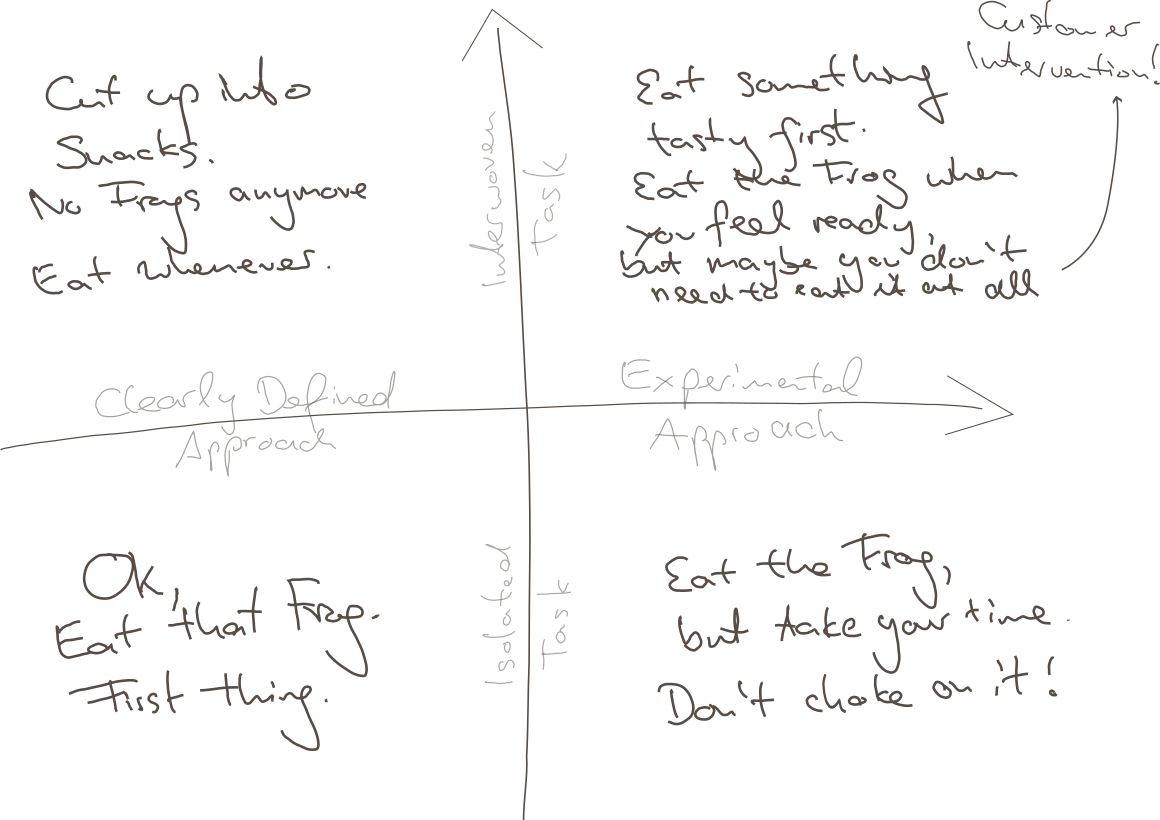
It turns out, there are several cases where it would be straightway destructive just to Eat the next-best Frog, and I will try to explain this to you using my impressive drawing skills:

Point being, there are at least two boundaries of application:

  • Clarity of Approach: How clearly-defined is it, as opposed to requiring one or multiple experimental, creative approachs?
  • Relation to other Tasks: How isolated is your task, is it heavily interwoven with other tasks?

Why these distinctions? Maybe we can agree on

  • Overwhelming Frog tasks can act stifling on your creativity, so if that very mindset is required for your approach, you will not succeed by pressuring through.
  • Thinking yourself into a complex topic first thing in the morning might require some warm up time for your brain, booting every relevant detail into your cloud of thoughts.
  • Parkinson’s Law states “Work expands so as to fill the time available for its completion.” – from which I derive: If your task is too large but it could be divided into sub-tasks, you might use any available time to do something related to your giant Frog, but not necessarily the most precise thing to do.
  • The motivation of having done multiple small tasks can provide you with the energy of finishing “That Frog” within the near future.

So to relate that to the Frogophage subject at hand; my findings are:

  • Bottom Right: If your task is quite isolated from other tasks, but still it’s approach isn’t very clear, do not think of your problem as a frog to be eaten right now. You will have to eventually have eaten it, but take your time, don’t choke on it – don’t destroy your creative thinking by believing that you can rush through it.
  • Top Left: If your Frog is defined as one well-defined task, but can actually be seen as a composition of many Sub-Frogs, stop for a minute and invest your time in actually resolving the atomic issues. This might feel like slowing you down, but there is no honor in having eaten That Disgusting Frog, if actually you could have eaten a tasty buffet of small snacks instead.
  • Top Right: Interwoven Tasks that also require an Experimental Approach are hard because you might just waste your time trying to upfront define your smaller snacks, and you might not have all the relevant information booted into your brain at the time of your supposed Frog Breakfast, so: Try to warm up yourself by solving some smaller of the connected issues first; by bringing your consciousness into the right state it can very well appear what can be tried.
    • Bonus Point: It can also render your whole Frog irrelevant when it becomes clear that your whole problem has to be redefined by Customer Intervention. Sometimes you just have to explain the poor guys that something is complicated (costly for them), and they might come up with a request that is completely different from your original frog.
  • Bottom Left: However, if none of thse apply and there’s just a nauseating thing in front of you, that you just know has to be done, you have somewhat of a clear idea how to start, it does not depend on many other things done first or simultaneously – better Eat That Frog. It likely won’t go away and you can then use the resulting feel-good moment to inspire the rest of your day.
Conclusion

I guess this all boils down to “whatever advice there is, there are some limits to its applications”. I hope you already weren’t the type of person who would just think of any problem as some big unquestionable Frog to be gobbled up without reconsideration…

… but nonetheless, maybe this can help in evaluating your strategy when facing the next difficult thing.

And don’t just eat frogs, please.

Finding refactoring candidates using reflection

If some of your types are always used together, that is probably a sign that you are missing an abstraction that bundles them. For example, if I always see the types Rectangle and Color together, it’s probably a good idea to create a ColoredRectangle class that combines the two. However, these patterns tend to emerge over time, so it’s hard to actually find them manually.

Reflection can help find these relationships between types. For example, you can look at all the function/method parameter lists in your code and mark all types appearing there as ‘being used together’. Then count how often these tuples appear, and you might have a good candidate for refactoring.

Here’s how to do that in C#. First pick a few assemblies you want to analyze. One way to get them is using Assembly.GetAssembly(typeof(SomeTypeFromYourAssembly)). Then get all the methods from all the types:

IEnumerable<MethodInfo> GetParameterTypesOfAllMethods(IEnumerable<Assembly> assemblies)
{
  var flags = BindingFlags.Instance | BindingFlags.Static | BindingFlags.Public
    | BindingFlags.NonPublic | BindingFlags.DeclaredOnly;
  foreach (var assembly in assemblies)
  {
    foreach (var type in assembly.GetTypes())
    {
      foreach (var method in type.GetMethods(flags))
      {
        yield return method;
      }
    }
  }
}

The flags are important: the default will not include NonPublic and DeclaredOnly. Without those, the code will not report private methods but give you methods from base classes that we do not want here.

Now this is where things become a little more muddy, and specific to your application. I am skipping generated methods with “IsSpecialName”, and then I’m only looking at non-generic class parameters:

foreach (var method in GetParameterTypesOfAllMethods(assemblies))
{
  if (method.IsSpecialName)
    continue;

  var parameterList = method.GetParameters();

  var candidates = parameterList
      .Select(x => x.ParameterType)
      .Where(x => !x.IsGenericParameter)
      .Where(x => x.IsClass);

  /* more processing here */
}

Then I convert the types to a string using ToString() to get a nice identifier that includes filled generic parameters. I sort and join the type ids to get a key for my tuple and count the number of appearances in a Dictionary<string, int>:

var candidateNames = candidates
    .Select(x => x.ToString())
    .OrderBy(x => x)
    .ToList();

if (candidateNames.Count <= 1)
  continue;

if (candidateNames.Any(string.IsNullOrWhiteSpace))
  continue;

var key = string.Join(",", candidateNames);

if (!lookup.ContainsKey(key))
{
  lookup.Add(key, 1);
}
else
{
  lookup[key]++;
}

Once that is done, you can sort the resulting lookup, print out all the tuples, and see if there are any good candidates.

There’s much room for improvement with a method like this. For example, skipping non-class types is a pretty arbitrary choice. And you will not find new tuples built from built-in types this way. However, because those types offer very little semantic by themselves, it can be hard to correlate multiple occurrences simply by their types.

Using the File System as an Interaction Device

In a recent project, my job was to build a scientific data processing pipeline for a new algorithm that wasn’t set in stone yet. Part of my work would be to explore different mathematical formulas interactively with the customer.

My usual approach to projects is a “risk first” strategy. I try to identify the riskiest or most demanding part of the project and deal with it first. This approach essentially resembles the “fail fast” mindset, just that we haven’t failed yet.

In the case of the calculation pipeline, the riskiest part and at the same time the functionality that matters to the customer most, was the pipeline itself. If we were able to implement a system that can transform the given entry data into the desired results, we had an end-to-end prototype and the means to explore different mathematical approaches.

The pipeline consists of different steps that can be described as a complex transformation each. The first step/transformation takes a proprietary data format file and converts it into a big JSON file. The main effort of this step is a deep physical analysis of the data contained in the proprietary format. This analysis requires a lot of thought, exploration and work, but can be seen as a black box that the data traverses on its way from proprietary format to JSON.

The next step takes the JSON input and extracts the necessary information required by the following step. It is essentially a data reduction operation.

The third step feeds the analyzed, reduced data into the formulas and stores the calculation result.

The fourth step aggregates the calculation results into a daily time series report in a format that can be read by a spreadsheet application. This report is the end product of the pipeline and will be used to make decisions and to rule out certain environmental hazards.

The main difference of this project to virtually every project before is that I didn’t write any user interface code. The application’s main window is still blank. The whole interaction of the system with other systems that provide the entry data, of the pipeline steps among each other and with the human user is based on files in the file system.

The system periodically checks for the existence of new entry data. If some is found, it is copied in the “inbox” directory of the first step. The first step periodically checks for the existence of files in its inbox and processes them into its “outbox” that conveniently serves as the inbox of the second step. You probably get the idea by now. All the steps in the system, including the upstream data fetching routine, are actors in an file-based actor model. The files serve as messages from one actor to another. The file system and its directory structure is the common communication channel that passes the messages around.

Each processing step is an actor node with input and output storages

One advantage of this approach is that the file system viewer application of the operating system can be used as the (graphical) user interface. By opening the appropriate directories and viewing their content, the user can supervise the operating state of the system. The system can report problems by moving the incoming message not in the step’s “done” directory , but into its “failed” or “problem” directory. If several directories are on display at once, the user can follow a specific piece of data through the pipeline and view the intermediate results. For domain specific reasons, the actors in this project also have the result directory “omitted” for data that will not be processed any further because some domain rules have determined a cancellation.

An user can even manipulate the data’s flow by moving files away or into a specific directory. Let’s say that we want to calculate a certain amount of data again, we can just copy the files from the “done” directory of the first step into its “inbox” and the system will process it again.

Because the analysis step takes some time while the calculation step is surprisingly fast, we can perform just the calculation again by not moving the initial data files, but the analyzed and reduced entry files for the calculation step. Using this approach, we can try different mathematical formulas by stopping the system, swapping the calculation step with a new version, starting the system again and moving the desired entry files into its inbox.

Using the file system as an interaction device for the user and the system’s parts has many immediate advantages, but some drawbacks, too. One drawback is performance. Using the harddisk for data transfer is the slowest possible way to bring data from step X to step X+1. If your system is required to have high throughput or low latency, this approach isn’t suitable. My project has a low, forecastable throughput and a latency requirement that is measured in minutes or seconds, but not in milliseconds or even nanoseconds. It can spend some time in the filesystem, because the first step alone takes several seconds for each file.

Another drawback is a certain fragility of the communication medium, the file system. You have to account for concurrent reads, writes or even deletes. The target platform of my system (Microsoft Windows) exhibits signs of exhaustion if the amount of files in one directory grows too large. This means that your file selection, already a costly operation, becomes more costly if the systems is put under pressure. If your throughput is usually steady, which is the case in my project, this won’t be a problem. Until you manually copy 100k files in an inbox for swift recalculation and discover that the file copy process alone takes several minutes.

Of course, the system cannot operate without a graphical user interface forever. But some basic interactions with the system will probably just result in some files being copied from one directory to another one in the background.