Naming is hard and Java Enums don’t help

This is a short blog post about a bug in my code that stumped me for some moments. I try to tell it in a manner where you can follow the story and try to find the solution before I reveal it. You can also just read along and learn something about Java Enums and my coding style.

A code structure that I use sometimes is the Enum type that implements an interface:

public enum BuiltinTopic implements Topic {

    administration("Administration"),
    userStatistics("User Statistics"),
    ;
	
    private final String denotation;

    private BuiltinTopic(String denotation) {
        this.denotation = denotation;
    }
	
    @Override
    public String denotation() {
        return this.denotation;
    }
}

The Topic interface is nothing special in this example. It serves as a decoupling layer for the (often large) part of client code that doesn’t need to know about any specifics that stem from the Enum type. It helps with writing tests that aren’t coupled to locked-down types like Enums. It is just some lines of code:

public interface Topic {

    String denotation();
}

Right now, everything is fine. The problems start when I discovered that the denotation text is suited for the user interface, but not for the configuration. In order to be used in the configuration section of the application, it must not contain spaces. Ok, so let’s introduce a name concept and derive it from the denotation:

public interface Topic {

    String denotation();
	
    default String name() {
        return Without.spaces(denotation());
    }
}

I’ve chosen a default method in the interface so that all subclasses have the same behaviour. The Without.spaces() method does exactly what the name implies.

The new method works well in tests:

@Test
public void name_contains_no_spaces() {
    Topic target = () -> "User Statistics";
    assertEquals(
       "UserStatistics",
       target.name()
    );
}

The perplexing thing was that it didn’t work in production. The names that were used to look up the configuration entries didn’t match the expected ones. The capitalization was wrong!

To illustrate the effect, take a look at the following test:

@Test
public void name_contains_no_spaces() {
    Topic target = BuiltinTopic.userStatistics;
    assertEquals(
        "userStatistics",
        target.name()
    );
}

You can probably spot the difference in the assertion. It is “userStatistics” instead of “UserStatistics”. For a computer, that’s a whole different text. Why does the capitalization of the name change from testing to production?

The answer lies in the initialization of the test’s target variable:

In the first test, I use an ad-hoc subtype of Topic.

In the second test and in production, I use an object of type BuiltinTopic. This object is an instance of an Enum.

In Java, Enum classes and Enum objects are enriched with automatically generated methods. One of these methods equip Enum instances with a name() method that has a default implementation to return the Enum instances’ variable/constant name. Which in my case is “userStatistics”, the same string I expect, minus the correct capitalization of the first character.

If I had named the Enum instance “UserStatistics”, everything would have worked out until somebody changes the name or adds another instance with a slight difference in naming.

If I had named my Enum instance something totally different like “topic2”, it would have been obvious. But in this case, with only the minor deviation, I was compelled to search for problems elsewhere.

The problem is that the auto-generated name() method overwrites my default method, but only in cases of real Enum instances.

So I thought hard about the name of the name() method and decided that I don’t really want a name(), I want an identifier(). And that made the problem go away:

public interface Topic {

    String denotation();
	
    default String identifier() {
        return Without.spaces(denotation());
    }
}

Because the configuration code only refers to the Topic type, it cannot see the name() method anymore and only uses the identifier() that creates the correct strings.

I don’t see any (sane) way to prohibit the Java Enum from automatically overwriting my methods when the signature matches. So it feels natural to sidestep the problem by changing names.

Which shows once more that naming is hard. And soft-restricting certain names like Java Enums do doesn’t lighten the burden for the programmer.
Trying ChatGPT as a professional software developer

We are a company of software developers that does not sell a product but provides a wide range of services. Our primary service is developing individual software or maintaining existing software for our customers.

Most of us are polyglot developers each sufficiently fluent in a couple of languages. While I see this as a strength it also means that I do not know the idiomatic solution for a task in all ecosystems in use in our projects by heart.

A few days ago I had a remote-pair-programming session with one of our customers and we wondered how to idiomatically trim certain characters from a string in JavaScript. My customer came up with the idea of asking ChatGPT for a solution while I would have asked Google or stackoverflow.

Being curious we took the ChatGPT route and it delivered a correct solution after I clarified what I mean with “trim”:

function trimCharacterFromStartAndEnd(str, char) {
  // Create a regular expression to match the specified character at the beginning and end of the string
  const regex = new RegExp(`^${char}+|${char}+$`, 'g');
  
  // Use the replace() function to remove the character from the start and end of the string
  const trimmedStr = str.replace(regex, '');
  
  return trimmedStr;
}

// Example usage
const originalString = '###Hello World!###';
const trimmedString = trimCharacterFromStartAndEnd(originalString, '#');
console.log(trimmedString); // Output: Hello World!

But from a professional perspective the code was not simple, concise and idiomatic. I intuitively knew there must be a better way.

So I did what ChatGPT does best: I chatted with it to improve the solution to arrive at a solution a was satisfied with:

function trimCharacterFromStartAndEnd(str, char) {
  return str.replace(/^${char}+|${char}+$/g, '');
}

// Example usage
const originalString = '###Hello World!###';
const trimmedString = trimCharacterFromStartAndEnd(originalString, '#');
console.log(trimmedString); // Output: Hello World!

However, you possibly need to handle regex special characters like '.', '*' etc. if they can part of your characters to trim.

Some of the intermediate steps also have their uses depending on the needed flexibility. See the full conversation at trim character from string chat.

Similarily, stackoverflow provides some comprehensive answers you can adapt to your specific situation.

Evaluation

Using ChatGPT can actually provide you useful results. To make the most out of it, you have to be able to judge the solution provided by the AI and try to push it in the wanted direction.

After my experiment our students got the inofficial advice that their solutions should not be worse than what ChatGPT delivers. 😀

Arriving at a good solution was not faster or easier than the traditional developers’ approach using Google and/or stackoverflow. Nevertheless it was more interactive, more fun and most importantly it worked.

It was a bit disappointing to lose context at some points in the conversation, with the g-flag for example. Also the “shortest” solution is longer than the variant with the regex-literal, so strictly speaking ChatGPT’s answer is wrong…

I will not radically change my style of work and jump on the AI-hype-train but I plan to continue experimenting with it every now and then.

ChatGPT and friends certainly have some potential depending on the use case but still require a competent human to judge and check the results.

Do Not Just Eat That Frog!

It is surely remarkable how much advice on Software Development is actually advice on Project Management, sometimes bordering into the psychological field and being more like management of personal Energy, Attention or Motivation. But this does make sense, considering how so often, some seemingly simple task can blow up to something difficult to manage, then becoming trivial again, then mathematically impossible, then simple again.

All of that within a context where somewhere, some customers enjoy their day, not being inclined to be part of these emotional loops at all. Just solve their problems. Which is our job.

So, one of the frequent Time Management tips passed around is “Eat That Frog” (Originally by Brian Tracy with some help from Mark Twain). The main idea is that some seriously demanding task (“having to eat a live frog”) will not become more attractive during the day, so it’s important to make it your very first priority to gulp that thing down, first thing the morning.

I found this approach quite helpful, and it can be part of a larger strategy known as “Risk First” as commonly mentioned by other authors around here.

However, any good advice can only be applied within boundaries and recently, I was dealing with several harder issues that made me refine the original thesis quite a bit.

I did not find this knowledge somewhere else, so feel free to discuss and correct me on my points of view. Not that I could be mistaken, though ¯\_(ツ)_/¯

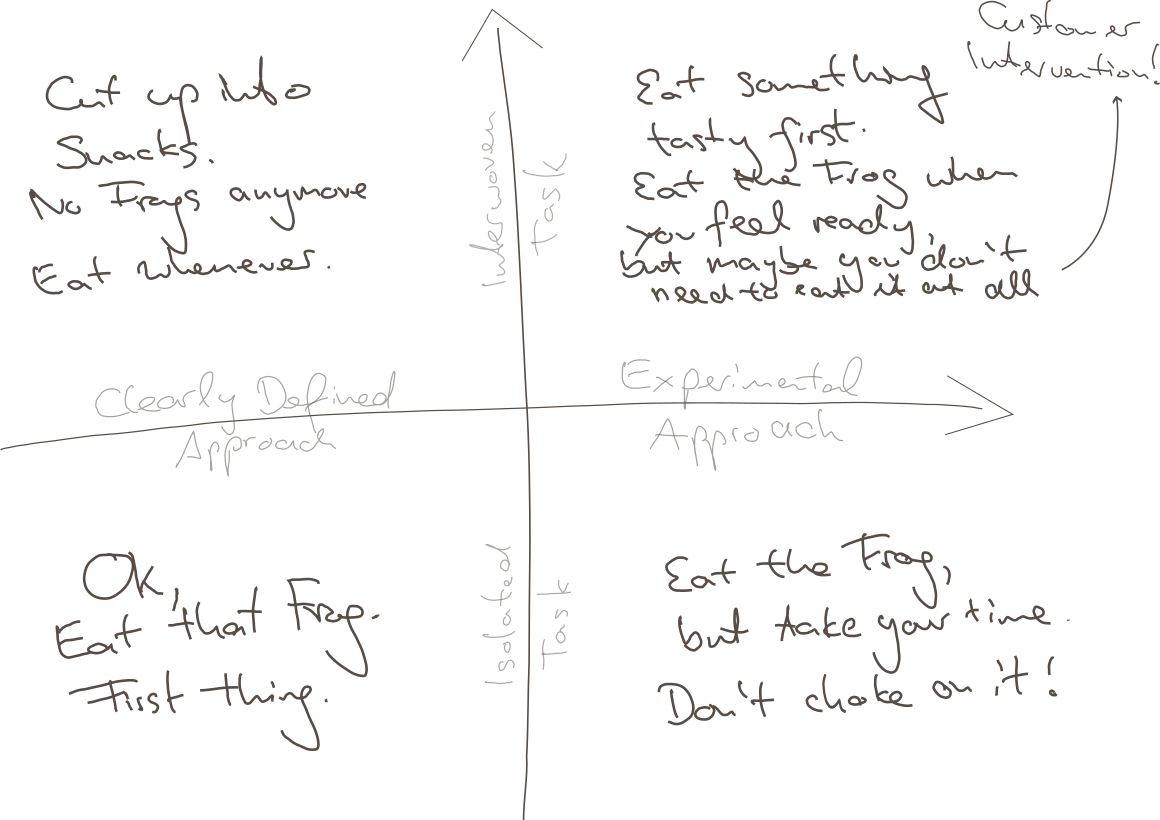
It turns out, there are several cases where it would be straightway destructive just to Eat the next-best Frog, and I will try to explain this to you using my impressive drawing skills:

Point being, there are at least two boundaries of application:

  • Clarity of Approach: How clearly-defined is it, as opposed to requiring one or multiple experimental, creative approachs?
  • Relation to other Tasks: How isolated is your task, is it heavily interwoven with other tasks?

Why these distinctions? Maybe we can agree on

  • Overwhelming Frog tasks can act stifling on your creativity, so if that very mindset is required for your approach, you will not succeed by pressuring through.
  • Thinking yourself into a complex topic first thing in the morning might require some warm up time for your brain, booting every relevant detail into your cloud of thoughts.
  • Parkinson’s Law states “Work expands so as to fill the time available for its completion.” – from which I derive: If your task is too large but it could be divided into sub-tasks, you might use any available time to do something related to your giant Frog, but not necessarily the most precise thing to do.
  • The motivation of having done multiple small tasks can provide you with the energy of finishing “That Frog” within the near future.

So to relate that to the Frogophage subject at hand; my findings are:

  • Bottom Right: If your task is quite isolated from other tasks, but still it’s approach isn’t very clear, do not think of your problem as a frog to be eaten right now. You will have to eventually have eaten it, but take your time, don’t choke on it – don’t destroy your creative thinking by believing that you can rush through it.
  • Top Left: If your Frog is defined as one well-defined task, but can actually be seen as a composition of many Sub-Frogs, stop for a minute and invest your time in actually resolving the atomic issues. This might feel like slowing you down, but there is no honor in having eaten That Disgusting Frog, if actually you could have eaten a tasty buffet of small snacks instead.
  • Top Right: Interwoven Tasks that also require an Experimental Approach are hard because you might just waste your time trying to upfront define your smaller snacks, and you might not have all the relevant information booted into your brain at the time of your supposed Frog Breakfast, so: Try to warm up yourself by solving some smaller of the connected issues first; by bringing your consciousness into the right state it can very well appear what can be tried.
    • Bonus Point: It can also render your whole Frog irrelevant when it becomes clear that your whole problem has to be redefined by Customer Intervention. Sometimes you just have to explain the poor guys that something is complicated (costly for them), and they might come up with a request that is completely different from your original frog.
  • Bottom Left: However, if none of thse apply and there’s just a nauseating thing in front of you, that you just know has to be done, you have somewhat of a clear idea how to start, it does not depend on many other things done first or simultaneously – better Eat That Frog. It likely won’t go away and you can then use the resulting feel-good moment to inspire the rest of your day.
Conclusion

I guess this all boils down to “whatever advice there is, there are some limits to its applications”. I hope you already weren’t the type of person who would just think of any problem as some big unquestionable Frog to be gobbled up without reconsideration…

… but nonetheless, maybe this can help in evaluating your strategy when facing the next difficult thing.

And don’t just eat frogs, please.

Finding refactoring candidates using reflection

If some of your types are always used together, that is probably a sign that you are missing an abstraction that bundles them. For example, if I always see the types Rectangle and Color together, it’s probably a good idea to create a ColoredRectangle class that combines the two. However, these patterns tend to emerge over time, so it’s hard to actually find them manually.

Reflection can help find these relationships between types. For example, you can look at all the function/method parameter lists in your code and mark all types appearing there as ‘being used together’. Then count how often these tuples appear, and you might have a good candidate for refactoring.

Here’s how to do that in C#. First pick a few assemblies you want to analyze. One way to get them is using Assembly.GetAssembly(typeof(SomeTypeFromYourAssembly)). Then get all the methods from all the types:

IEnumerable<MethodInfo> GetParameterTypesOfAllMethods(IEnumerable<Assembly> assemblies)
{
  var flags = BindingFlags.Instance | BindingFlags.Static | BindingFlags.Public
    | BindingFlags.NonPublic | BindingFlags.DeclaredOnly;
  foreach (var assembly in assemblies)
  {
    foreach (var type in assembly.GetTypes())
    {
      foreach (var method in type.GetMethods(flags))
      {
        yield return method;
      }
    }
  }
}

The flags are important: the default will not include NonPublic and DeclaredOnly. Without those, the code will not report private methods but give you methods from base classes that we do not want here.

Now this is where things become a little more muddy, and specific to your application. I am skipping generated methods with “IsSpecialName”, and then I’m only looking at non-generic class parameters:

foreach (var method in GetParameterTypesOfAllMethods(assemblies))
{
  if (method.IsSpecialName)
    continue;

  var parameterList = method.GetParameters();

  var candidates = parameterList
      .Select(x => x.ParameterType)
      .Where(x => !x.IsGenericParameter)
      .Where(x => x.IsClass);

  /* more processing here */
}

Then I convert the types to a string using ToString() to get a nice identifier that includes filled generic parameters. I sort and join the type ids to get a key for my tuple and count the number of appearances in a Dictionary<string, int>:

var candidateNames = candidates
    .Select(x => x.ToString())
    .OrderBy(x => x)
    .ToList();

if (candidateNames.Count <= 1)
  continue;

if (candidateNames.Any(string.IsNullOrWhiteSpace))
  continue;

var key = string.Join(",", candidateNames);

if (!lookup.ContainsKey(key))
{
  lookup.Add(key, 1);
}
else
{
  lookup[key]++;
}

Once that is done, you can sort the resulting lookup, print out all the tuples, and see if there are any good candidates.

There’s much room for improvement with a method like this. For example, skipping non-class types is a pretty arbitrary choice. And you will not find new tuples built from built-in types this way. However, because those types offer very little semantic by themselves, it can be hard to correlate multiple occurrences simply by their types.

Avoid fragmenting your configuration

Nowadays configuration often is done using environment (aka ENV) variables. They work great using docker/containers, in development and production, on all platforms and using all languages. In short I think environment variables are great for configuration of many aspects of an application.

However, I encountered a pattern in several different applications that I really dislike: Several, fragmented ENV variables for one configurable aspect of the application.

Let us have a look at two examples to see what I mean, then I will try to explain where it could come from and why I think it is bad practice. Finally I will show a better alternative – at least in my opinion.

First real world example

In one javascript app a websocket url was made configurable using 4 (!) ENV variables like this:

WS_PREFIX || "wss://";
WS_HOST || "hostname";
WS_PORT || "";
WS_PATH || "/ws";

function ConnectionString(prefix, host, port, path) {
  return {
    attrib: {
      prefix, 
      host,
      port,
      path,
    },
    string: prefix + host + port + path,
  };
}

We immediately see, that the author wrote a function to deal with the complex configuration in the rest of the application. Not only the devops team or administrators need to supply many ENV variables but they have to supply them in a peculiar way:

The port needs to be specified as :8888, using a leading colon (or the host needs a trailing colon…) which is more than unexpected. The alternative would be a better and more sophisticated implementation of ConnectionString…

Another real example

In the following example the code there are again three ENV variables dealing with hosts, urls and websockets. This examples feels quite convoluted, is hard to understand and definitely needs a refactoring.

TANGOGQL_SOCKET=ws://${TANGO_HOST}:5004/socket

const defaultHost = window.TANGOGQL_HOST ?? "localhost:5004";
const defaultSocketUrl = window.TANGOGQL_SOCKET ?? ws://${defaultHost}/socket;

// dealing with config peculiarities somewhere else
const socketUrl = React.useMemo(() =>
        config.host.replace(/.*:\/\//, "ws://") + "/socket"
    , [config.host]);

Discussion

The examples show clearly that something simple like a configuration for an URL can lead to complicated and hard to use solutions. Most likely the authors tried to not repeat themselves and factored the URLs into the smallest sensible components. While this may sound like a good idea it puts burden on both the developers and the devops team configuring the application.

In my opinion it would be much simpler and more usable for both parties to have complete URLs for the different use cases. Of course this could mean repeating protocols, hostnames and ports if they are the same in the different situations. But just having one or two ENV variables like

WS_URL=wss://myhost:8080/ws
HOST_URL=https://myhost:8080

would be straightforward to use in code and to be configured in the runtime environment. At the same time the chance for errors and the complexity in the configuration is reduced.

Even though certain parts of the URLs are duplicated in the configuration I highly prefer this approach over the presented real world solutions.

Using Message Queuing Telemetry Transport (MQTT) for communication in a distributed system

If you have several participants who are interested in each other’s measurements or events, you can use the MQTT protocol for this. In the following, I will present the basics.

The Mqtt protocol is based on publish and subscribe with asynchronous communication. Therefore it can also be used in networks with high latency. It can also be operated with low bandwidth.

At the center is an MQTT broker. It receives published messages and forwards them to the subscribing clients. The MQTT topics are used for this purpose. Each message is published to a topic. The topics look like a file path and can be chosen almost freely. The only exception are names beginning with $, because these are used for MQTT-own telemetry data. An example for such a topic would be “My/Test/Topic”. Attention, the topic is case sensitive. Every level of the topic can be subscribed to. For example “My/Test/Topic/#”, “My/Test/#” or “My/#”. In the latter case, a message published to “My/Productive/Things” would also be received by the subscriber. This way you can build your own message hierarchy using the Topics.

In the picture a rough structure of the MQTT infrastructure is shown. Two clients have subscribed to a topic. If the sensor sends data to the topic, the broker forwards it to the clients. One of the clients writes the data into a database, for example, and then processes it graphically with a tool such as Grafana.

How to send messages

For the code examples I used Python with the package paho-mqtt. First, an MQTT client must be created and connected.

self.client = mqtt.Client()
self.client.connect("hostname-broker.de", 1883)
self.client.loop_start()

Afterwards, the client can send messages to the MQTT broker at any time using the publish command. A topic and the actual message are sent as payload. The payload can have any structure. For example Json format or xml. In the code example json is used

self.client.publish(topic="own/test/topic", payload=json.dumps(payload))

How to subscribe topics

Even when subscribing, an MQTT client must first be created and a connection established. However, the on_connect and on_message functions are also used here. These are always called when the client establishes a connection or a new message arrives. It makes sense to make the subscriptions in the on_connect method, since they are created so with a new connection also always new and are not lost.

self.client = mqtt.Client()
self.client.on_connect = on_connect
self.client.on_message = on_message
self.client.connect("hostname-broker.de", 1883)
self.client.loop_start()

Here you can see an example on_connect method that outputs the result code of the connection setup and subscribes to a topic. For this, only the respective topic must be specified.

def on_connect(client, userdata, flags, rc):
      print(Connected with result code " + str(rc))
      self.client.subscribe("own/test/topic/#")

In the on_message method you can specify what should happen to an incoming message.

Conclusion

MQTT is a simple way to exchange data between a variety of devices. You can customize it very much and have a lot of freedom. All messages are TSL encrypted and you can set up client authentication in the broker, which is why it is also considered secure. For asynchronous communication, this is definitely a technology to consider.

Developing for Cordova + SQLite in a standard Browser environment

As any developer, who doesn’t just love it when a product that has grown over the years suddenly needs to target a new platform (e.g. operating system) because some customer demands changed, some dependency broke or some other totally unexpected thing called “progress” happened?

Fortunately, there are some approachs to cross-platform development and if one expects such a change of direction, one can early on adopt a suitable runtime environment such as Apache Cordova or Capacitor/Ionic or similar, who all promise you a Write-Once-Run-Anywhere experience, decoupling the application logic from the lower-level OS interactions.

Unfortunately though, this promise is a total lie and usually, after starting such a totally platform-agnostic project, really soon you will want to use a dependency that will only work for one platform and then your options are limited.

One such example is a Cordova project we are currently moving from Android to iOS, and in that process also redesigning a nice, modern frontend to replace a very outdated (read: unmaintainable) Vanilla JS application. So now we have set it up smoothly (React + Vite + Typescript – you name it!), so technically we do not need anything iOS-specific yet, so we can work on our redesign in a pure-browser environment with hot reloading and the likes – life is good!

Then comes the realization that our application is quite data heavy and uses an on-device SQL database to persist its data, and we don’t have that in the browser – so, life turned bad.

What to do? There had been a client-side WebSQL database specification once, but this was unofficial and never fully implemented, abandoned in 2010, still present in Chrome but they are even live announcing how they are removing it, so this is not the future-proof way to go.

We crave a smooth flow of development.

  • It is not an option to re-build the app at every change.
  • It is not an option to have the production system use its SQLite DB and the development environment to use a totally different one like IndexedDB – certain SQLite queries are too ingrained in our application.
  • It’s only probably an option to use an experimental technology like absurd-sql, which aims to fill in that gap but then again needs advanced API features like Web Workers, SharedArrayBuffer, Atomics API which we wouldn’t require else
  • It is possible to use in-memory SQLite via sql.js but for persistence, it wasn’t instantly obvious to me how to couple that with the partially supported Origin Private File System API

So after all, this is the easiest solution that still gave me most of my developer smoothness back: Use sql.js in memory and for development, display two nice buttons on the UI which let me download the whole DB and upload one from file again. This is the sketch:

We create a CombinedDatabase class which, depending on the environment, can hand out such a database in a Singleton-like manner

class CombinedDatabase {

    // This is the Singleton-part

    private static instance: CombinedDatabase;

    public static get = async (): Promise<CombinedDatabase> => {
        if (!this.instance) {
            const {db, type} = await this.createDatabase();
            this.instance = new CombinedDatabase(db, type);
        }
        return this.instance;
    };

    private static createDatabase = async () => {
        if (inProductionEnvironment()) {
            return {
                db: createCordovaSqliteInstance(),
                type: "CordovaSqlite"
             };
        } else {
            const sqlWasmUrl = (await import("../assets/sql-wasm.wasm?url")).default;
            // we extend the window object for reasons I tell you below
            window.sqlJs = await initSqlJs({locateFile: () => sqlWasmUrl});
            const db = new window.sqlJs.Database();
            return {db, type: "InMemory"};
        }
    }


    // This is the actual flesh, i.e. a switch of which API to use

    private readonly type: string;
    private cordovaSqliteDb: SQLitePlugin.Database | null = null;
    private inMemorySqlJsDb: SqlJsDatabase | null = null;

    private constructor(db: SQLitePlugin.Database | SqlJsDatabase, type: string) {
        this.type = type;
        switch(type) {
            case "CordovaSqlite":
                this.cordovaSqliteDb = db as SQLitePlugin.Database;
                break;
            case "InMemory":
                this.inMemorySqlJsDb = db as SqlJsDatabase;
                break;
            default:
                throw Error("Invalid CombinedDatabase type: " + type);
        }
    }

   // ... and then there are some methods

}

(This is simplified – in actual, type is an enum for me , and there’s also error handling, but you know – not the point here).

This structure is nice, because you can now implement low-level methods like some executeQuery(...) etc. which just decide depending on the type, which of the private DB instances it can address, and even if they work differently, return a unified response format.

The rest of our application does not know anything about any Cordova-SQLite-dependency, or sql.js, or whatever. Life is good again.

So How do Import / Export work?

I gave the CombinedDatabase some interfacing methods, similar to


    public async export() {
        switch (this.type) {
            case "CordovaSqlite":
                throw Error("Not implemented for cordova-sqlite database");
            case "InMemorySqlJs":
                return this.inMemorySqlJsDb!.export();
            default:
                throw Error("DB not initialized, cannot export.");
        }
    }

    public async import(binaryData: Uint8Array) {
        if (this.type !== CombinedDatabaseType.InMemorySqlJs) {
            throw Error("DB import only implemented for the in-memory/sql.js database, this is a DEVELOPMENT feature!");
        }
        await this.close();
        this.inMemorySqlJsDb = new window.sqlJs.Database(binaryData);
    }

This is also the reason why I monkey-patched the window object earlier, so I still have this API around outside the Singleton instantiation (createDatabase). Yes, this is a global variable and a kind of hack, but imo is what can safely be done inside the Browser within some good measure.

Remember, in Typescript you need to declare this e.g. in some global.d.ts file

import {SqlJsStatic} from "sql.js";

declare global {
    interface Window {
        sqlJs?: SqlJsStatic
    }
}

Or go around the Window interface by casting (window as any).sqlJs – you decide what you prefer.

Anyway, the export() functionality can then be used quite handily, it returns the in-memory database as a binary array and you can make the browser download that via a Blob URL:

api.db.export().then((array: Uint8Array) => {
    const blob = new Blob([array], {type: "application/x-sqlite3"});
    const link = document.createElement("a");
    link.href = URL.createObjectURL(blob);
    link.download = `bonpland${Date.now()}.db`;
    link.target = "_blank";
    link.click();
});

And similarly, you can use import() by reading a Uint8Array from a temporary <input type="file"> element with a FileReader() (somewhat common solution, but just comment below if you want the details).

To be exact, I don’t even use the import() button anymore because I pass my development DB as an asset to the dev server. This is nice (and only takes a few seconds on hot reloading because our DB is like 50 MB in size), but somewhat Vite-specific, which is why I will postpone this topic to some later blog time.

Even better automated instance construction in C++

In the previous articles on automated instance construction (first and second) I showed how you can use constructor-argument deduction to automatically do dependency injection. While that approach worked nicely in general, one little detail was still nagging me: Since construction of the actual objects happens at the end of a recursion, the stack depth in some of those construction could get quite deep. In fact there are an additional Maxactual number of c’tor parameters functions on the stack before the c’tor is called. This effect is even worse when resolving long dependency chains, were those functions are there for each of the dependencies currently being resolved.

The previous code uses an std::index_sequence of the exactly the right length to inject the same number of mimic parameters that are then used to locate dependencies. If we knew the right length, there wouldn’t have to be any recursion around the construction. And that’s actually easy to refactor out, we can just figure out the std::index_sequence first and return, and then use it outside of the recursion:

template <class T, std::size_t Head, std::size_t... Rest>
constexpr auto
injection_parameter_sequence(std::index_sequence<Head, Rest...>,
  decltype(T{ mimic<T>{ Head }, mimic<T>{ Rest }... })* = nullptr)
{
  return std::index_sequence<Head, Rest...>{};
}

template <class T>
constexpr auto injection_parameter_sequence(std::index_sequence<>)
{
  return std::index_sequence<>{};
}

template <class T, std::size_t... Rest>
constexpr auto
injection_parameter_sequence(std::index_sequence<Rest...>)
{
  return injection_parameter_sequence<T>(std::make_index_sequence<sizeof...(Rest) - 1>{});
}

Starting with a “long” index sequence, this overload set returns the smaller index sequence for the construction. We can use a small tool function to actually create the instance:

template <class T, std::size_t... Params>
constexpr auto make_unique_injected_with_sequence(service_provider const& p, std::index_sequence<Params...>)
{
  return std::make_unique<T>(mimic<T>(p, Params)...);
}

Which can be called like this:

template <class T, std::size_t Max = 16> auto make_unique_injected(service_provider const& p)
{
  return make_unique_injected_with_sequence<T>(p,
    injection_parameter_sequence<T>(std::make_index_sequence<Max>{}));
}

Only these last two function will be added to the call stack for each constructor call, which is not a whole lot. This construction has the additional advantage that only these two need to be changed to support different kinds construction, e.g. using std::make_shared instead of std::make_unique.

Avoid special values of the result type for error indication

As many of you may know we work with a variety of programming languages and ecosystems with very different code bases. Sometimes it may be a modern green field project using state of the art frameworks. At other times it may be a dreaded legacy project initially written many years ago (either by us or someone we do not even know) using ancient languages and frameworks like really old java stuff (pre jdk 7) or C++ (pre C++11), for example.

These old projects could not use features of modern incarnations of these languages/compilers/environments – and that is fine with me. We usually gradually modernize such systems and try to update the places where we come along to fix some issues or implement new features.

Over the years I have come across a pattern that I think is dangerous and easily leads to bugs and harder to maintain code:

Special values of the resulting type of a function to indicate errors

The examples are so numerous and not confined to a certain programming environment that they urged me to write this article. Maybe some developers using this practice will change their mind and add a few tools to their box to write safer and more expressive code.

A simple example

Let us image a function that returns a simple integer number like this:

/**
 * Here we talk to a hardware sensor. If everything works, we should
 * get a value between -50 °C and +50 °C.
 * If something goes wrong, we return -9999.
int readAmbientTemperature();

Given the documentation, clients can surely use this kind of function and if every use site interprets the result correctly, nothing will ever go wrong. The problem here is, that we need a lot of domain knowledge and that we have to check for the special value.

If we use this pattern for other values where the value range is not that clearly bounded we may either run into problems or invent other “impossible values” for each use case.

If we forget to check for the special value the users may see it an be confused or even worse it could be used in calculations.

The problem even gets worse with more flexible types like floating point numbers or strings where it is harder to compare and divide valid results from failure indicators.

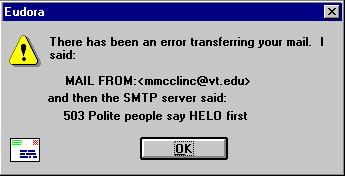
Classic error message that mixes technical code and error message in a confusing, albeit funny sentence (Source: Interface Hall Of Shame)

Of course, there are slightly better alternatives like negative numbers in a positive-only domain function or MAX_INT, NaN or the like provided by most languages.

I do not find any of the above satisfying and good enough for production use.

Better alternatives

Many may argue, that their environment lacks features to implement distinct error indicators and values but I tend to disagree and would like to name a few widely used alternatives for very different languages and environments:

  • Return codes and out-parameters for C-like languages like in the unix and win32 APIs (despite all their other flaws… 😀 )
  • Exceptions for Java, Python, .NET and maybe in some cases even C++ with sufficiently specific type and details to differentiate different failures
  • Optional return types when the failures do not need special handling and absence of a value is enough
  • HTTP status code (e.g. 400 or 404) and a JSON object containing reason and details instead of a 2xx status with the value
  • A result struct or object containing execution status and either a value on success or error details on failure

Conclusion

I am aware that I probably spent way too much words on such a basic topic but I think the number of times I have encountered such a style – especially in code of autodidacts, but also professionals – justifies such an article in my opinion. I hope I provided some inspiration for those who do not know better or those who want to help others improve.

What else can we do?

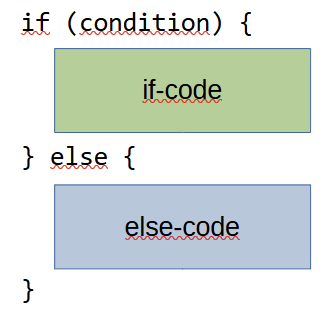
A common code structure to implement a decision is the if-statement, or in its complete form, the if-else-statement:

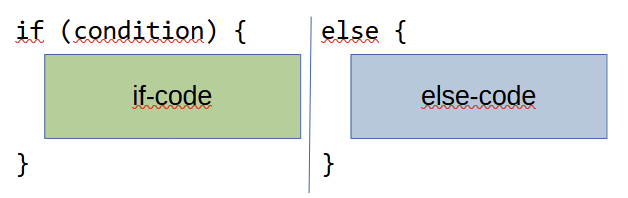
By using the explicit if-else-statement, you essentially partition a part of your code into two “execution lanes” that are used mutually exclusive. Instead of writing them one upon the other, we could, if our code editors supported it, write them side by side:

There are some graphical code editors that tried this tabular approach. It certainly looks unfamiliar to the eye trained on the first notation, but it makes one thing clear: The code flow will go through only one of the columns, not both.

Dependence on explicit conditionals

Using the if-else-statement became so second-nature to most developers that they acted confused and helpless when presented with a simple restriction:

“Don’t use the else keyword”

Jeff Bay, Object Calisthenics, 2008

The restriction is imposed as the second of nine rules from the object calisthenics by Jeff Bay. In the explanation of the rule, he stated that the rule should act as a first step towards implicit conditional statements. Paraphrased: There are 99 ways to express an else statement without using the keyword, but the average developer knows none of them.

In my opinion, the rule is merely the warm-up phase to a bigger challenge, as stated by the “anti-if campaign”: To get rid of if-statements (and else-statements by that matter) in all contexts where alternatives prove more effective.

In order to decide when not to use if-statements, we should learn about the alternatives. There are plenty to choose from! (refer to slide #4)

But we should also learn about the if-statement itself. The goal isn’t to abandon it, but to use it when appropriate and then use it to its full potential.

An interesting thought about the “else”

We already know everything about the if and else? I had the opportunity to learn something new not long ago. The hint came from Kevlin Henney in one of his talks (Non-Functional Coding):

The talk is fairly recent and has some traditional “Kevlin parts” in it. The part I highlighted is unusually aggressive for him. The reasoning is sound, but the nearly personal attack towards the audience (to “piss them off”) is uncalled for.

But, the “volume up to 200 %”-style works more often than not and the bit got me thinking. The culprit in question is this code:

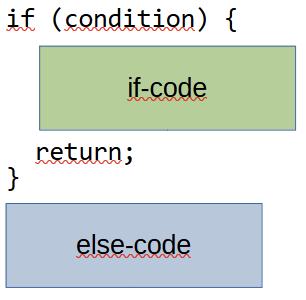
According to Kevlin, this style “is just wrong”. Let’s try to find out why.

There is one principle that is mentioned by Kevlin in passing: The “Single Level of Abstraction” principle that states that you should not mix different levels of abstraction in one block of code (the principle talks about methods). It is a foundation for the first rule in the object calisthenics: “Only one level of indentation per method”.

If you look at the if-code and else-code, they operate on the same level of abstraction. Maybe not on the same level of probability, but they deal with the same topic. Elevating one part by eliminating the else-block in favor of an early return means that this part is more important. It also designates the if-code and in fact the whole if-statement to be a guard clause. Guard clauses typically deal with invalid state and don’t complement the desired functionality. They act as gatekeepers and interdict the invalid state to enter the method’s main body. As a metaphor: The bouncers in front of a club are like guard clauses. To say that being denied entry by a bouncer is comparable fun to being in the club is probably not a widespread opinion.

Unfinished reflection

I still reflect on other clues that are name-dropped by Kevlin, like the stated reduction of refactoring opportunities, but that’s probably because I don’t have enough comparison material.

There is one thing that I haven’t got a proper hold on yet and that’s the term “control state“. My google kung-fu is not mighty enough to reach past some obscure ASP.NET concepts from ten years ago. I haven’t heard the term in books – at least I don’t remember it.

So here is my call for help: Can you provide some source or explanation about what Kevlin Henney means by “control state“?

And what else do you think about the whole discussion?