Tell different stories within the same universe

You might know this from fantasy book series: the author creates a unique world, a whole universe of their own and sets a story or series of books within it. Then, a few years later, a new series is released. It is set in the same universe, but at a different time, with different characters, and tells a completely new story. Still, it builds on the foundation of that original world. The author does not reinvent everything from scratch. They use the same map, the same creatures, the same customs and rules established in the earlier books.

Examples of this are the Harry Potter series and Fantastic Beasts, or The Lord of the Rings and The Hobbit.

But what does this have to do with software development?
In one of my projects, I faced a very similar use case. I had to implement several services, each covering a different use case, but all sharing the same set of peripherals, adapters, and domain types.

So I needed an architecture that did not just allow for interchangeable periphery, as is usually the focus, but also supported interchangeable use cases. In other words, I needed a setup that allowed for multiple “books” to be written within the same “universe.”

Architecture

Let’s start with a simple example: user management.
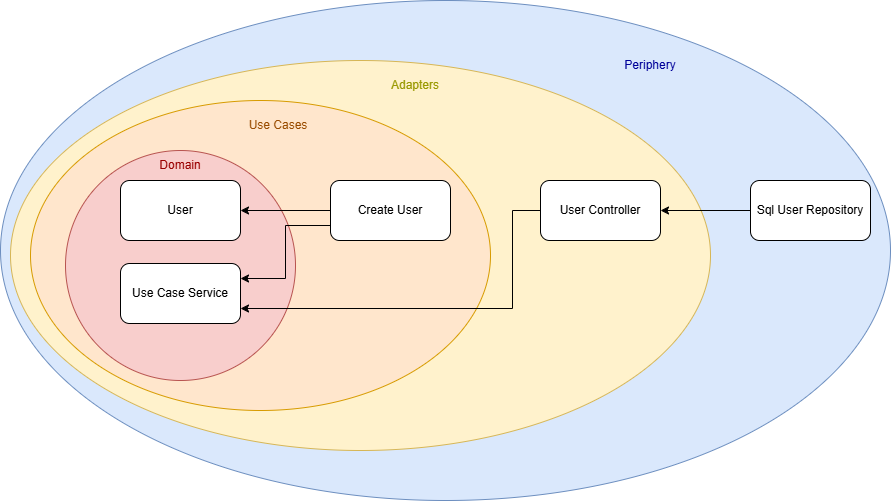
I originally implemented it following Clean Architecture principles, where the structure resembles an onion, dependencies flow inward, from the outer layers to the core domain logic. This makes the outer layers (the “peel”) easily replaceable or extendable.

Our initial use case is a service that creates a user. The use case defines an interface that the user controller implements, meaning the dependency flows from the outer layer (the controller) toward the core. So far, so good.

However, I wanted to evolve the architecture to support multiple use cases. For that, the direct dependency from the UserController to the CreateUser use case had to be removed.

My solution was to introduce a new domain module, a shared foundation that contains all interfaces, data types, and common logic used by both use cases and adapters. I called this module the UseCaseService.

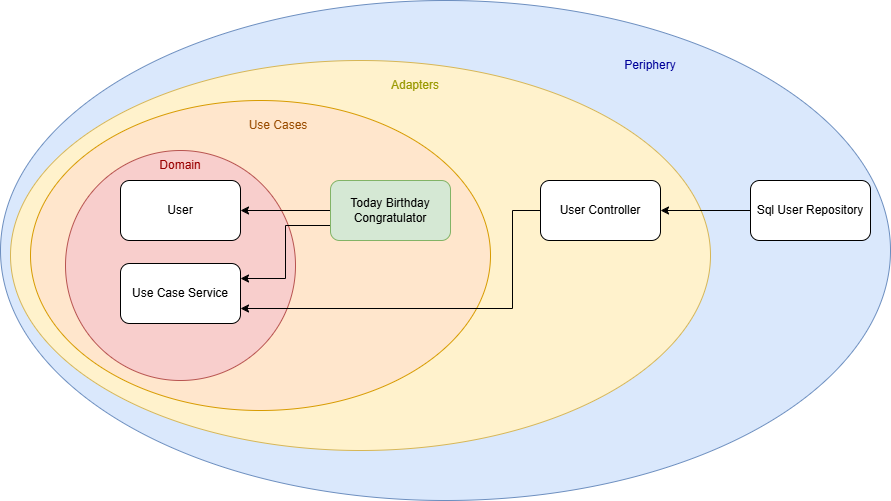
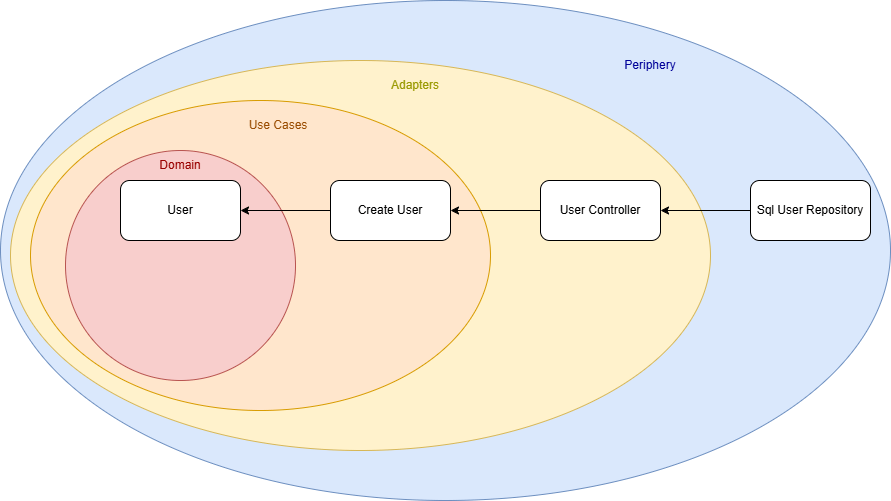
The result is a new architecture diagram:

There is no longer a direct connection between a specific use case and an adapter. Instead, both depend on the shared UseCaseService module. With this setup, I can easily create new use cases that reuse the existing ecosystem without duplicating code or logic.

For example, I could implement another service that retrieves all users whose birthday is today and sends them birthday greetings. (Whether this is GDPR-compliant is another discussion!) But thanks to this architecture, I now have the freedom to implement that use case cleanly and efficiently.

Conclusion

Architecture is a highly individual matter. There is no one-size-fits-all solution that solves every problem or suits every project. Models like Clean Architecture can be helpful guides, but ultimately, you need to define your own architectural requirements and find a solution that meets them. This was a short story of how one such solution came to life based on my own needs.

It is also a small reminder to keep the freedom to think outside the box. Do not be afraid to design an architecture that truly fits you and your project, even if it deviates from the standard models.

The algorithm in an algorithm – Builder design pattern

In the following blog post, I would like to explain to you, the design pattern builder, why this is an algorithm in the algorithm and what advantages result from it.

General

The builder is a creational design pattern. It separates the construction of complex objects from their representations, allowing the same construction processes to be reused.

The design pattern consists of a director, the builder interface, and concrete builder implementations. The director is responsible for the abstract construction of the product and has a defined interface with the builder to pass the design instructions. The concrete builders then build the concrete product according to the instructions and can also provide the generated product.

So in the end, the director defines its own little programming language inside the program where the construction instructions can be programmed as algorithm. The builder then executes that algorithm. So we have a program in the program, an algorithm in the algorithm. Crazy!

Example cake recipe

We know such procedures from real life. For example, from the kitchen. When you bake a cake, you take your yellow mixing bowl, the ingredients, and the blue mixer and make the dough. Very concrete.

But now, if someone asks about the recipe, then we abstract it from our concrete equipment to a general manual. There, it only says you are mixing the ingredients, and your yellow mixing bowl and blue mixer are not mentioned. So someone else can bake the cake in their own kitchen with their own equipment. Should your blue mixer ever fail, you can easily carry out the recipe with a whisk or with the new food processor.

Example file generation

An example from programming is the generation of a file. For example, a pdf certificate. If you program everything directly in PDFBox, it works first. But if you ever want to use a different library, or if you also want the certificate as a normal text document or image, you need to rewrite everything.

With the design pattern, you would have an algorithm that says I want “certificate” as a title, then a dividing line, then a table and then this paragraph. Exactly how this will be implemented is not known. The PDFBox builder takes these instructions and creates the file with its own library-specific commands.

If the library or file type changes, only one new builder needs to be written. For example, a text file builder, an image builder or an OpenPDF builder. The logic of how the certificate should look at the end remains unchanged.

Conclusion

Finally, separating the construction from the production offers some advantages. The program is more expandable and modifiable. It also complies with the single responsibility principle. The disadvantage is a close coupling between the product, the concrete builder, and the classes involved in the construction, making it difficult to change the basic process.

Separation of Intent and Implementation

Last week, my colleague wrote about building blocks and how to achieve a higher-level language in your code by using them. Instead of talking about strings and files, you change your terms to things like coordinates and resources.

I want to elaborate on one aspect of this improvement, that aims at the separation of your intent from the current implementation. Your intent is what you want to achieve with the code you write. The current implementation is how you achieve it right now. I point out the transience of the implementation so clearly because it is most likely the first (and maybe even only) thing to change.

I have an example of this concept that is hopefully understandable enough. Let’s say that you build a system that gathers a lot of environmental data and stores it for later analysis and introspection. Don’t worry, the data consists mostly of things like air pressure, temperature and radioactive load. Totally harmless stuff – unless you find the wrong isotopes. In that case, you want to have a closer look and understand the situation. Most temporarily increased radioactivity in the air is caused by a normal thunderstorm. Most temporarily decreased radioactivity in the air is caused by a normal rain.

Storing all the data requires something like an archive. We want to store the data separated by the point of measurement (a “station”), the type of data (let’s call it “data entry type” because we aren’t very creative with names here) and by the exact point in time the measurement took place. To make matters a little bit more complicated, we might have more than one device in a station that captures a specific data entry type. Think about two thermometers on both sides of the station to make local heatup effects visible.

In order to reference a definite entry in our archive, we need a value for four aspects or dimensions :

  • The station
  • The data entry type
  • The device
  • The date and time

Thinking from the computer

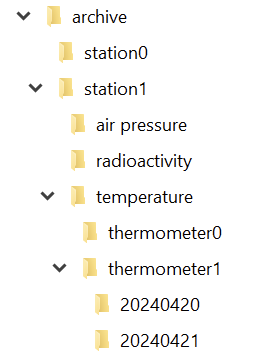
If you implement your archive in the file system, you can probably see the directory structure right before you:

And in each directory for the day, we have a file for each hour:

So we can just write a class that takes our four parameters and returns the corresponding file. That is a straighforward and correct implementation.

It is also one of the implementations that couples your intent (an archive with four dimensions of navigability) nearly inseparably with your decisions on how to use your computer’s basic resources.

Thinking from the algorithms point of view

In order to separate your intent from your current implementation, you need to specify your intent as unencumbered from details as possible. Let’s specify our 4-axis archive nagivation system as a coordinate:

public record ArchiveCoordinate(
    StationId station,
    DataEntryType type,
    DeviceId device,
    LocalDateTime measurementTime
) {
}

There is nothing in here that point towards file system things like directories or files. We might have a hunch of the actual hierarchy by looking at the order of the parameters, but it is easy to implement a hierarchy-free nagivation between coordinates:

public record ArchiveCoordinate([...]) {
    public ArchiveCoordinate withStationChangedTo(
        StationId newStation
    ) {
        [...]
    }
    
    public ArchiveCoordinate withTypeChangedTo(
        DataEntryType newType
    ) {
        [...]
    }
    
    public ArchiveCoordinate withDeviceChangedTo(
        DeviceId newDevice
    ) {
        [...]
    }
    
    public ArchiveCoordinate withMeasurementTimeChangedTo(
        LocalDateTime newMeasurementTime
    ) {
        [...]
    }
}

The concept is that if you know one coordinate, you can navigate relative to it through the archive, without knowingly changing the directory or whatever implementation structure lies beneath your model layer. Let’s say we have the coordinate of a particular measurement of one thermometer. How do we get the same measurement of the other thermometer?

ArchiveCoordinate measurementForThermometer0 = new ArchiveCoordinate([...]);
ArchiveCoordinate measurementForThermometer1 = measurementForThermometer0.withDeviceChangedTo(thermometer1);

We can provide methods that allow us to step forward and backward in time. We can provide our application code with everything it requires to implement clear and concise algorithms based on our model of the archive.

But there will be the moment where you want to “get real” and access the data. You might decide to let your current implementation shine through to your intent layer and provide an actual file:

public interface Archive {
    Optional<File> entryFor(ArchiveCoordinate coordinate);
}

That’s all you need from the archive to get your file. But you might also decide to prolong your intent layer and wrap the file in your own data type that provides everything your algorithms need without revealing that it is really a file that lies underneath:

public interface Archive {
    Optional<ArchiveResource> entryFor(ArchiveCoordinate coordinate);
}

The new ArchiveResource is a thin, but effective veneer (some might call it a wrapper or a facade) that gives us the required information:

public interface ArchiveResource {
    String name();
    long size();
    InputStream read();
}

Of course, we need to provide an implementation for all of this. But by staying vague in the intent layer, we open the door for an implementation that has nothing to do with files. Instead of a file system, there could be a relational database underneath and we wouldn’t notice. Our algorithms would still work the same way and read their data from ArchiveResources that aren’t FileArchiveResources anymore, but DatabaseArchiveResources.

You can probably imagine how you can provide the intent for data writing using the example above. If not, let me show you the necessary additions:

public interface Archive {
    Optional<ArchiveResource> entryFor(ArchiveCoordinate coordinate);
    ArchiveResource createEntryFor(ArchiveCoordinate coordinate) throws IOException;
}
public interface ArchiveResource {
    String name();
    long size();
    InputStream read();
    OutputStream write();
}

Now you can store additional data to the archive without ever knowing if you write to a file or a database or something completely different.

Summary

By separating your intent from your current actual implementation, you gain at least three things for the cost of more work and some harder thinking:

  1. Your algorithms only use your intent layer. You design it exclusively for your algorithms. It will fit like a glove.
  2. The terms you use in your intent layer shape the algorithm metaphors way better than the terms of your current implementation. You can freely decide what terms you’ll use.
  3. The algorithms and your intent layer are designed to last. Your current implementation can be swapped out without them noticing.

If this sounds familiar to you, it is a slightly different take on the “ports and adapters” architecture. The important thing is that by starting with the intent and naming it from the standpoint of your algorithms (application code), you are less prone to let your implementation shine through.

How building blocks can be a game changer for your project

I have just completed my first own project. In this project I have a web server whose main task is to load files and return them as a stream.
In the first version, there was a static handler for each file type, which loaded the file and sent it as a stream.

As part of a refactoring, I then built building blocks for various tasks and the handler changed fundamentally.

The initial code

Here you can see a part of my web server. It offers a path for both images and audio files. The real server has significantly more handlers and file types.

public class WebServer{
    public static void main(String[] args) {
        var app = Javalin.create()
            .get("api/audio/{root}/{path}/{number}", FileHandler::handleAudio)
            .get("api/img/{root}/{path}/{number}", FileHandler::handleImage)
            .start(7070);
    }
}

Below is a simplified illustration of the handlers. I have also shown the imports of the web server class and the web server technology, in this case Javalin. The imports are not complete. They are only intended to show these two dependencies.

import WebServer;
import io.javalin.http.Context;
// ...

public class FileHandler {

    public static void handleImage(Context ctx) throws IOException {
        var resource = Application.class.getClassLoader().getResourceAsStream(
            String.format(
                "file/%s/%s/%s.jpg", 
                ctx.pathParam("root"), 
                ctx.pathParam("path"), 
                ctx.pathParam("fileName")));
        String mimetyp= "image/jpg";

        if (resource != null) {
            ctx.writeSeekableStream(resource, mimetyp);
        }
    }

    public static void handleAudio(Context ctx) {
        var resource = Application.class.getClassLoader().getResourceAsStream(
            String.format(
                "file/%s/%s/%s.mp3", 
                ctx.pathParam("root"), 
                ctx.pathParam("path"), 
                ctx.pathParam("fileName")));
        String mimetyp= "audio/mp3";

        if (resource == null) {
            resource = Application.class.getClassLoader().getResourceAsStream(
            String.format(
                "file/%s/%s/%s.mp4", 
                ctx.pathParam("root"), 
                ctx.pathParam("path"), 
                ctx.pathParam("fileName")));
            mimetyp= "video/mp4";
        }

        if (resource != null) {
            ctx.writeSeekableStream(resource, mimetyp);
        }
    }
}

The handler methods each load the file and send it to the Javalin context. The audio handler first searches for an audio file and, if this is not available, for a video file. The duplication is easy to see. And with the static handler and Javalin dependencies, the code is not testable.

Refactoring

So first I build an interface, called a decorator, for the context to get the Javalin dependency out of the handlers. A nice bonus: I can manage the handling of not found files centrally. In the web server, I then inject the new WebContext instead of the Context.

public interface WebContext {
    String pathParameter(String key);
    void sendNotFound();
    void sendResourceAs(String type, InputStream resource);
    default void sendResourceAs(String type, Optional<InputStream> resource){
        if(resource.isEmpty()){
            sendNotFound();
            return;
        }
        sendResourceAs(type, resource.get());
    }
}

public class JavalinWebContext implements WebContext {
    private final Context context;

    public JavalinWebContext(Context context){
        this.context = context;
    }

    @Override
    public String pathParameter(String key) {
        return context.pathParam(key);
    }

    @Override
    public void sendNotFound() {
        context.status(HttpStatus.NOT_FOUND);
    }

    @Override
    public void sendResourceAs(String type, InputStream resource) {
        context.writeSeekableStream(resource, type);
    }
}

Then I write a method to load the file and send it as a stream.

private boolean sendResourceFor(String path, String mimetyp, Context context){
    var resource = Application.class.getClassLoader().getResourceAsStream(path);
    if (resource != null) {
        context.sendResourceAs(mimetyp, resource);
        return true;
    }
    return false;
}

The next step is to build a loader for the files, which I pass to the no longer static handler during initialization. Here I can run a quick check to see if anyone is trying to manipulate the specified path.

public class ResourceLoader {
    private final ClassLoader context;

    public ResourceLoader(ClassLoader context){
        this.context = context;
    }

    public Optional<InputStream> asStreamFrom(String path){
        if(path.contains("..")){
            return Optional.empty();
        }
        return Optional.ofNullable(this.context.getResourceAsStream(path));
    }
}

Finally, I build an extra class for the paths. The knowledge of where the files are located and how to determine the path from the context should not be duplicated everywhere.

public class FileCoordinate {
    private static final String FILE_CATEGORY = "file";
    private final String root;
    private final String path;
    private final String fileName;
    private final String extension;

    private FileCoordinate(String root, String path, String fileName, String extension){
        super();
        this.root = root;
        this.path = path;
        this.fileName = fileName;
        this.extension = extension;
    }

    private static FileCoordinate pathFromWebContext(WebContext context, String extension){
        return new FileCoordinate(
                context.pathParameter("root"),
                context.pathParameter("path"),
                context.pathParameter("fileName"),
                extension
        );
    }

    public static FileCoordinate toImageFile(WebContext context){
        return FileCoordinate.pathFromWebContext(context, "jpg");
    }

    public static FileCoordinate toAudioFile(WebContext context){
        return FileCoordinate.pathFromWebContext(context, "mp3");
    }

    public FileCoordinate asToVideoFile(){
        return new FileCoordinate(
                root,
                path,
                fileName,
                "mp4"
        );
    }

    public String asPath(){
        return String.format("%s/%s/%s/%s.%s", FILE_CATEGORY, root, path, fileName, extension);
    }
}

Result

My handler looks like this after refactoring:

public class FileHandler {
    private final ResourceLoader resource;

    public FileHandler(ResourceLoader resource){
        this.resource = resource;
    }

    public void handleImage(WebContext context) {
        var coordinate = FileCoordinate.toImageFile(context);
        sendResourceFor(coordinate, "image/jpg", context);     
    }

    public void handleAudio(WebContext context) {
        var coordinate = FileCoordinate.toAudioFile(context);
        var found = sendResourceFor(coordinate, "audio/mp3", context);
        if(!found)
            sendResourceFor(coordinate.asToVideoFile(), "video/mp4", context);
    }

    private boolean sendResourceFor(FileCoordinate coordinate, String mimetype, WebContext context){
        var stream = resource.asStreamFrom(coordinate);
        context.sendResourceAs(mimetype, stream);
        return stream.isPresent();
    }
}

It is much shorter, easier to read and describes more what is done and not how it is technically done. Another advantage is that I can, for example, fully test my FileCoordinate and mock my WebContext.

For just these two handler methods, it still looks like a overkill. Overall, more code has been created than has disappeared and yes, a smaller modification would probably have been sufficient for this handler alone. But my application is not just this handler and most of them are much more complex. For example, I work a lot with json files, which are loaded and which my loader can now simply interpret using an additional function that return a JsonNode instead a stream. The conversion has significantly reduced the complexity of the application, avoided duplications and made the code more secure and testable.

Walking Skeletons

The time has come. My first own project is starting. But where to start? In the backend, frontend, with the data? Or perhaps with the infrastructure and the delivery pipeline that the current state can always reach the customer? But what should be delivered when I don’t have it yet?

The solution for me was the walking skeleton. The zombie apocalypse may not sound like a good solution at first, but in the following I explain what the term means in software development and what the advantages are.

What is a walking skeleton?

The word walking skeleton can be divided into the components walking and skeleton. Walking means that the software is executable. Skeleton means only a minimalist implementation of the software has been completed and the flesh is still missing. In the case of a first walking skeleton, this means that the backend and frontend have already been set up with the technology of choice and that the components are connected. For example, the backend delivers the frontend.

How to build it? An example.

In my use case, I go one step further and want the walking skeleton to be a Docker container in which the backend and frontend run together.

The first step is to choose the technologies for the frontend and backend. In my case, react with vite and javalin. Then both projects have to be set up. Since my application will be very small, I decided to put the projects inside each other, so that the frontend can be found in the src/main/webapp folder. So I can build them with just one gradle on the top level.

With react, I can already use the example page was created by setup project for my walking skeleton. In Javalin I need a main class which can deliver the htlm page of the react application via a web server. In my code example, the index.html file is automatically delivered if it is stored in the resources/public folder.

import io.javalin.Javalin;
import io.javalin.http.staticfiles.Location;

public class Application {
    public static void main(String[] args) {
        var app = Javalin.create(config -> {
                    config.staticFiles.add("/public", Location.CLASSPATH);
                })
                .start(7070);
    }
}

With some gradle plugins it is possible to build the react app using gradle (com.github.node-gradle.node), pack the java application and all sources into a jar (com.github.johnrengelman.shadow) and create a docker image from it (com.bmuschko.docker-remote-api).

// omitted dependencies, imports and plugins
node {
    version = '20.11.0'
    yarnVersion = '1.22.19'
    distBaseUrl = 'https://nodejs.org/dist'
    download = true
    nodeProjectDir = file('src/main/webapp')
}

tasks.register('bundle', YarnTask) {
    dependsOn yarn
    group = 'build'
    description = 'Build the client bundle'
    args = ['run', 'bundle']
}

tasks.register('webpack', YarnTask) {
    dependsOn yarn
    group = 'build'
    description = 'Build the client bundle in watch mode'
    args = ['run', 'build']
}

tasks.register('jestTest', YarnTask) {
    dependsOn yarn
    group = 'verification'
    description = 'Run the jest tests of our javascript frontends'
    environment = ['CI': 'true']
    ignoreExitValue = true
    args = ['run', 'test']
}

tasks.register('prepareDocker', Copy) {
    dependsOn assemble
    description = 'Copy files from src/main/docker and application jar to Docker temporal build directory'
    group = 'Docker'

    from 'src/main/docker'
    from project.shadowJar

    into dockerBuildDir
}

tasks.register('buildImage', DockerBuildImage) {
    dependsOn prepareDocker
    description = 'Create Docker image to run the Grails application'
    group = 'Docker'

    inputDir = file(dockerBuildDir)
    images.add(dockerTag)
}

Here you can see the snippet from build.gradle, where the tasks for building the project can be seen.

Now my walking skeleton has been brought back to life and can run around the neighborhood cheerfully.

Why this is a good start?

But what is the advantage of letting undead walk?

Once you have completed this step, you can develop the individual parts independently of each other. The walking skeleton is a kickstart for pursuing approaches such as test-driven development. And the delivery pipeline can now also be tackled, as the walking skeleton can be delivered. All in all, the walking skeleton is a way to get started on a project as quickly as possible.

Always apply the Principle Of Least Astonishment to yourself, too

Great principles have the property that while they can be stated in a concise form, they have far-reaching consequences one can fully appreciate after many years of encountering them.

One of these things is what is known as the Principle of Least Astonishment / Principle of Least Surprise (see here or here). As stated there, in a context of user interface design, its upshot is “Never surprise the user!”. Within that context, it is easily understandable as straightforward for everyone that has ever used any piece of software and notices that never once was he glad that the piece didn’t work as suggested. Or did you ever feel that way?

Surprise is a tool for willful suspension, for entertainment, a tool of unnecessary complication; exact what you do not want in the things that are supposed to make your job easy.

Now we can all agree about that, and go home. Right? But of course, there’s a large difference between grasping a concept in its most superficial manifestation, and its evasive, underlying sense.

Consider any software project that cannot be simplified to a mere single-purpose-module with a clear progression, i.e. what would rather be a script. Consider any software that is not just a script. You might have a backend component with loads of requirements, you have some database, some caching functionality, then you want a new frontend in some fancy fresh web technology, and there’s going to be some conflict of interests in your developer team.

There will be some rather smart ways of accomplishing something and there will be rather nonsmart ways. How do you know which will be which? So there, follow your principle: Never surprise anyone. Not only your end user. Do not surprise any other team member with something “clever”. In most situations,

  1. it’s probably not clever at all
  2. the team member being fooled by you is yourself

Collaboration is a good tool to let that conflict naturally arise. I mean the good kind of conflict, not the mistrust, denial of competency, “Ctrl+A and Delete everything you ever wrote!”-kind of conflict. Just the one where someone would tell you “hm. that behaviour is… astonishing.”

But you don’t have a team member in every small project you do. So just remember to admit the factor of surprise in every thing you leave behind. Do not think “as of right now, I understand this thing, ergo this is not of any surprise to anyone, ever”. Think, “when I leave this code for two months and return, will there be anything… of surprise?”

This principle has many manifestations. As one of Jakob Nielsen’s usability heuristics, it’s called “Recognition rather than Recall”. In a more universal way of improving human performance and clarity, it’s called “Reduce Cognitive Load”. It has a wide range of applicability from user interfaces to state management, database structures, or general software architecture. I like the focus of “Surprise”, because it should be rather easy for you to admit feeling surprised, even by your own doing.

Wear parts in software

I want to preface my thoughts with the story that originally sparked them (and yes, I oftentimes think about software development when unrelated things happen in the real world).

I don’t own a car myself, but I’m a non-hesistant user of rental cars and car sharing services. So when I have to drive long distances, I use many different models of cars. One model family is the Opel Corsa compact cars, where I’ve driven the models A to C and in the story, model D.

It was on the way back, on the highway, when darkness settled in. I switched on the headlamps and noticed that one of them was not working. In germany, this means that your car is unfit for travel and you should stop. You cannot stop on the highway, so I continued driving towards the next gas and service station.

Inside the station, I headed to the shelf with car spare parts and searched for a lightbulb for a Corsa model D. Finding the lightbulbs for A, B and C was easy, but the bulbs for D weren’t there. In fact, there wasn’t even a place for them on the shelf. I asked the clerk for help and he laughed. They didn’t sell lightbulbs for the Corsa model D because changing them wasn’t possible for the layman.

To change a lightbulb in my car, you have to remove the engine block, exchange the lightbulb and install the engine block again. You need to perform this process in a repair shop and be attentive to accidental leakage and connector damage.

Let me summarize the process: To replace an ordinary wear part, you have to perform delicate expert work.

This design paradigm seems to be on the rise with consumer products. If you know how to change the battery on your smartphone or laptop, you probably explicitly chose the device because of this feature.

Interestingly, the trend is reversed for software development. Our architectures and design efforts try to separate between primary code and wear part code. Development principles like SRP (Single Responsibility Principle) or OCP (Open/Closed Principle) have the “wear part code” metaphor in mind, even if it isn’t communicated in such clarity.

On the architecture field, a microservice paradigm maps a complex mechanism onto several small and isolated parts. The isolation aspect is crucial because it promotes replaceability – you don’t need to remove and reinstall a central microservice if you want to replace a more peripheral one. And even the notion of “central and peripheral” services indicates the existence and consideration of an abrasion effect.

For a single application, the clean, hexagonal or onion architecture layout makes the “wear part code” metaphor the central aspect of your code positioning. The goal is to prepare for the inevitable technology replacement and don’t act surprised if the thing you chose as your baseplate turns out to behave like rotting wood.

A good product design (at least for the customer/user) facilitates maintainability by making simple upkeep tasks easy.

We software developers weren’t expected to produce good products because the technological environment moved faster than the wear and nobody but ourselves could inspect the product anyway.

If a field moves faster than the abrasion can occur, longevity of a product is not a primary concern. Your smartphone will be outdated and replaced long before the battery is worn out. There is simply no need to choose wear parts that live longer than the main product. My postulation is that software development as a field has slowed down enough to make the major abrasive factors and areas discernable.

If nobody can inspect the software product and evaluate its sustainability, at least the original developer can, right? You can check for yourself with a simple experiment. Print the source code of your software (or parts of it), take two text markers (my favorite colors for this kind of approach are green and blue) and mark the code you deem primary with the first text marker. Any code you consider a wear part gets colored with the second marker. If you find it difficult to make the distinction or if the colors are mingled all over the place, this might be an indication that you could improve things.

What is a wear part in software? I would love to hear your thoughts and definitions in the comment section! My description, with no claim to be complete, would be any code that has a high probability to change because of one of the following reasons:

  • The customer/user is forced to make a change request by external forces like legal regulation
  • Another software/system/service changes, forcing your software to adjust its understanding of its surrounding
  • The technical field moved, changing your perception of the code

If you plan for maintainability in software development, you always plan for obsolescence and replacement. Our wear parts are different from mechanical ones in their uniqueness – we don’t replace a lightbulb with the same model, we replace unique code with different, but also unique code. But the concept of wear parts is the same:

Things that are likely to be replaced are designed for easy replacement.

Redux-Toolkit & Solving “ReferenceError: Access lexical declaration … before initialization”

Last week, I had a really annoying error in one of our React-Redux applications. It started with a believed-to-be-minor cleanup in our code, culminated in four developers staring at our code in disbelief and quite some research, and resulted in some rather feasible solutions that, in hindsight, look quite obvious (as is usually the case).

The tech landscape we are talking about here is a React webapp that employs state management via Redux-Toolkit / RTK, the abstraction layer above Redux to simplify the majority of standard use cases one has to deal with in current-day applications. Personally, I happen to find that useful, because it means a perceptible reduction of boilerplate Redux code (and some dependencies that you would use all the time anyway, like redux-thunk) while maintaining compatibility with the really useful Redux DevTools, and not requiring many new concepts. As our application makes good use of URL routing in order to display very different subparts, we implemented our own middleware that does the data fetching upfront in a major step (sometimes called „hydration“).

One of the basic ideas in Redux-Toolkit is the management of your state in substates called slices that aim to unify the handling of actions, action creators and reducers, essentially what was previously described as Ducks pattern.

We provide unit tests with the jest framework, and generally speaking, it is more productive to test general logic instead of React components or Redux state updates (although we sometimes make use of that, too). Jest is very modular in the sense that you can add tests for any JavaScript function from whereever in your testing codebase, the only thing, of course, is that these functions need to be exported from their respective files. This means that a single jest test only needs to resolve the imports that it depends on, recursively (i.e. the depenency tree), not the full application.

Now my case was as follows: I wrote a test that essentially was just testing a small switch/case decision function. I noticed there was something fishy when this test resulted in errors of the kind

  • Target container is not a DOM element. (pointing to ReactDOM.render)
  • No reducer provided for key “user” (pointing to node_modules redux/lib/redux.js)
  • Store does not have a valid reducer. Make sure the argument passed to combineReducers is an object whose values are reducers. (also …/redux.js)

This meant there was too much going on. My unit test should neither know of React nor Redux, and as the culprit, I found that one of the imports in the test file used another import that marginally depended on a slice definition, i.e.

///////////////////////////////
// test.js
///////////////////////////////
import {helper} from "./Helpers.js"
...

///////////////////////////////
// Helpers.js
///////////////////////////////
import {SOME_CONSTANT} from "./state/generalSlice.js"
...

Now I only needed some constant located in generalSlice, so one could easily move this to some “./const.js”. Or so I thought.

When I removed the generalSlice.js depency from Helpers.js, the React application broke. That is, in a place totally unrelated:

ReferenceError: can't access lexical declaration 'loadPage' before initialization

./src/state/loadPage.js/</<
http:/.../static/js/main.chunk.js:11198:100
./src/state/topicSlice.js/<
C:/.../src/state/topicSlice.js:140
> [loadPage.pending]: (state, action) => {...}

From my past failures, I instantly recalled: This is a problem with circular dependencies.

Alas, topicSlice.js imports loadPage.js and loadPage.js imports topicSlice.js, and while some cases allow such a circle to be handled by webpack or similar bundlers, in general, such import loops can cause problems. And while I knew that before, this case was just difficult for me, because of the very nature of RTK.

So this is a thing with the RTK way of organizing files:

  • Every action that clearly belongs to one specific slice, can directly be defined in this state file as a property of the “reducers” in createSlice().
  • Every action that is shared across files or consumed in more than one reducer (in more than one slice), can be defined as one of the “extraReducers” in that call.
  • Async logic like our loadPage is defined in thunks via createAsyncThunk(), which gives you a place suited for data fetching etc. that always comes with three action creators like loadPage.pending, loadPage.fulfilled and loadPage.rejected
  • This looks like
///////////////////////////////
// topicSlice.js
///////////////////////////////
import {loadPage} from './loadPage.js';

const topicSlice = createSlice({
    name: 'topic',
    initialState,
    reducers: {
        setTopic: (state, action) => {
            state.topic= action.payload;
        },
        ...
    },
    extraReducers: {
        [loadPage.pending]: (state, action) => {
              state.topic = initialState.topic;
        },
        ...
    });

export const { setTopic, ... } = topicSlice.actions;

And loadPage itself was a rather complex action creator (thunk), as it could cause state dispatches as well, as it was built, in simplified form, as:

///////////////////////////////
// loadPage.js
///////////////////////////////
import {setTopic} from './topicSlice.js';

export const loadPage = createAsyncThunk('loadPage', async (args, thunkAPI) => {
    const response = await fetchAllOurData();

    if (someCondition(response)) {
        await thunkAPI.dispatch(setTopic(SOME_TOPIC));
    }

    return response;
};

You clearly see that import loop: loadPage needs setTopic from topicSlice.js, topicSlice needs loadPage from loadPage.js. This was rather old code that worked before, so it appeared to me that this is no problem per se – but solving that completely different dependency in Helpers.js (SOME_CONSTANT from generalSlice.js), made something break.

That was quite weird. It looked like this not-really-required import of SOME_CONSTANT made ./generalSlice.js load first, along with it a certain set of imports include some of the dependencies of either loadPage.js or topicSlice.js, so that when their dependencies would have been loaded, their was no import loop required anymore. However, it did not appear advisable to trace that fact to its core because the application has grown a bit already. We needed a solution.

As I told before, it required the brainstorming of multiple developers to find a way of dealing with this. After all, RTK appeared mature enough for me to dismiss “that thing just isn’t fully thought through yet”. Still, code-splitting is such a basic feature that one would expect some answer to that. What we did come up with was

  1. One could address the action creators like loadPage.pending (which is created as a result of RTK’s createAsyncThunk) by their string equivalent, i.e. ["loadPage/pending"] instead of [loadPage.pending] as key in the extraReducers of topicSlice. This will be a problem if one ever renames the action from “loadPage” to whatever (and your IDE and linter can’t help you as much with errors), which could be solved by writing one’s own action name factory that can be stashed away in a file with no own imports.
  2. One could re-think the idea that setTopic should be among the normal reducers in topicSlice, i.e. being created automatically. Instead, it can be created in its own file and then being referenced by loadPage.js and topicSlice.js in a non-circular manner as export const setTopic = createAction('setTopic'); and then you access it in extraReducers as [setTopic]: ... .
  3. One could think hard about the construction of loadPage. This whole thing is actually a hint that loadPage does too many things on too many different levels (i.e. it violates at least the principles of Single Responsibility and Single Level of Abstraction).
    1. One fix would be to at least do away with the automatically created loadPage.pending / loadPage.fulfilled / loadPage.rejected actions and instead define custom createAction("loadPage.whatever") with whatever describes your intention best, and put all these in your own file (as in idea 2).
    2. Another fix would be splitting the parts of loadPage to other thunks, and the being able to react on the automatically created pending / fulfilled / rejected actions each.

I chose idea 2 because it was the quickest, while allowing myself to let idea 3.1 rest a bit. I guess that next time, I should favor that because it makes the developer’s intention (as in… mine) more clear and the Redux DevTools output even more descriptive.

In case you’re still lost, my solution looks as

///////////////////////////////
// sharedTopicActions.js
///////////////////////////////
import {createAction} from "@reduxjs/toolkit";
export const setTopic = createAction('topic/set');
//...

///////////////////////////////
// topicSlice.js
///////////////////////////////
import {setTopic} from "./sharedTopicActions";
const topicSlice = createSlice({
    name: 'topic',
    initialState,
    reducers: {
        ...
    },
    extraReducers: {
        [setTopic]: (state, action) => {
            state.topic= action.payload;
        },

        [loadPage.pending]: (state, action) => {
              state.topic = initialState.topic;
        },
        ...
    });

///////////////////////////////
// loadPage.js, only change in this line:
///////////////////////////////
import {setTopic} from "./sharedTopicActions";
// ... Rest unchanged

So there’s a simple tool to break circular dependencies in more complex Redux-Toolkit slice structures. It was weird that it never occured to me before, i.e. up until to this day, I always was able to solve circular dependencies by shuffling other parts of the import.

My problem is fixed. The application works as expected and now all the tests work as they should, everything is modular enough and the required change was not of a major structural redesign. It required to think hard but had a rather simple solution. I have trust in RTK again, and one can be safe again in the assumption that JavaScript imports are at least deterministic. Although I will never do the work to analyse what it actually was with my SOME_CONSTANT import that unknowingly fixed the problem beforehand.

Is there any reason to disfavor idea 3.1, though? Feel free to comment your own thoughts on that issue 🙂

Pattern Matching and the SLAP

You probably know that effect: One starts writing a lot of code in a new language, after a while gains a decent appreciation of this or that goodness and a decent annoyance about these or that oddities… Then you do some other project in other languages (the Softwareschneiderei projects are quite diverse in this respect), and each time you switch languages there’s that small moment of pondering about certain design decisions.

Then after a while, sometimes there’s that feeling of a deep “ooooooh”, and you get a understanding of a fundamental mindset that probably must have been influential there. This is always interesting, because you can start to try using similar patterns in other languages, just to find out whether they are generally useful or not.

Now, as I’ve been writing quite some Rust code lately, I somehow started to like the way of pattern matching that it proposes. Suppose you have a structure that is some composition of multiple decisions, that somehow belong together to a sufficient degree that you don’t split it up into multiple pieces. That might be the state of some file handling that was passed to your program, as an example. Such a structure could look like (u32 is Rust’s unsigned 32-bit integer format):

enum InputState {
    Unitialized,
    PlainText(String),
    ImageData {
        width: u32,
        height: u32,
        base64Data: String,
    },
    Error {
        code: u32,
        message: String
    }
}

Now, in order to read such a thing in a context, there’s the “match” statement, a kind of “switch/select with superpowers”, in that it allows you to simultaneously destructure its content to reduce unnecessary typing. This might look like

fn process_input(state: InputState) {
    match state {
        InputState::Uninitialized => {
            println!("Uninitialized. Nothing to do!");
            std::process::exit();
        },
        InputState::PlainText(str) => {
            display_string(str);
        },
        InputState::ImageData {_, base64Data} => {
            println!("This seems to be a image and is now to be displayed");
            display_image(base64Data);
        }
        _ => (),
    }
}

(I probably forgot several &references in writing that example, but that’s Rust and not my point here :D). Anyway. At first, I was quite irritated with that – why does Rust want me to always include the placeholders (the _)? Why can’t it just let me take care of the stuff I want to take care right now? Why does the compiler complain instead of always assuming that _ => (), i.e. if nothing else matches, do nothing? But I eventually found out.

To make my point, a comparison with a more loosely typed environment like JavaScript, where (as a quick sketch) one could have written that as

// inputState might be null, or {message: "bla"},
// or {width: ..., height:..., base64Data}, or {code: ..., message: "bla"}...

if (!inputState) { return; }
if (inputState.code) { /* Error case */ }
else if (inputState.base64Data) { /* Image case */ }
else if (inputState.message) { /* probably the PlainText case */ }

/* but are you sure you forgot nothing? */

Now my point is, that these are not merely translations of the same idea between different languages. These are structurally different.

The latter example is a very microscopic view. I have a kind of squishy looking, alien thing called inputState that lies on the center of my operating table, I take the scalpel and dissect – what do we have here? what color is that? does this have bones? … Without further ado, you grab into the interior of whatever and you better hope that you’re not in a kind of Sci-Fi Horror Movie… :O

The former Pattern Matching, however, is an approach more true to its original question. It stops you with your scalpel right at the beginning.

We first want to know all eventualities. Then cut where it makes sense, and free your mind from the first decision.

We just wanted to distinguish our proceeding depending on the general nature of our object of interest. We do not want to look into details at that moment, we just want to know where we are.

In the language of Clean Code, this is the Single Level of Abstraction Principle (SLAP). It states that each method you write should explicitly concern itself with a constant degree of looking at a certain problem. E.g. Low-level mathematical calculations like milliseconds vs. system time conversions should not appear next to high-level server initialization; with the simple reason of understandability – switching levels of abstractions is quite irritating for the human brain (i.e. everyone who didn’t write that code). It breaks your line of thinking, especially when you are trying to find a bug or worse.

From my experience, I know that I myself would argue “well that’s not true; I can indeed hold multiple level of abstractions in my head simultaneously!” and this isn’t really a lie. But I still see embarrassing mistakes later, of the type “of course there’s also that case. I should have known.”

Another metaphor: Think you just ask your friend about the time. She then directly initiates a very detailed lecture about the movement of Sun and Earth, paired with some epistological considerations about the Heisenberg uncertainty principle, not to neglect the role of time in the concept of Entropy. Would you rather respond with “Thanks, that helped” or “… are you on drugs?”?

With Pattern Matching, this is the same. Look at a single decision, and then first lay all the options open: “What is this?” – then go on to another method. “What do do about it?” is another level. “How?” goes deeper, “And how, actually, if you consider these or that additional conditions” even deeper. And at the bottom are something like components, that just take one input and mangle these bytes without regard for higher morals.

It is a very helpful principle that still sometimes needs a little reminder. For me, I was just happy to see that kind-of-compulsive approach embodied by the Rust match operator.

So, how far do you think one should take it with SLAP? Do you manage to always follow it, or does it work differently for you?

PS: Of course, one could introduce the same caution by defining a similar control flow also in JavaScript. There’s no need to break the SLAP. But it makes you the one responsible of keeping track, while in my Rust example you have the annoying linting / compiler do that for you.

The IT architect, Part III: Improve your environment

If you happen to work on a system that scales to the size of an IT landscape, your worst bet is to let it evolve by circumstances. You want to have a plan and act upon that plan. The base for your plan could be a landscape map, which we talked about in the first part of this series. Upon drawing the map, you want to interpret it in order to find the strong points and weak spots. We’ve talked about assessing the map in the second part of this series.

In this blog article, we look at ways to improve our IT landscape towards the goal of overall stability.

Our mission statement

If we want to improve things, we need to know in what aspect the improvement should occur. At the scale of an IT landscape, overall stability is a commonly desired trait. This doesn’t mean rigidity, where you cannot change a thing in the landscape lest the whole thing breaks. It also doesn’t mean that ever part of our landscape needs to be stable itself. Overall stability means that even with the inevitable outage or replacement of a part, the whole system still works. The system is resilient to change and failure, at least resilient enough for the organization working with the system.

If our mission is to improve towards overall stability, we need to work on the relationships between our services (or assets, as we called them earlier, because “service” is a greatly overloaded term) more than we need to work on the service itself.

This doesn’t mean that individual stability of an asset isn’t important. It certainly is, but more often than not, you cannot improve this single value that much. What you can iterate on with recognizable effect is limiting the consequences of lacking individual stability.

Our mantra

The fundamental rule that brings overall stability is the “dependency rule” of the clean architecture that is meant for internal software application architecture. But if we see our IT landscape as one big application (software or not might make less of a difference than thought), we can apply the rule without modification:

All dependencies point towards the center (inside) and never in the opposite direction (outside).

That’s it. You define a center of your map and have all dependencies point towards it. This results in a structure of “rings” around the center that denote different levels of stability. The dependency rule can be rewritten as such:

All dependencies point from the less stable asset to the more stable asset and never in the opposite direction.

If you think of stability only in terms of “service availability” that tells you the percentage of time you can utilize the service without degradation, you’re thinking too short. Stability also means stable interface and stable implementation. You can have a really rock solid ISDN internet connection at the center of your IT landscape map, if your ISP discontinues the technology, the lack of implementation stability will force you to change the asset and hope that all dependent assets (basically your whole map) are not affected by the change.

Planning for obsolescence

Trying to bring the relationships between your assets in congruence with their significance for your IT landscape is the central work of an IT architect. The main question is always: What happens if this asset needs to be replaced?

In IT, there is no such thing as an “eternally working asset”. I’m not well-versed in more physical domains like mechanical engineering to say that this an univeral invariant, but in my field of speciality, everything changes eventually.

If you create an IT landscape where every asset can be replaced with manageable effort and predictable consequences, you’ve created an overall stable system. You can probably improve the availability of parts of it, but you won’t need to overhaul the whole thing over and over again. Your IT landscape is ready to grow, evolve and change, but it does so in a controlled manner and without compromising the mission.

Anti-obsolescence patterns

On your way from your current map to your anticipated one, you’ll recognize recurring patterns that you employ to solve dependency problems or improve the longevity of overall structures. Here are three patterns that have helped me in my endeavours:

Protected variation

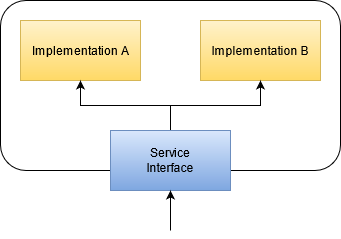
If you have more than one implementation for basically the same service (like the example of an internet connection), you probably want the rest of the map to not know about the multiplicity. In this case, you introduce an additional asset that acts as a router between the implementations. Think of the router (or service interface) as a guarding wall for your service implementations. It acts as a “portal” to the real service and can be paper-thin (at least for now). If you want to improve the runtime availability of your service, the router can also act as a load balancer and a circuit breaker. The important rule is that all outside relationships only point to the router, not the actual implementations.

Opinionated interface

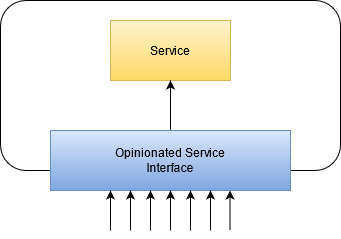
If you find an asset that has a lot of incoming dependencies, you’ve found a change risk. If you swap the service for a newer version with a similar, but not quite equivalent interface, you’ll find that you have to adjust lots of dependent assets in oftentimes surprising fashion. You can reduce your surprise by introducing a “portal” interface, just like you did in the protected variations, but without the variations. The portal or “opinionated service” interface offers everything your other assets require of the original service, but nothing more. It captures the “opinion” of your organization towards the service. When you introduce such a portal, it is nothing more than a forwarding service that maybe handles authentication itself. If you plan to swap the service, the portal becomes your requirement list and its new implementation will convert data back and forth.

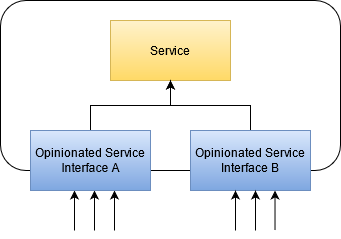
If you find that your portal gets to big, you could think about multiple portals with their own separated “opinion” about the service, all forwarding to the same “source of truth”:

Now you need to maintain several interface services, but they separate different concerns or contexts into separate assets, which might help with future migrations. Chances are, if there are separate concerns, that they will be provided by separate assets in the future.

Circular portals

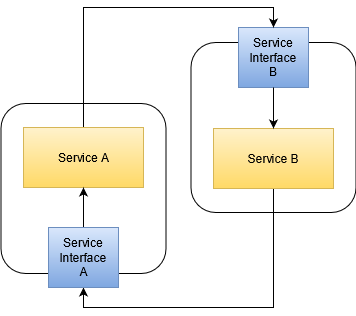
The most nasty thing to occur on your map is the ring (see part II of the series). In its smallest form, its just two assets requiring each other:

There are no easy ways out of this situation. But we can make some steps in the right direction and see where it takes us. The first step is introducing buffer assets that act as stand-ins for the real asset:

This doesn’t break the ring yet, but it gives us a chance to do so later. The service interfaces are opinionated and maybe even tailored specifically to the service using it. This reduces the “area of dependency” to its minimum. With a little luck, we find that Service A requires things of Service B that, if isolated, don’t require things of Service A themselves. If that’s the case, we can work on splitting Service B in two parts: One dependent on Service A, but not required by it and one indepedent of Service A, but needed by it. This would break the ring and give us a long chain that is much easier to work with. The problem is: None of this is guaranteed. In the worst case, you’ll still end up with your circular dependency with extra steps and nothing can be done about it.

Conclusion

When you begin to work with your IT landscape map, you begin to transform your assets from what they provide to what others actually require from them. Minimizing the relationships between assets, if not by number then at least by scope, is an appreciable improvement that gives you leeway to make changes in your actual IT setup without compromising the overall structure.

If you accompany your journey towards the best-fitting IT landscape with your map, you always have a plan at hands that you can show to people to form a shared understanding of the current state and the desired outcome. And if you keep old versions of your map in the archives, you can sometimes look back and see how far you’ve come yet.