How I accidentally cut my audio-files in half

A couple of weeks ago, I asked my brother to test out my new game You Are Circle (please wishlist it and check out the demo, if that’s up your alley!) and among lots of other valuable feedback, he mentioned that the explosion sound effects had a weird click sound at the end that he could only hear with his headphones on. For those of you not familiar with audio signal processing, those click or pop sounds usually appear when the ‘curvy’ audio signal is abruptly cut off1. I did not notice it on my setup, but he has a lot of experience with audio mixing, so I trusted his hearing. Immediately, I looked at the source files in audacity:

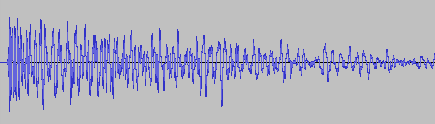
They looked fine, really. The sound slowly fades out, which is the exact thing you need to do to prevent clicks & pops. Suspecting the problem might be on the playback side of his particular setup, I asked him to record the sound on his computer the next time he tested and then kind of forgot about it for a bit.

Fast-forward a couple of days. Neither of us had followed up on the little clicky noise thing. While doing some video captures with OBS, I noticed that the sound was kind of terrible in some places, the explosions in particular. Maybe that was related?

While building a new version of my game, Compiling resources... showed up in my console and it suddenly dawned on me: What if my home-brew resource compiler somehow broke the audio files? I use it to encode all the .wav originals into Ogg Vorbis for deployment. Maybe a badly configured encoding setup caused the weird audio in OBS and for my brother? So I looked at the corresponding .ogg files, and to my surprise, it indeed had a small abrupt cut-off at the end. How could that happen? Only when I put both the original and the processed file next to each other, did I see what was actually going on:
It’s only half the file! How did that happen? And what made this specific file so special for it to happen? This is one of many files that I also convert from stereo to mono in preprocessing. So I hypothesized that might be the problem. No way I missed all of those files being cut in half though, or did I? So I checked the other files that were converted from stereo to mono. Apparently, I did miss it. They were all cut in half. So I took a look at the code. It looked something like this:

while (keep_encoding)
{
  auto samples_in_block = std::min(BLOCK_SIZE, input.sample_count() - sample_offset);
  if (samples_in_block != 0)
  {
    auto samples_per_channel = samples_in_block / channel_count;
    auto channel_buffer = vorbis_analysis_buffer(&dsp_state, BLOCK_SIZE);
    auto input_samples = input.samples() + sample_offset;

    if (convert_to_mono)
    {
      for (int sample = 0; sample < samples_in_block; sample += 2)
      {
        int sample_in_channel = sample / channel_count;
        channel_buffer[0][sample_in_channel] = (input_samples[sample] + input_samples[sample + 1]) / (2.f * 32768.f);
      }
    }
    else
    {
      for (int sample = 0; sample < samples_in_block; ++sample)
      {
        int channel = sample % channel_count;
        int sample_in_channel = sample / channel_count;
        channel_buffer[channel][sample_in_channel] = input_samples[sample] / 32768.f;
      }
    }

    vorbis_analysis_wrote(&dsp_state, samples_per_channel);
    sample_offset += samples_in_block;
  }
  else
  {
    vorbis_analysis_wrote(&dsp_state, 0);
  }

  /* more stuff to encode the block using the ogg/vorbis API... */
}

Not my best work, as far as clarity and deep nesting goes. After staring at it for a while, I couldn’t really figure out what was wrong with it. So I built a small test program to debug into, and only then did I see what was wrong.

It was terminating the loop after half the file, which now seems pretty obvious given the outcome. But why? Turns out it wasn’t the convert_to_mono at all, but the whole loop. What’s really the problem here is mismatched and imprecise terminology.

What is a sample? The audio signal is usually sampled several thousand times (44.1kHz, 48kHz or 96kHz are common) per second to record the audio waves. One data point is called a sample. But that is only enough of a definition if the sound has a single channel. But all those with convert_to_mono==true were stereo, and that’s exactly were the confusion is in this code. One part of the code thinks in single-channel samples, i.e. a single sampling time-point has two samples in a stereo file, while the other part things in multi-channel samples, i.e. a single sampling time-point has only one stereo sample, that consists of multiple numbers. Specifically this line:

auto samples_in_block = std::min(BLOCK_SIZE, input.sample_count() - sample_offset);

samples_in_block and sample_offset use the former definition, while input.sample_count() uses the latter. The fix was simple: replace input.sample_count() with input.sample_count() * channel_count.

But that meant all my stereo sounds, even the longer music files, were missing the latter half. And this was not a new bug. The code was in there since the very beginning of the git history. I just didn’t hear its effects. For the sound files, many of them have a pretty long fade out in the second half, so I can kind of get why it was not obvious. But the music was pretty surprising. My game music loops, and apparently, it also loops if you cut it in half. I did not notice.

So what did I learn from this? Many of my assumptions while hunting down this bug were wrong:

  • My brother’s setup did not have anything to do with it.
  • Just because the original source file looked fine, I thought the file I was playing back was good as well.
  • The bad audio in OBS did not have anything to do with this, it was just recorded too loud.
  • The ogg/vorbis encoding was not badly configured.
  • The convert_to_mono switch or the special averaging code did not cause the problem.
  • I thought I would have noticed that almost all my sounds were broken for almost two years. But I did not.

What really cause the problem was an old programming nemesis, famously one of the two hard things in computer science: Naming things. There you have it. Domain language is hard.

  1. I think this is because this sudden signal drop equates to a ‘burst’ in the frequency domain, but that is just an educated guess. If you know, please do tell. ↩︎
Save yourself from releasing garbage with Git Hooks

Times do happen, where one would write code that should please, please not land in the production release, like for example:

  • Overwriting a certain URL with a local one
  • Having a dialog always-open in order to efficiently style it
  • or generally, mocking code of something that is not-important-right-now™

And then we all already know that such shortcuts tend to stay in the code longer than intended. One might tell oneself:

Oh, I will mark this as // TODO: Remove ASAP

This is the feature branch, so either me or the Code Review will catch it when merging on main.

And this is better than nothing – some Git clients might disallow you from even committing code with any //TODO, but I feel that this is direct violation of the idea of “Commit Early, Commit Often”. As in, now you’re bound to finish your feature before you commit. This is the opposite of helping. By now you figure:

Thanks for nothing, I will just rename this as // TO_REMOVE

Rest of above logic applies untampered with.

These keyword-in-comments are sometimes called Code Tags (e.g. here), and here we just worked around the point that //TODO is more commonly used than other tags, but of course, these still are comments of no specific meaning.

You might now be able to push again, but still – say, the Code Reviewer does the heinous mistake of trusting you too much – this might lead to code in the official release that behaves so silly that it just makes every customer question your mental sanity, or worse.

Git Hooks can help you with appearing more sane than you are.

These are bash scripts in your specific repository instance (i.e. your local clone, or the server copy, individually) to run at specific points in the Git workflow.

For our particular use case, two hooks are of interest:

  • A pre-receive hook run on the server-side repository instance that can prevent the main branch from receiving your dumb development code. This sounds more rigid, but you need access to the server hosting the (bare) repository.
  • A pre-push hook run on your local repository instance that can prevent you from pushing your toxic waste to the branch in question. Keep in mind that if you do your merging unto main via GitLab Merge Requests etc. that this hook will not run then – but implementing it is easier because you already have all the access.

The local pre-push hook is as simple as adding a file named pre-push in the .git/hooks subfolder. It needs to be executable – (which, under Windows, you can use e.g. Git Bash for.)

cd $repositoryPath/.git/hooks
touch pre-push
chmod +x pre-push

And it contains:

#!/bin/sh
 
while read localRef localHash remoteRef remoteHash; do
    if [[ "$remoteRef" == "refs/heads/main" ]]; then
        for commit in $(git rev-list $remoteHash..$localHash); do
            if git grep -n "// REMOVE_ME" $commit; then
                echo "REJECTED: Commit contains REMOVE_ME tag!"
                exit 1
            fi
        done
    fi
done

This already will then lead git push to fail with output like

2f5da72ae9fd85bb5d64c03171c9a8f248b4865f:src/DevelopmentStuff.js:65:        // REMOVE_ME: temporary override for database URL
REJECTED: Commit contains REMOVE_ME tag!
failed to push some refs to '...'

and if that REMOVE_ME is removed, the push goes through.

Some comments:

  • You can easily extend this to multiple branches with the regex condition:
    if [[ "$remoteRef" =~ /(main|release|whatever)$ ]];
  • The git grep -n flag is there for printing out the offending line number.
  • You can make this more convenient with git grep -En "//\s*REMOVE_ME", i.e. allowing an arbitrary number of whitespace between the // and the tag.
  • The surrounding loop structure:
    while read localRef localHash remoteRef remoteHash;
    is exactly matching the way git is processing this pre-push hook. Each hook has a while read <arg list> structure, but the specific arguments depend on the actual hook type.

Hope this can help you taking some extra care!

However, remember that for these local hooks, every developer has to setup them for themselves; they are not pushed to the server instance – but implementing a pre-receive hook there is the topic for a future blog post.

You are mislead about the Big-O notation

One statement I have people say and people repeat a lot, especially in the data-oriented design bubble, is that Big-O notation cannot accurately real-life performance of contemporary computer programs, especially in the presence of multi-tier memory hierarchies like L1/L2/L3-caches for RAM. This is, at best, misleading and gives this fantastic tool a bad reputation.

At it’s core, Big-O is just a way to categorize functions in how they scale. There’s nothing in the formal definition about performance at all. Of course, it is often used to categorize performance of algorithms and implementations of them. But to use it for that, you need two other things: A machine model and a metric for it.

Traditionally, when performance categorization using Big-O is taught, the machine model is either the Turing-machine or the slightly closer-to-reality RAM-machine. The metric is a number of operations. The operation that is counted has a huge impact. For example, insertion sort can easily be implemented in O(n*log(n)) when counting the number of comparisons (by using binary search to find the insertion point), but is in O(n²) when counting the number of memory moves/swaps.

Neither the model nor the metric is intrinsic to Big-O. To use in in the context of memory hierarchies, you just need to start counting what matters to you, e.g. memory accesses, cache misses or branch mispredictions. This is not new either, I learned about cache-aware and cache-oblivious machine models for this in university over 15 years ago.

TL;DR: Big-O is not obsolete, you just have to use it to count the appropriate performance-critical element in your algorithm.

How building blocks can be a game changer for your project

I have just completed my first own project. In this project I have a web server whose main task is to load files and return them as a stream.
In the first version, there was a static handler for each file type, which loaded the file and sent it as a stream.

As part of a refactoring, I then built building blocks for various tasks and the handler changed fundamentally.

The initial code

Here you can see a part of my web server. It offers a path for both images and audio files. The real server has significantly more handlers and file types.

public class WebServer{
    public static void main(String[] args) {
        var app = Javalin.create()
            .get("api/audio/{root}/{path}/{number}", FileHandler::handleAudio)
            .get("api/img/{root}/{path}/{number}", FileHandler::handleImage)
            .start(7070);
    }
}

Below is a simplified illustration of the handlers. I have also shown the imports of the web server class and the web server technology, in this case Javalin. The imports are not complete. They are only intended to show these two dependencies.

import WebServer;
import io.javalin.http.Context;
// ...

public class FileHandler {

    public static void handleImage(Context ctx) throws IOException {
        var resource = Application.class.getClassLoader().getResourceAsStream(
            String.format(
                "file/%s/%s/%s.jpg", 
                ctx.pathParam("root"), 
                ctx.pathParam("path"), 
                ctx.pathParam("fileName")));
        String mimetyp= "image/jpg";

        if (resource != null) {
            ctx.writeSeekableStream(resource, mimetyp);
        }
    }

    public static void handleAudio(Context ctx) {
        var resource = Application.class.getClassLoader().getResourceAsStream(
            String.format(
                "file/%s/%s/%s.mp3", 
                ctx.pathParam("root"), 
                ctx.pathParam("path"), 
                ctx.pathParam("fileName")));
        String mimetyp= "audio/mp3";

        if (resource == null) {
            resource = Application.class.getClassLoader().getResourceAsStream(
            String.format(
                "file/%s/%s/%s.mp4", 
                ctx.pathParam("root"), 
                ctx.pathParam("path"), 
                ctx.pathParam("fileName")));
            mimetyp= "video/mp4";
        }

        if (resource != null) {
            ctx.writeSeekableStream(resource, mimetyp);
        }
    }
}

The handler methods each load the file and send it to the Javalin context. The audio handler first searches for an audio file and, if this is not available, for a video file. The duplication is easy to see. And with the static handler and Javalin dependencies, the code is not testable.

Refactoring

So first I build an interface, called a decorator, for the context to get the Javalin dependency out of the handlers. A nice bonus: I can manage the handling of not found files centrally. In the web server, I then inject the new WebContext instead of the Context.

public interface WebContext {
    String pathParameter(String key);
    void sendNotFound();
    void sendResourceAs(String type, InputStream resource);
    default void sendResourceAs(String type, Optional<InputStream> resource){
        if(resource.isEmpty()){
            sendNotFound();
            return;
        }
        sendResourceAs(type, resource.get());
    }
}

public class JavalinWebContext implements WebContext {
    private final Context context;

    public JavalinWebContext(Context context){
        this.context = context;
    }

    @Override
    public String pathParameter(String key) {
        return context.pathParam(key);
    }

    @Override
    public void sendNotFound() {
        context.status(HttpStatus.NOT_FOUND);
    }

    @Override
    public void sendResourceAs(String type, InputStream resource) {
        context.writeSeekableStream(resource, type);
    }
}

Then I write a method to load the file and send it as a stream.

private boolean sendResourceFor(String path, String mimetyp, Context context){
    var resource = Application.class.getClassLoader().getResourceAsStream(path);
    if (resource != null) {
        context.sendResourceAs(mimetyp, resource);
        return true;
    }
    return false;
}

The next step is to build a loader for the files, which I pass to the no longer static handler during initialization. Here I can run a quick check to see if anyone is trying to manipulate the specified path.

public class ResourceLoader {
    private final ClassLoader context;

    public ResourceLoader(ClassLoader context){
        this.context = context;
    }

    public Optional<InputStream> asStreamFrom(String path){
        if(path.contains("..")){
            return Optional.empty();
        }
        return Optional.ofNullable(this.context.getResourceAsStream(path));
    }
}

Finally, I build an extra class for the paths. The knowledge of where the files are located and how to determine the path from the context should not be duplicated everywhere.

public class FileCoordinate {
    private static final String FILE_CATEGORY = "file";
    private final String root;
    private final String path;
    private final String fileName;
    private final String extension;

    private FileCoordinate(String root, String path, String fileName, String extension){
        super();
        this.root = root;
        this.path = path;
        this.fileName = fileName;
        this.extension = extension;
    }

    private static FileCoordinate pathFromWebContext(WebContext context, String extension){
        return new FileCoordinate(
                context.pathParameter("root"),
                context.pathParameter("path"),
                context.pathParameter("fileName"),
                extension
        );
    }

    public static FileCoordinate toImageFile(WebContext context){
        return FileCoordinate.pathFromWebContext(context, "jpg");
    }

    public static FileCoordinate toAudioFile(WebContext context){
        return FileCoordinate.pathFromWebContext(context, "mp3");
    }

    public FileCoordinate asToVideoFile(){
        return new FileCoordinate(
                root,
                path,
                fileName,
                "mp4"
        );
    }

    public String asPath(){
        return String.format("%s/%s/%s/%s.%s", FILE_CATEGORY, root, path, fileName, extension);
    }
}

Result

My handler looks like this after refactoring:

public class FileHandler {
    private final ResourceLoader resource;

    public FileHandler(ResourceLoader resource){
        this.resource = resource;
    }

    public void handleImage(WebContext context) {
        var coordinate = FileCoordinate.toImageFile(context);
        sendResourceFor(coordinate, "image/jpg", context);     
    }

    public void handleAudio(WebContext context) {
        var coordinate = FileCoordinate.toAudioFile(context);
        var found = sendResourceFor(coordinate, "audio/mp3", context);
        if(!found)
            sendResourceFor(coordinate.asToVideoFile(), "video/mp4", context);
    }

    private boolean sendResourceFor(FileCoordinate coordinate, String mimetype, WebContext context){
        var stream = resource.asStreamFrom(coordinate);
        context.sendResourceAs(mimetype, stream);
        return stream.isPresent();
    }
}

It is much shorter, easier to read and describes more what is done and not how it is technically done. Another advantage is that I can, for example, fully test my FileCoordinate and mock my WebContext.

For just these two handler methods, it still looks like a overkill. Overall, more code has been created than has disappeared and yes, a smaller modification would probably have been sufficient for this handler alone. But my application is not just this handler and most of them are much more complex. For example, I work a lot with json files, which are loaded and which my loader can now simply interpret using an additional function that return a JsonNode instead a stream. The conversion has significantly reduced the complexity of the application, avoided duplications and made the code more secure and testable.

React for the algebra enthusiast – Part 2

In Part 1, I explained how algebra can shed some light on a quite restricted class of react-apps. Today, I will lift one of the restrictions. This step needs a new kind of algebraic structure:

Categories

Category theory is a large branch of pure mathematics, with many facets and applications. Most of the latter are internal to pure mathematics. Since I have a very special application in mind, I will give you a definition which is less general than the most common ones.

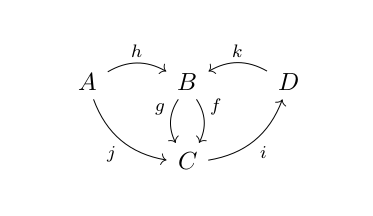
Categories can be thought of as generalized monoids. At the same time, a Category is a labelled, directed multigraph with some extra structure. Here is a picture of a labelled directed multigraph – its nodes are labelled with upper case letters and its edges are labelled with lower case letters:

If such a graph happens to be a category, the nodes are called objects and the edges morphisms. The idea is, that the objects are changed or morphed into other objects by the morphisms. We will write h:A\to B for a morphism from object A to object B.

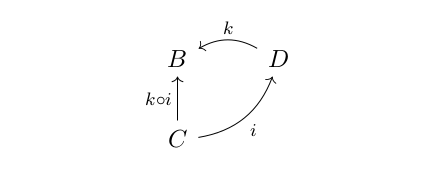
But I said something about extra structure and that categories generalize monoids. This extra structure is essentially a monoid structure on the morphisms of a category, except that there is a unit for each object called identity and the operation “\_\circ\_” can only be applied to morphisms, if they form “a line”. For example, if we have morphisms like k and i in the picture below, in a category, there will be a new morphism “k\circ i“:

Note that “i” is on the right in “k\circ i” but it is the first morphism if you follow the direction indicated by the arrows. This comes from function composition in mathematics, which suffers from the same weirdness by some historical accident. For now that just means that chains of morphisms have to be read from right to left to make sense of them.

For the indentities and the operation “\_\circ\_“, we can ask for the same laws to hold as in a monoid, which will complete the definition of a category:

Definition (not as general as it could be…)

A category consists of the following data:

  • A set of objects A,B,…
  • A set of morphisms f : A_1\to B_1, g:A_2\to B_2,\dots
  • An operation “\_\circ\_” which for all (consecutive) pairs of morphisms f:A\to B and g:B\to C returns a morphism g \circ f : A \to C
  • For any object a morphism \mathrm{id}_A : A\to A

Such that the following laws hold:

  • \_\circ\_ ” is associative: For all morphisms f : A \to B, g : B\to C and h : C\to D, we have: h \circ (g \circ f) = (h \circ g) \circ f
  • The identities are left and right neutral: For all morphisms f: A\to B we have: f \circ \mathrm{id}_A=\mathrm{id}_B \circ f

Examples

Before we go to our example of interest, let us look at some examples:

  • Any monoid is a category with one object O and for each element m of the monoid a morphism m:O\to O. “m\circ n” is defined to be m\cdot n.
  • The graph below can be extended to a category by adding the morhpisms ef: B\to B, fe: A\to A, efe: A\to B, fef: B\to A, \dots and an identity for A and B. The operation “\_\circ\_” is defined as juxtaposition, where we treat the identities as empty sequences. So for example, ef\circ efe is efefe: A\to B.
  • More generally: Let G be a labelled directed graph with edges e_1,\dots,e_r and nodes n_1,\dots,n_l. Then there is a category C_G with objects n_1,\dots,n_l and morphisms all sequences of consectutive edges – including the empty sequence for any node.

Action Categories

So let’s generalize Part 1 with our new tool. Our new scope are react-apps, which have actions without parameters, but now, action can not neccessarily be applied in any order. If an action can be fired, may now depend on the state of the app.

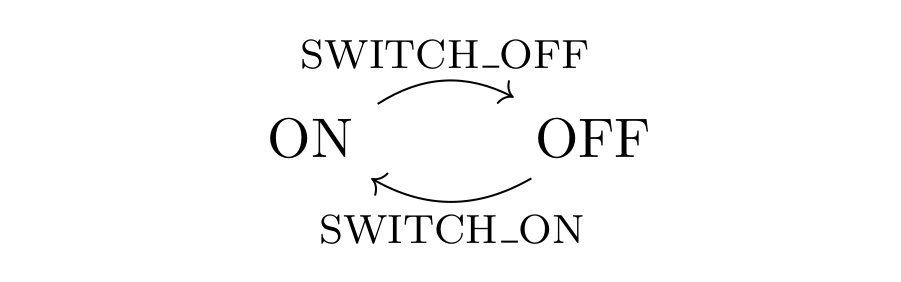
The smallest example I can think of, where we can see whats new, is an app with two states, let’s call them ON and OFF and two actions, let’s say SWITCH_ON and SWITCH_OFF:

Let us also say, that the action SWITCH_ON can only be fired in state OFF and SWITCH_OFF only in state ON. The category for that graph has as its morphims the possible sequences of actions. Now, if we follow the path of part 1, the obvious next step is to say that SWITCH_ON after SWITCH_OFF (and the other way around) is the same as the empty action-sequence — which leads us to…

Quotients

We made a pretty hefty generalization from monoids to categories, but the theory for quotients remains essentially the same. As we defined equivalence relations on the elements of a monoid, we can define equivalence relations on the morphisms of a category. As last time, this is problematic in general, but turns out to just work if we replace sequences of morphisms in the action category with matching source and target.

So in the example above, it is ok to say that SWITCH_ON SWITCH_OFF is the empty sequence on ON and SWITCH_OFF SWITCH_ON is the empty sequence on OFF (keep in mind that the first action to be executed is on the right). Then any action sequence can be reduced to simply SWITCH_ON, SWITCH_OFF or an empty sequence (not the empty sequence, because we have two of them with different source and target). And in this case, the quotient category will be what we drew above, but as a category.

Of course, this is not an example where any high-powered math is needed to get any insights. So far, these posts where just about understanding how the math works. For the next part of this series, my plan is to show how existing tools can be used to calculate larger examples.

React for the algebra enthusiast – Part 1

When I learned to use the react framework, I always had the feeling that it is written in a very mathy way. Since simple googling did not give me any hints if this was a consideration in the design, I thought it might be worth sharing my thoughts on that. I should mention that I am sure others have made the same observations, but it might help algebraist to understand react faster and mathy computer scientiests to remember some algebra.

Free monoids

In abstract algebra, a monoid is a set M together with a binary operation “\cdot” satisfying these two laws:

  • There is a neutral element “e”, such that: \forall x \in M: x \cdot e = e \cdot x = e
  • The operation is associative, i.e. \forall x,y,z \in M: x \cdot (y\cdot z) = (x\cdot y) \cdot z

Here are some examples:

  • Any set with exactly one element together with the unique choice of operation on it.
  • The natural numbers \mathbb{N}=\{0,1,2,\dots \} with addition.
  • The one-based natural numbers \mathbb{N}_1=\{1,2,3,\dots\} with multiplication.
  • The Integers \mathbb Z with addition.
  • For any set M, the set of maps from M to M is a monoid with composition of maps.
  • For any set A, we can construct the set List(A), consisting of all finite lists of elements of A. List(A) is a monoid with concatenation of lists. We will denote lists like this: [1,2,3,\dots]

Monoids of the form List(A) are called free. With “of the form” I mean that the elements of the sets can be renamed so that sets and operations are the same. For example, the monoid \mathbb{N} with addition and List({1}) are of the same form, witnessed by the following renaming scheme:

0 \mapsto []

1 \mapsto [1]

2 \mapsto [1,1]

3 \mapsto [1,1,1]

\dots

— so addition and appending lists are the same operation under this identification.

With the exception of \mathbb{N}_1, the integers and the monoid of maps on a set, all of the examples above are free monoids. There is also a nice abstract definition of “free”, but for the purpose at hand to describe a special kind of monoid, it is good enough to say, that a monoid M is free, if there is a set A such that M is of the form List(A).

Action monoids

A react-app (and by that I really mean a react+redux app) has a set of actions. An action always has a type, which is usally a string and a possibly empty list of arguments.

Let us stick to a simple app for now, where each action just has a type and nothing else. And let us further assume, that actions can appear in arbirtrary sequences. That means any action can be fired in any state. The latter simplification will keep us clear from more advanced algebra for now.

For a react-app, sequences of actions form a free monoid. Let us look at a simple example: Suppose our app is a counter which starts with “0” and has an increment (I) and decrement (D) action. Then the sequences of action can be represented by strings like

ID, IIDID, DDD, IDI, …

which form a free monoid with juxtaposition of strings. I have to admit, so far this is not very helpful for a practitioner – but I am pretty sure the next step has at least some potential to help in a complicated situation:

Quotients

Quotients of sets by an equivalence relation are a very basic tool of modern math. For a monoid, it is not clear if a quotient of its underlying set will still be a monoid with the “same” operations.

Let us look at an example, where everything goes well. In the example from above, the counter should show the same integer if we decrement and then increment (or the other way around). So we could say that the two action sequences

  • ID and
  • DI

do really nothing and should be considered equivalent to the empty action sequence. So let’s say that any sequence of actions is equivalent to the same sequence with any occurence of “DI” or “ID” deleted. So for example we get:

IIDIIDD \sim I

With this rule, we can reduce any sequence to an equivalent one that is a sequence of Is, a sequence of Ds or empty. So the quotient monoid can be identified with the integers (in two different ways, but that’s ok) and addition corresponds to juxtaposition of action sequences.

The point of this example and the moral of this post is, that we can take a syntactic description (the monoid of action sequences), which is easy to derive from the source code and look at a quotient of the action monoid by a reasonable relation to arrive at some algebraic structure which has a lot to do with the semantic of the app.

So the question remains, if this works just well for an example or if we have a general recipe.

Here is a problem in the general situation: Let x,y,z\in M be elements of a monoid M with operation “\cdot” and \sim be an equivalence relation such that x is identified with y. Then, denoting equivalence classes with [\_] it is not clear if [x] \cdot [y] should be defined to be [x\cdot z] or [y\cdot z].

Fortunately problems like that disappear for free monoids like our action monoid and equivalence relations constructed in a specific way. As you can see on wikipedia, it is always ok to take the equivalence relation generated by the same kind of identifications we made above: Pick some pairs of sequences which are known “to do the same” from a semantic point of view (like “ID” and “DI” did the same as the empty sequence) and declare sequences to be equivalent, if they arise by replacing sequences known to be the same.

So the approach is that general: It works for apps, where actions do not have parameters and can be fired in any order and for equivalence relations generated by defining finitely many action sequences to do the same. The “any order” is a real restriction, but this post also has a “Part 1” in the title…

The inevitable emergence of domain events

If you’ve ever encountered code that cannot be modified anymore because business relies on a specific side effect of it, you’ve encountered an implicit domain event.

Even if you’ve read the original Domain Driven Design book by Eric Evans, you’ve probably still not heard about domain events (or DDD Domain Events), as he didn’t include them in the book. He talked about it a lot since then, for example in this talk in 2009 in the first 30 minutes.

Domain Events

In short, domain events are occurrences of “something that domain experts care about”. You should always be on the lookout for these events, because they are integral parts of the interface between the technical world and the domain world. In your source code, both worlds condense as the same things, so it isn’t easy (or downright impossible) to tell them apart. But if you are familiar with the concept of “pure fabrication”, you probably know that a single line of code can clearly belong to the technical fabric and still be relevant for the domain. Domain events are one possibility to separate the belongings again. But you have to listen to your domain experts, and they probably still don’t tell you the full story about what they care about.

Revealed by Refactoring

To underline my point, I want to tell you a story about a software project in a big organization. The software is already in production when my consulting job brings me into contact with the source code. We talked about a specific part of the code that screamed “pure fabrication” with just a few lines of domain code in between. Our goal was to refactor the code into two parts, one for the domain code and the other, bigger one for the technical part. In the technical part, some texts get logged into the logfile, like “item successfully written to the database” and “database connection closed”. It were clearly technical aspects of the code that got logged.

One of the texts had a spelling error in it and I reached out to correct it. A developer stopped me: “Don’t do that! They filter for that exact phrase.”. That surprised me. Nothing in the code indicated the relevance of that log statement, least of all the necessity of that typo. And I didn’t know who “they” were and that the logfiles got searched. So I asked a lot of questions and finally understood the situation:

Implicit Domain Events

The developers implemented the requirements of the domain experts as given in the specification documents. Nothing in there specified the exact text or even presence of logfile entries. But after the software was done and in production, the business side (including the domain experts) needed to know how many items were added to the system in a given period. And because they needed the information right away and couldn’t wait for the next development cycle, they contacted the operation department (that is separated from the development department) and got copies of the logfiles. They scanned the logfiles with some crude regular expression magic for the entries (like “item written to the database”) and got their result. The question was answered, the problem solved and the solution even worked a second time – and a third time, and so on. The one-time makeshift script was used permanently and repeatedly, in fact, it ran every hour and scanned for new items, because it became apparent that the business not only needed the statistics, but wanted to start a business process for each new item (like an editorial review of sorts) in a timely manner.

Pinned Code

Over the course of a few weeks, the purely technical logfile entry line in the source code got pinned and converted to a crucial domain requirement without any formal specification or even notification. Nothing in the source code hinted at the importance of this line or its typo. No test, no comment, no code structure. The line looked exactly the same as before, but suddenly played in another league. Every modification at this place or its surrounding code could hamper the business. Performing a well-intended refactoring could be seen as direct sabotage. The code was sacred, but in the unspoken kind. The code became a minefield.

Extracting the Domain Event

The whole hostage situation could be resolved by revealing the domain event and making it explicit. Let’s say that we model an “item added” domain event and post it in addition to the logfile entry. How we post it is up to the requirement or capabilities of the business department. An HTTP request to another service for every new item is a simple and viable solution. A line of text in a dedicated event log file would be another option. Even an e-mail sent to an human recipient could be discussed. Anything that separates the technical logfile from the business view on the system is better than forbidden code. After the separation, we can refactor the technical parts to our liking and still have tests in place that ensure that the domain event gets posted.

Domain Events are important

These domain events are important parts of your system, because they represent things (or actions) that the business cares about. Even if the business only remembers them after the fact, try to incorporate them in an explicit manner into your code. Not only will you be able to tell domain code and technical code apart easily, but you’ll also get this precious interface between business and tech. Make a list of all your domain events and you’ll know how your system is seen in the domain expert world. Everything else is more or less just details.

What story about implicit domain events comes to your mind? Tell us in a comment or write a blog entry about it. We want to hear from you!

A Game Optimization War Story

As our customers surely know, I’m not working here on fridays. This is because that’s the time I allocate to my side project, an arcade real-time strategy game called abstractanks. It is a passion project above all else, but of course, I am also learning a lot, much of which I can apply to my “day job” here as well. Today I want to share the story of how I optimized a critical bit of code in that game.

The Big Slowdown

While working on scripted missions, one main element I am using is to make a group of units attack when you enter an area (a.k.a. a zone-trigger). This seems easy enough, but was causing massive slowdowns as soon as the enemy group started moving. My average logic frame-time jumped from 0.3 ms to more than 1500 ms, which essentially makes the game unplayable. When seeing a performance problem, your first instinct should always be to profile it. So I booted up WPR/WPA and did just that. Once I had the profile, I followed the most-sampled path in the stack and found my way to the supposed culprit: the parking algorithm.

Context

When optimizing, you need as much context as you possible to find the best possible course of action. So let me explain how that algorithm fits into the broader picture.

Parking

My main game-mechanic is moving around your units. You do this by selecting a group and then clicking somewhere on the map to issue the move-order. In addition to path-finding process, this also runs an algorithm I call park-planning (as in parking a car). It makes sure that the units know to position themselves around the target point in a roughly circular shape once they arrive. It is essential to the interaction of this mechanic with the capturing of objectives, which are circular as well. Before this was implemented, the units would just decelerate after passing the target point. This caused them to “overshot” and miss the objectives, which was frustrating to the players: they clicked in the right place, but the units would not stop there, but slightly behind it. To make things worse, units arriving later, would bump into those that were already there, further pushing them away and clumping up.

AI Moving

In my particular case, the AI enemy was repeatedly issuing move-orders to close in on the intruder – the player. Since the player group usually also moved, the AI was trying to adapt by changing the move order every frame (effectively working at around 2000 APMs).

Diving into the code

My park-planning implementation is divided into two steps: finding enough parking spots, and then assigning units to it. The profiler was showing that the first part was the problem while the assignment was negligible in terms of run-time. Historically, the first step was reusing and extending some code I first wrote for spawning units, which worked like this:

optional<v2> GameWorld::FindFreePosition(v2 Center, std::vector<v2> const& Occupied)
{
  auto CheckPosition = [&](v2 Candiate)
  {
    if (!IsPassable(Candidate))
      return false;

    if (OverlapsWith(Occupied))
      return false;

    return !FriendlyUnitOccupies(Candidate);   
  };

  if (CheckPosition(Center))
    return Center;

  auto Radius = UNIT_SIZE;
  while (Radius < MAX_SEARCH_RADIUS)
  {
    // Roll a random starting angle
    auto AngleOffset = RandomAngle();
    auto Angle = 0.f;
    while (Angle < 2*Pi)
    {
      auto Candidate = Center + AngleVector(Angle + AngleOffset)*Radius;
      if (CheckPosition(Candidate))
        return Candidate;

      // Move along this circle
      Angle += 2*Pi*Radius / UNIT_SIZE / OVERSAMPLING_FACTOR;
    }

    // Increase the Radius
    Radius += UNIT_SIZE;
  }
  return none;  
}

Note that all the functions in the CheckPosition lambda are “size aware” and respect the UNIT_SIZE – so they are slightly more complex than what the pseudo-code here would have you believe.
The occupied parameter was added for the parking-position finding. It successively fills up the std::vector with positions and uses them once it found enough.

Back to the profiling results: They were showing that most of the time was spent in the FriendlyUnitOccupies, followed by IsPassable and and then OverlapsWith. FriendlyUnitOccupies dominated the time by about 8x times the rest. That function uses a quad-tree to accelerate spatial queries for other units.

Next steps

Obviously, this code uses pretty simplistic approach to the problem – basically just brute-forcing it. But that’s good now there are many different paths to take, many optimization opportunities. My approach was a relatively simple change that got the frame time back down below 1 ms, but before I did that, I considered many and tested a few other different approaches. I will talk about that in detail in my next post. How would you approach this?

Analysing a React web app using SonarQube

Many developers especially from the Java world may know the code analysis platform SonarQube (formerly SONAR). While its focus was mostly integration all the great analysis tools for Java the modular architecture allows plugging tools for other languages to provide linter results and code coverage under the same web interface.

We are a polyglot bunch and are using more and more React in addition to our Java, C++, .Net and “what not” projects. Of course we would like the same quality overview for these JavaScript projects as we are used to in other ecosystems. So I tried SonarQube for react.

The start

Using SonarQube to analyse a JavaScript project is as easy as for the other languages: Just provide a sonar-project.properties file specifying the sources and some paths for analysis results and there you go. It may look similar to the following for a create-react-app:

sonar.projectKey=myproject:webclient
sonar.projectName=Webclient for my cool project
sonar.projectVersion=0.3.0

#sonar.language=js
sonar.sources=src
sonar.exclusions=src/tests/**
sonar.tests=src/tests
sonar.sourceEncoding=UTF-8

#sonar.test.inclusions=src/tests/**/*.test.js
sonar.coverage.exclusions=src/tests/**

sonar.junit.reportPaths=test-results/test-report.junit.xml
sonar.javascript.lcov.reportPaths=coverage/lcov.info

For the coverage you need to add some settings to your package.json, too:

{ ...
"devDependencies": {
"enzyme": "^3.3.0",
"enzyme-adapter-react-16": "^1.1.1",
"eslint": "^4.19.1",
"eslint-plugin-react": "^7.7.0",
"jest-junit": "^3.6.0"
},
"jest": {
"collectCoverageFrom": [
"src/**/*.{js,jsx}",
"!**/node_modules/**",
"!build/**"
],
"coverageReporters": [
"lcov",
"text"
]
},
"jest-junit": {
"output": "test-results/test-report.junit.xml"
},
...
}

This is all nice but the set of built-in rules for JavaScript is a bit thin and does not fit React apps nicely.

ESLint to the recue

But you can make SonarQube use ESLint and thus become more useful.

First you have to install the ESLint Plugin for SonarQube from github.

Second you have to setup ESLint to your liking using eslint --init in your project. That results in a eslintrc.js similar to this:

module.exports = {
  'env': {
    'browser': true,
    'commonjs': true,
    'es6': true
  },
  'extends': 'eslint:recommended',
  'parserOptions': {
    'ecmaFeatures': {
      'experimentalObjectRestSpread': true,
      'jsx': true
    },
    'sourceType': 'module'
  },
  'plugins': [
    'react'
  ],
  'rules': {
    'indent': [
      'error',
      2
    ],
    'linebreak-style': [
      'error',
      'unix'
    ],
    'quotes': [
      'error',
      'single'
    ],
    'semi': [
      'error',
      'always'
    ]
  }
};

Lastly enable the ESLint ruleset for your project in sonarqube and look at the results. You may need to tune one thing or another but you will get some useful static analysis helping you to improve your code quality further.

Analyzing gradle projects using SonarQube without gradle plugin

SonarQube makes static code analysis easy for a plethora of languages and environments. In many of our newer projects we use gradle as our buildsystem and jenkins as our continuous integration server. Integrating sonarqube in such a setup can be done in a couple of ways, the most straightforward being

  • Integrating SonarQube into your gradle build and invoke the gradle script in jenkins
  • Letting jenkins invoke the gradle build and execute the SonarQube scanner

I chose the latter one because I did not want to add further dependencies to the build process.

Configuration of the SonarQube scanner

The SonarQube scanner must be configured by property file called sonar-project.properties by default:

# must be unique in a given SonarQube instance
sonar.projectKey=domain:project
# this is the name and version displayed in the SonarQube UI. Was mandatory prior to SonarQube 6.1.
sonar.projectName=My cool project
sonar.projectVersion=23

sonar.sources=src/main/java
sonar.tests=src/test/java
sonar.java.binaries=build/classes/java/main
sonar.java.libraries=../lib/**/*.jar
sonar.java.test.libraries=../lib/**/*.jar
sonar.junit.reportPaths=build/test-results/test/
sonar.jacoco.reportPaths=build/jacoco/test.exec

sonar.modules=application,my_library,my_tools

# Encoding of the source code. Default is default system encoding
sonar.sourceEncoding=UTF-8
sonar.java.source=1.8

sonar.links.ci=http://${my_jenkins}/view/job/MyCoolProject
sonar.links.issue=http://${my_jira}/browse/MYPROJ

After we have done that we can submit our project to the SonarQube scanner using the jenkins SonarQube plugin and its “Execute SonarQube Scanner” build step.

Optional: Adding code coverage to our build

Even our gradle-based projects aim to be self-contained. That means we usually do not use repositories like mavenCentral for our dependencies but store them all in a lib directory along the project. If we want to add code coverage to such a project we need to add jacoco in the version corresponding to the jacoco-gradle-plugin to our libs in build.gradle:

allprojects {
    apply plugin: 'java'
    apply plugin: 'jacoco'
    sourceCompatibility = 1.8

    jacocoTestReport {
        reports {
            xml.enabled true
        }
        jacocoClasspath = files('../lib/org.jacoco.core-0.7.9.jar',
            '../lib/org.jacoco.report-0.7.9.jar',
            '../lib/org.jacoco.ant-0.7.9.jar',
            '../lib/asm-all-5.2.jar'
        )
    }
}

Gotchas

Our jenkins build job consists of 2 steps:

  1. Execute gradle
  2. Submit project to SonarQube’s scanner

By default gradle stops execution on failure. That means later tasks like jacocoTestReport are not executed if a test fails. We need to invoke gradle with the --continue switch to always run all of our tasks.